








Treat Every Pet and the Home: Stop Flea Allergy Flares in UK Cats
Treat Every Pet and the Home: Stop Flea Allergy Flares in UK Cats
Flea allergy dermatitis (FAD) is an intense allergic reaction to proteins in flea saliva, and even one flea bite can set off severe, prolonged itching in a sensitive cat. It’s the most common allergic skin disease seen in cats, and it doesn’t wait for a full infestation to take hold. If your cat is scratching relentlessly, contact your vet and start strict, vet-recommended flea control on every pet in the house and throughout the home straight away.
TL;DR:
- Most cats can groom away fleas quickly, but the skin reaction and itching can persist for days, making the problem hard to detect visually.
- A single flea bite can trigger symptoms that last for weeks, even if no fleas are visible on the cat during examination.
- Effective diagnosis relies on a combination of clinical signs, lesion patterns, and response to a strict flea control trial, rather than finding live fleas.
- Complete flea eradication requires treating the entire home environment with vacuuming, washing, and insect growth regulators over several weeks.
- Year-round flea prevention with licensed topical or oral products is essential, as just one missed treatment can cause a flare in allergic cats.
Table of Contents
- What is flea allergy dermatitis in cats and how does it happen?
- What does flea allergy look like in cats?
- How do vets diagnose flea allergy dermatitis in cats?
- What is the treatment for flea allergy dermatitis in cats?
- How do you get rid of fleas in the house, not just on your cat?
- What is the best flea prevention for cats with allergies?
- When should you contact the vet about flea allergy symptoms?
- What’s the outlook after starting treatment for cat flea allergy?
- Practical tools that support your cat’s flea plan
- Are there other treatments for flea allergy dermatitis besides steroids?
- What happens if flea allergy dermatitis in cats is left untreated?
- Is it flea allergy or something else entirely?
- A word from Giddy pets
- How Giddy pets supports your cat’s flea recovery at home
- Sources
What is flea allergy dermatitis in cats and how does it happen?
Flea allergy dermatitis isn’t a reaction to fleas themselves. It’s a hypersensitivity to specific proteins found in flea saliva. When a flea bites, it injects a tiny amount of saliva to stop the blood clotting, and in most cats this passes unnoticed. In an allergic cat, the immune system treats those saliva proteins as a threat and mounts a disproportionate response involving antibodies and inflammatory cells in the skin. The result is itching wildly out of proportion to the size of the problem.
The species behind nearly all of this in the UK is Ctenocephalides felis, the cat flea, which happily lives on dogs too. This matters for multi-pet households, because treating the cat alone while the dog carries fleas around the house solves nothing.
Here’s the part owners find hardest to accept:
- A cat can groom away every trace of a flea within minutes of being bitten
- The itching and skin damage from that one bite can persist for days afterwards
- Fastidious grooming is often mistaken for a sign there’s “no flea problem” when it’s actually erasing the evidence
That gap between cause and visible proof is what makes flea allergy dermatitis so easy to misread at home.
What does flea allergy look like in cats?
The core signs are intense itching, excessive licking or overgrooming, patchy hair loss, and a distinctive rash of small crusted bumps called miliary dermatitis. Owners often describe a cat that grooms itself raw around specific areas rather than all over.
Lesions typically cluster around the head, neck and tail base, spreading along the back, belly, and inner thighs in more severe cases. You might notice:
- Bald patches where fur has been licked or bitten away
- Small scabby bumps you can feel more than see, especially along the spine
- Red, inflamed skin that looks sore to the touch
- Broken skin from scratching, which can weep or crust over
A single flea can trigger a flare that lasts for weeks after the bite itself has healed, which is why the visible damage often looks far worse than the actual flea burden would suggest.
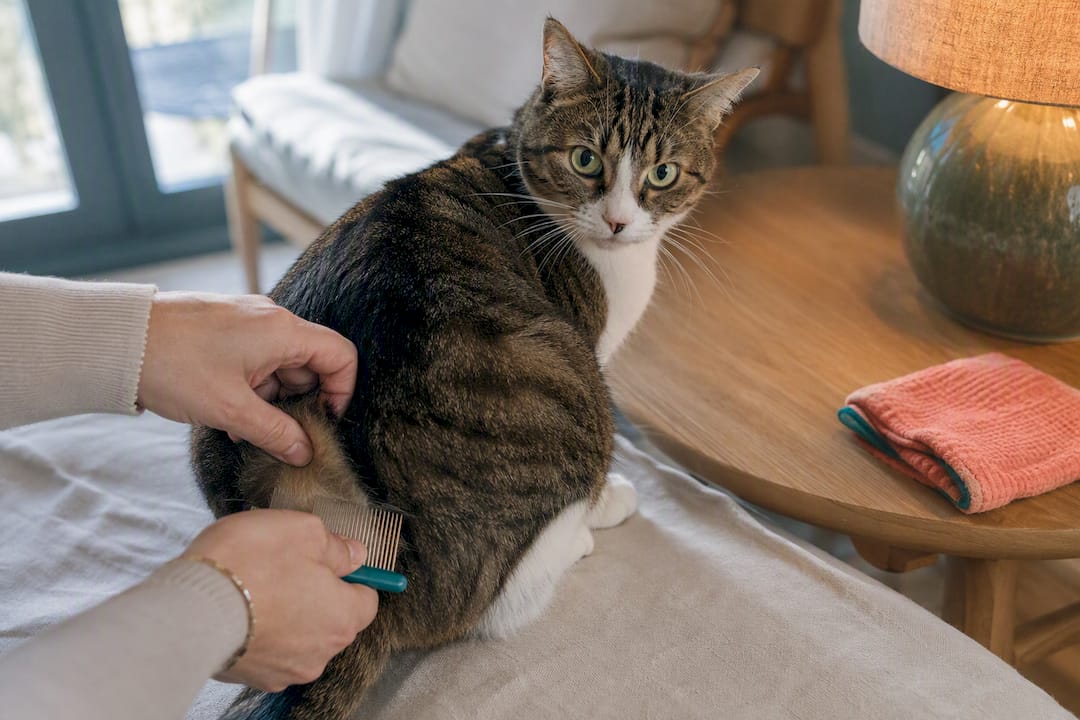
Secondary problems tend to follow. Constant self-trauma opens the door to bacterial skin infections, and cats that groom out fleas can swallow flea larvae carrying tapeworm eggs, leading to a tapeworm infestation on top of the skin disease. Running a fine-toothed flea comb through the coat, particularly at the base of the tail and around the neck, is the most reliable way to check for fleas or flea dirt at home. Finding nothing on the comb doesn’t clear your cat of FAD; it just means the fleas have already been groomed away.
How do vets diagnose flea allergy dermatitis in cats?
There’s no single blood test that confirms FAD in general practice, so vets build the diagnosis from a combination of history, examination, and how the cat responds to treatment.
- Taking a history. Your vet will ask about itching patterns, other pets in the household, current flea products, and how long signs have been present.
- Examining lesion distribution. The Merck Veterinary Manual notes that clinical signs and typical lesion patterns are central to reaching a working diagnosis, rather than relying on finding live fleas.
- Ruling out look-alikes. Skin cytology can check for secondary bacterial or yeast infection, and skin scrapes help exclude mites, food allergy, or atopic dermatitis presenting similarly.
- Running a therapeutic trial. Because grooming hides the evidence, a strict, sustained course of flea control is often used as a practical diagnostic step. If signs settle down once fleas are eliminated, that response effectively confirms the diagnosis.
If lesions don’t resolve on trial flea control, or the pattern looks unusual, your vet may refer you to a veterinary dermatologist for allergy testing or a food trial to investigate other allergic skin conditions.
What is the treatment for flea allergy dermatitis in cats?
Treatment runs on two tracks at once: calming the current flare and killing every flea on the cat before more bites occur.
Itch relief comes first. A short course of an oral corticosteroid such as prednisolone is commonly used to interrupt the itch-scratch cycle while flea control takes effect, and vets aim for the lowest effective dose for the shortest time rather than ongoing steroid use. Cats generally tolerate short steroid courses well, but this should always be under veterinary supervision, never self-medicated with leftover tablets or another pet’s prescription. Oclacitinib is sometimes discussed for cats, but it’s an off-label use in this species in the UK, so it’s a conversation to have directly with your vet rather than something to source independently.
Secondary infection needs its own plan. If cytology or the appearance of the skin points to a bacterial infection from all that scratching, antibiotics are added; they’re not given as a matter of course otherwise.
Killing the fleas is non-negotiable. Vets typically reach for:
- Spot-on treatments licensed specifically for cats
- Oral flea preventatives labelled for feline use
- Products combining an adulticide with an insect growth regulator (IGR) to stop eggs and larvae developing
Every animal in the home needs treating on the same schedule, even pets showing no symptoms, because untreated pets keep the flea population going. Following the product’s exact reapplication interval matters more than most owners realise. Missed or late doses are one of the most common reasons flea control fails in practice, alongside forgetting a pet or skipping the environment.
How do you get rid of fleas in the house, not just on your cat?
Fleas spend the vast majority of their life cycle off the animal. Only around 5% of a flea infestation lives on the pet; the rest is eggs, larvae, and pupae scattered through carpets, bedding, and soft furnishings. Treat the cat without treating the house, and reinfestation is almost guaranteed within days.
- Vacuum daily during an active flea problem, focusing on carpet edges, skirting boards, sofas, and anywhere your cat sleeps, then empty the vacuum outside straight away.
- Wash bedding on a hot cycle, including your cat’s bed, blankets, and any throws on furniture they favour.
- Treat carpets and soft furnishings with a household spray or powder containing an IGR to kill eggs and larvae the vacuum misses.
- Consider professional pest control for a heavy infestation, particularly in homes with deep carpeting or multiple pets.
- Repeat treatments on schedule rather than stopping the moment the itching improves.
Set your expectations accordingly: full eradication commonly takes several weeks to a few months, because pupae can lie dormant in the environment and hatch well after you think the problem is solved. Keep monitoring your cat and the home rather than declaring victory too soon.
What is the best flea prevention for cats with allergies?
Once a cat has shown itself to be flea-allergic, year-round prevention stops being optional. A single missed month can trigger another flare, so consistency matters more than which specific product you choose, provided it’s genuinely suitable for cats.
Options vets commonly recommend include monthly spot-on topicals, oral tablets or chews licensed for cats, and in some cases flea collars. Some newer systemic products are noted for killing fleas quickly and effectively as part of an ongoing prevention plan, though your vet should confirm what’s appropriate for your cat’s age, weight, and health status.
- Always check the label states “for cats” specifically, not just “for pets”
- Never substitute a dog product, particularly anything containing permethrin
- In multi-cat households, treat every cat on the same day to avoid gaps in cover
- If pilling or applying topicals is a struggle, ask your vet about easier-to-administer formats rather than skipping doses
When should you contact the vet about flea allergy symptoms?
Seek urgent veterinary attention if your cat shows open, weeping wounds, signs of severe pain, lethargy, or refuses food, since these can point to a serious secondary infection or another condition entirely.
Book a routine appointment (or an earlier one if things are worsening) when itching hasn’t improved after a week or two of strict flea control, when a scabby area starts spreading rather than healing, or if you notice side effects from prescribed medication.
Before your consultation, jot down which flea products you’ve used and when, whether other pets and the home have been treated, and any environmental steps already taken. That detail speeds up the vet’s decision-making considerably.
What’s the outlook after starting treatment for cat flea allergy?
Most cats show noticeably less itching within a few days of starting steroid treatment and effective flea control, with skin lesions gradually healing over the following two to four weeks.
Because the allergy itself never goes away, a single lapse in flea prevention can bring symptoms straight back, sometimes within days. Ongoing monitoring, and a willingness to adjust the prevention plan with your vet if a product stops working well enough, keeps flare-ups rare rather than routine.
Practical tools that support your cat’s flea plan
A fine-toothed flea comb makes home checks quick and gives you real evidence to describe to your vet. Gentle grooming brushes help clear loose fur and flea dirt without irritating already-sore skin, and if you’re managing a separate skin issue alongside FAD, our cat ear mites guide is worth a read. None of these replace prescribed treatment; they simply make the daily management easier.
Are there other treatments for flea allergy dermatitis besides steroids?
Antihistamines are sometimes tried for milder itching, though most vets find them considerably less reliable in cats than the short steroid courses used for genuine flare-ups. They’re occasionally used as a lower-dose maintenance option once a flare has settled, but they rarely control an acute reaction on their own.
Allergen-specific immunotherapy, essentially a series of injections designed to gradually desensitise the immune system, exists for some allergic skin conditions but is rarely used specifically for flea allergy. The practical reason is straightforward: strict flea avoidance already removes the trigger almost entirely, so immunotherapy adds cost and complexity without a clear advantage over consistent prevention.
Essential fatty acid supplements, often fish oil based, are sometimes added to a treatment plan to support skin barrier health and take some pressure off the inflammatory response, though they work alongside flea control rather than instead of it. A veterinary clinic’s overview of allergy testing in cats is a useful read if your vet suspects a concurrent allergy, such as atopy or a food sensitivity, complicating the picture.
The honest summary: for FAD specifically, no adjunct therapy outperforms rigorous flea control. Antihistamines and fatty acids can smooth the edges of a flare, but they’re supporting acts, not the main treatment.
What happens if flea allergy dermatitis in cats is left untreated?
Left unaddressed, FAD rarely stays a simple itchy patch. The constant scratching and biting breaks the skin’s natural barrier, letting bacteria in and turning a manageable allergy into a recurring infection that needs its own course of antibiotics.
Chronic self-trauma also thickens and darkens the skin over time, a change called lichenification, which can become permanent even after the flea problem is solved. Some cats develop bald patches that never fully regrow normal fur in severely affected areas.
There’s a psychological cost too. Cats living with constant, unrelieved itching often become withdrawn, irritable, or reluctant to be handled, particularly around the affected areas. And because fleas ingested during grooming can carry tapeworm larvae, an ongoing flea problem frequently means an ongoing, easily missed, tapeworm burden as well.
Perhaps the most frustrating outcome is the cat that’s treated for the skin symptoms repeatedly, with steroids or antibiotics, while the actual flea exposure in the home never gets addressed. The itching keeps returning because the trigger was never removed, not because the treatment failed.
Is it flea allergy or something else entirely?
Several feline skin conditions look remarkably similar to FAD at first glance, which is exactly why vets lean so heavily on lesion distribution and response to flea control rather than appearance alone.
Food allergy tends to cause itching around the face, ears, and neck too, but often comes with gastrointestinal signs like soft stools, and doesn’t resolve with flea control alone.
Atopic dermatitis (environmental allergy to pollen, dust mites, or mould) produces a similar itch-scratch pattern but usually shows seasonal patterns tied to pollen counts, or year-round signs if the trigger is something like house dust mites.
Mite infestations, such as Cheyletiella or scabies, cause intense itching and scaling but typically respond to specific anti-parasitic treatment rather than flea products, and skin scrapes usually reveal the mites under a microscope.
Ringworm, a fungal infection despite the name, causes circular patches of hair loss and scaling but is far less intensely itchy than true FAD in most cases.
The distribution pattern (head, neck, tail base, and miliary dermatitis) combined with a positive response to strict flea elimination remains the most practical way to separate FAD from these look-alikes in everyday practice.
A word from Giddy pets
Watching a cat scratch itself raw is one of the most helpless feelings an owner can have, and we understand why it keeps people up at night. The reassuring truth is that flea allergy dermatitis responds well to consistent care: strict flea control, patience through the environmental clean-up, and a vet in your corner. Use our vet-finder tool to locate a practice near you, and lean on practical aids like a good comb while the real treatment does its work.
— Giddy
How Giddy pets supports your cat’s flea recovery at home
Your vet handles the prescribing; the daily grind of managing coat, bedding, and comfort during a flare is where the right tools genuinely earn their keep. A soft grooming glove lets you check for flea dirt and remove loose fur without triggering more scratching from irritated skin, and a proper flea and tick comb gives you a clear, honest look at what’s actually on your cat’s coat between vet visits.

These are supportive aids, not a replacement for vet-prescribed flea adulticides or steroid courses. Pair them with a deshedding cat brush to keep the coat easier to inspect, and if your cat’s bedding needs replacing after a heavy flea season, the wider Giddy pets shop stocks washable options built for exactly this kind of clean sweep. Browse the range today, and if you haven’t confirmed a diagnosis yet, book that vet appointment before adding anything new to your cat’s routine.
This article is general information, not a substitute for advice from a qualified doctor. Consult a qualified healthcare professional about your own circumstances before acting on anything here.
Sources
- Flea Allergic Dermatitis in cats | PDSA
- Flea allergy dermatitis in dogs and cats | Merck Veterinary Manual
- Flea bite allergy in dogs and cats | Small and Large Animal Dermatology Handbook (University of Minnesota open text)
- 2023 AAHA management of allergic diseases in dogs and cats guidelines