


How to Measure a Dog for a Coat or Jumper
Three measurements, in the right order, and the one that actually decides the size. Plus what to do when your dog is between sizes.
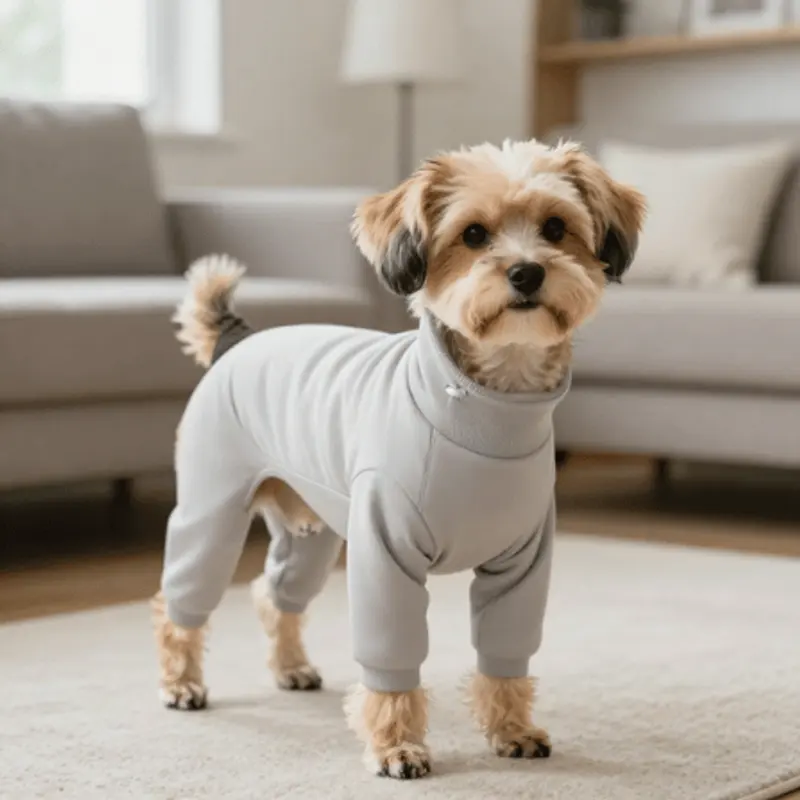
The quick answer
Measure three things with your dog standing: back length from the base of the neck to the base of the tail, chest girth at the widest point just behind the front legs, and neck circumference where a collar sits. Chest girth is the measurement that decides the size on most coats — back length only decides how far it reaches. If your dog is between sizes, go up.
Most dog coats that get returned were not the wrong product, they were the wrong number. And most sizing charts are ordered in a way that makes people pick the wrong one — by back length, when the measurement that actually decides whether a coat fits is the chest.
The three measurements
Do this with your dog standing up, not sitting or lying, and use a soft tailor's tape. A piece of string marked with your thumb and then held against a ruler works perfectly well.
1. Back length. From the base of the neck — where a collar sits, between the shoulder blades — straight along the spine to the base of the tail. Not to the tip of the tail.
2. Chest girth. All the way around the deepest part of the chest, just behind the front legs. Snug, not tight — you should be able to slip two fingers under the tape.
3. Neck. Around the neck where the collar sits, again with two fingers of room.
Which one decides the size
Chest girth. A coat that is slightly too long looks a bit odd. A coat that is too tight around the chest restricts the shoulders, and the dog will refuse to walk in it — usually by planting themselves and staring at you.
Back length only determines coverage. If it is a little short, the coat sits above the tail, which is fine. If it is a little long, it can catch when they squat, which matters more for females and is worth checking on a raincoat.
If your dog is between sizes
Go up. Always. A slightly roomy coat is a minor irritation; a tight one does not get worn.
Two exceptions where you should think harder rather than just sizing up:
- Deep-chested, narrow-waisted breeds — greyhounds, whippets, lurchers, salukis. Their chest girth suggests a much bigger size than their back length does. Look for breed-specific cuts, or a coat with an adjustable waist strap. - Long-and-low breeds — dachshunds, corgis, bassets. The opposite problem: a coat long enough for the back is far too big around. Again, look for a cut made for the shape.
For both, the breed or shape-specific fit matters more than the size letter.
Knitted jumpers run smaller than coats
Knitwear has less give across the chest than a fleece or a padded coat, and it does not adjust. If you are buying a Christmas jumper or any knitted layer, size up more readily than you would for a raincoat, and check behind the front legs once it is on — rubbing there is the single most common reason a dog refuses to walk in a jumper, and they cannot tell you. They just stop.
Checking the fit once it arrives
- Two fingers should slide under the neck and chest openings. - The front legs should move freely — walk them a few steps indoors before removing tags. - Nothing should press on the throat. - Check the harness opening lines up if you use one, or buy a coat with a harness hole. - Watch them for a minute. A dog who freezes, walks strangely, or tries to reverse out of it is telling you it does not fit.
A note on which dogs need one at all
Sizing is academic if the coat is unnecessary. Thin-coated and short-haired breeds, older dogs and puppies genuinely benefit below about 7°C. Double-coated breeds — huskies, German shepherds, collies — are already wearing one, and adding another risks overheating. There is a breed-by-breed guide here.
Inches or centimetres?
Most UK makers list both; some list only one. Measure once in centimetres and convert if you need to — 1 inch = 2.54cm — rather than measuring twice.
Where this catches people out is buying from a US or EU brand, where the same size letter covers a different range. Never buy on the letter. Always find the actual cm or inch range in that specific brand's chart, because an "M" from two makers can differ by 10cm of back length.
Measuring without a tape measure
Perfectly doable, and more accurate than guessing:
1. Take a length of string, a phone charger cable, or a bootlace, and run it along the measurement. 2. Mark the point with your thumb, or a knot, or a bit of tape. 3. Hold it against a ruler, a tape measure from a toolbox, or a piece of A4 paper — the long edge is 29.7cm, the short edge 21cm, which is enough to measure most dogs in two steps.
A soft dressmaking tape is easier if you have one, and they cost almost nothing. A rigid metal builder's tape does not follow the curve of the chest and will read short.
Measuring a wriggler
- Do it when they are tired, after a walk, not before one. - Have someone else hold a treat at nose height so the dog stands square. - Measure over the coat they will wear it on, not against wet or freshly-groomed fur. - If they will not stand still, measure a jumper that already fits while it is laid flat, and double the chest measurement.
Dog height, and when it matters
Height at the withers — the ridge between the shoulder blades — is measured from the floor with the dog standing square. It matters for crates, carriers, car barriers and stair gates. It is not used for coat sizing, which is why almost no coat chart asks for it, and it is a common reason people arrive with the wrong three numbers.
Size charts by breed: useful shortcut, unreliable rule
Breed-based charts ("Labrador = L") are a starting point, not an answer. Within any breed there is a wide spread — a working cocker and a show cocker are different shapes, and a rescue of unknown parentage fits no chart at all.
Use a breed chart to narrow it to two sizes, then measure to pick between them. And for deep-chested or long-and-low breeds, skip the chart and go by chest girth, because that is exactly where the breed averages break down.
Sources
Common questions
How do I know what size coat to get my dog?
Measure back length, chest girth and neck with the dog standing, then size on CHEST GIRTH rather than back length — the chest is what restricts movement if it is wrong. Check the specific brand’s chart, since sizes are not standardised across makers.
Should I size up or down if my dog is between sizes?
Size up. A slightly loose coat is a minor annoyance; a tight one restricts the shoulders and will not be worn. The exceptions are deep-chested breeds like greyhounds and long-and-low breeds like dachshunds, which are better served by a shape-specific cut than by a bigger size.
Where exactly do I measure a dog’s back length?
From the base of the neck, between the shoulder blades where a collar sits, straight along the spine to the base of the tail — not to the tip of the tail. Measure with the dog standing, since the length changes when they sit.
Do dog jumpers fit differently to dog coats?
Yes. Knitted jumpers have less give across the chest than padded or fleece coats and no adjustment, so size up more readily. Check behind the front legs once it is on — rubbing there is the most common reason a dog refuses to walk in one.
How do I measure my dog for a coat without a tape measure?
Run a piece of string, a bootlace or a charger cable along the measurement, mark it with your thumb, then hold it against a ruler or a sheet of A4 — the long edge is 29.7cm and the short edge 21cm. It is far more accurate than estimating, and a soft dressmaking tape costs very little if you buy coats often.
Should I measure my dog in inches or centimetres?
Whichever the maker’s chart uses — most UK brands list both. Measure once and convert if needed (1 inch = 2.54cm). Never buy on the size letter alone: an "M" varies by up to 10cm of back length between brands, and US and EU sizing differs again.
Do I need my dog’s height for a coat?
No. Height at the withers is used for crates, carriers and car barriers, not coats. Coat sizing uses back length, chest girth and neck — and chest girth is the one that decides the size.
Are dog coat size charts by breed accurate?
Only as a starting point. The spread within a breed is wide — a working and a show cocker are different shapes — and crossbreeds fit no chart. Use a breed chart to narrow it to two sizes, then measure to choose between them.
About the author
Matt Garnett — founder, Giddy Pets
Matt started Giddy Pets to make getting pets the good stuff simpler and fairer. Everything in these guides comes from real life with pets and a lot of trial and error — it's practical guidance, not veterinary advice. If a guide gets something wrong, tell him directly.
Advice & planning
Free tools & more guides
Practical calculators and trusted guides relevant to this product.
Read next
Dog Breeds That Feel the Cold Most (and How to Keep Them Warm)
How Cold Is Too Cold to Walk a Dog?
A rough temperature guide by size and coat, plus the factors that matter more than the number on the thermometer.
Outdoor Cat Shelter for Winter: What Actually Works
Small, raised, straw-filled and facing away from the wind. The common mistakes make a shelter colder than no shelter at all.
Muddy Paws After Winter Walks: The Five-Minute Routine
Washing and drying properly after a muddy walk prevents sore paws, saves the house, and is the one precaution recommended against Alabama rot.