


Taurine in cat food: what every owner needs to know
Taurine in cat food: what every owner needs to know
Cats require taurine every single day, and unlike most mammals, they cannot produce enough of it themselves. The good news: most high-quality, life-stage-appropriate commercial cat foods supply adequate taurine when fed as directed, a position supported by VCA Animal Hospitals and PetMD. If your cat eats a complete, labelled commercial diet, you likely have nothing to worry about. If they eat mainly dog food, home-cooked meals, or low-quality kibble, the risk of deficiency is real and worth addressing with your vet. Giddy pets stocks a range of vetted complete cat foods to make the right choice straightforward.
- Book a vet appointment promptly if you notice: vision changes, laboured breathing, lethargy, or reproductive problems in your cat.
- Reassurance: standard complete commercial cat foods formulated for cats are routinely fortified with taurine and are considered safe for daily feeding.
Key takeaways
Cats need dietary taurine daily, and a complete, life-stage-appropriate commercial cat food is the most reliable way to supply it consistently and safely.
| Point | Details |
|---|---|
| Daily taurine is non-optional | Cats cannot synthesise enough taurine internally and must obtain it from food every day. |
| Complete commercial diets are usually sufficient | High-quality, labelled complete cat foods are formulated to meet feline taurine requirements without extra supplementation. |
| Deficiency signs to act on | Vision changes and breathing difficulty are urgent; book a vet appointment the same day. |
| High-risk diets to avoid | Dog food, unformulated home-cooked meals, and low-quality kibble are the most common causes of deficiency. |
| Giddy pets | Stocks a curated range of complete cat foods and interactive toys to support your cat’s nutrition and wellbeing. |
Table of Contents
- What taurine is and why it matters for your cat
- What taurine does in a cat’s body
- Where cats get taurine: food sources and what processing does to them
- Signs and long-term consequences of taurine deficiency
- Common causes and risk factors for taurine deficiency
- How vets diagnose taurine deficiency
- Treating taurine deficiency and expected recovery
- How to prevent taurine deficiency: practical feeding tips
- How much taurine do cats need?
- Safety: can a cat eat too much taurine?
- Key studies and EU regulation: a brief evidence snapshot
- Sources
What taurine is and why it matters for your cat
Taurine is an amino sulfonic acid found naturally in animal tissues. It is not a protein-building amino acid in the conventional sense, but it is classed as an essential nutrient for cats because their bodies cannot synthesise enough of it from other amino acids. Most mammals, including dogs and humans, produce sufficient taurine internally. Cats have a limited enzymatic capacity for this synthesis and do not store taurine well, so they depend on a steady dietary supply every day.
Because taurine turns over continuously in feline metabolism, even a few weeks on a taurine-poor diet can begin to deplete tissue reserves, though clinical signs often take considerably longer to appear.
What taurine does in a cat’s body
Taurine is involved in several systems simultaneously, which is why deficiency tends to produce a cluster of problems rather than a single obvious symptom.
- Retinal health and vision: taurine is concentrated in the photoreceptor cells of the retina. Without adequate supply, those cells degrade progressively, leading to a condition called feline central retinal degeneration (FCRD) and, ultimately, irreversible blindness.
- Cardiac function: taurine supports myocardial contractility. Deficiency is directly linked to dilated cardiomyopathy (DCM), a serious and potentially fatal heart condition in which the heart muscle weakens and enlarges.
- Bile acid conjugation and digestion: cats conjugate bile acids almost exclusively with taurine. Without it, fat digestion is impaired and nutrient absorption suffers.
- Reproduction and kitten development: queens with low taurine levels produce smaller litters, experience higher rates of foetal resorption, and their kittens may be born with developmental abnormalities or fail to thrive.
- Immune function: taurine plays a role in white blood cell activity and the regulation of inflammatory responses.
The clinical stakes are high. Retinal degeneration and dilated cardiomyopathy can develop silently over an extended period, which is why prevention through consistent, quality-controlled feeding matters so much.
Where cats get taurine: food sources and what processing does to them
Taurine exists only in animal tissues. Muscle meat, heart, liver, and other organ meats are the richest natural sources. Plant-based proteins contain none, which is one of several reasons cats are obligate carnivores and cannot thrive on vegetarian or vegan diets.
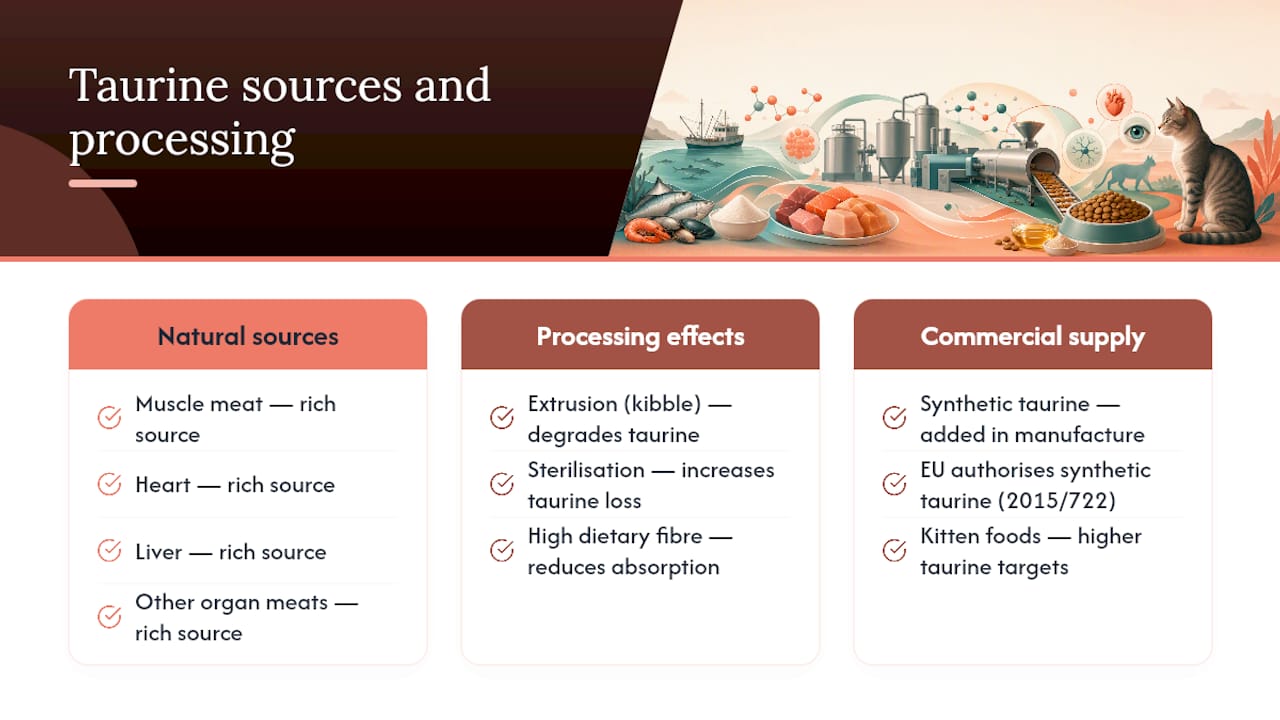
Commercial cat foods supply taurine in two ways: through the animal-derived ingredients already present, and through synthetic taurine added during manufacturing. The EU implementing regulation 2015/722 authorises synthetic taurine as a feed additive for Felidae, confirming it is both efficacious and well tolerated. Reputable manufacturers formulate to life-stage targets, so kitten foods typically contain higher concentrations than adult maintenance diets.
Processing affects how much taurine actually reaches your cat. Extrusion (the high-heat, high-pressure process used to make dry kibble) can degrade some taurine, and canned diets can increase enterohepatic taurine loss due to heat and matrix changes during sterilisation. This is why peer-reviewed literature identifies different minimum target concentrations for dry and canned foods. High dietary fibre also reduces taurine absorption by increasing bacterial degradation in the gut.
Pro Tip: If you feed a mix of wet and dry food, check that both carry a “complete” label rather than “complementary.” Complementary foods are not formulated to meet all nutrient requirements on their own.
Signs and long-term consequences of taurine deficiency
Clinical signs of taurine deficiency tend to emerge slowly, often after months of inadequate intake. By the time symptoms are obvious, some damage may already have occurred. Knowing what to watch for gives you the best chance of catching problems early.
- Progressive vision loss: your cat may bump into furniture, become reluctant to jump, or show dilated pupils in normal light. These are signs of retinal degeneration and warrant urgent veterinary attention.
- Breathing difficulty or rapid breathing at rest: a key warning sign of dilated cardiomyopathy. Seek veterinary care the same day.
- Lethargy and reduced exercise tolerance: a cat that tires quickly or sleeps far more than usual may be showing early cardiac signs.
- Collapse or sudden weakness: treat as an emergency and contact your vet immediately.
- Reproductive failure: queens experiencing repeated miscarriages, small litters, or kittens that fail to thrive should be assessed for nutritional deficiencies including taurine.
- Poor coat condition and digestive upset: less specific, but worth mentioning to your vet alongside other signs.
Signs 1 and 2 are urgent. Do not wait for a routine appointment if your cat is struggling to breathe or has suddenly lost vision.
Common causes and risk factors for taurine deficiency
Most cases of taurine deficiency in cats trace back to a feeding choice rather than a medical condition. A quick audit of your cat’s diet can reveal whether they are at risk.
- Home-cooked diets without veterinary formulation: even meat-heavy homemade meals are often unbalanced for essential amino acids. VCA Animal Hospitals caution specifically that home-cooked diets are a common source of accidental long-term deficiency.
- Feeding dog food to cats: dog food is not formulated to meet feline taurine requirements. Cats fed dog food as a primary diet are at genuine risk.
- Low-quality commercial cat foods: products with high plant-protein content and minimal animal-derived ingredients may not supply adequate taurine even after fortification.
- High-fibre therapeutic diets: certain prescription diets can increase taurine excretion; cats on these long-term should be monitored by a vet.
- Prolonged feeding of a single low-taurine brand: even within the commercial market, quality varies. Rotating cautiously between reputable complete diets reduces this risk.
Risk-check questions to ask yourself:
- Does your cat’s food carry a “complete and balanced” label specifically for cats?
- Have you fed the same low-cost kibble for more than a year without a vet check?
- Does your cat ever eat primarily from your plate or from the dog’s bowl?
Growing kittens, pregnant queens, and cats on unusual therapeutic diets face the highest risk and benefit most from regular veterinary nutritional review. For kitten-specific guidance, Giddy pets has a detailed guide on best kitten food UK covering nutrient requirements at each growth stage.
How vets diagnose taurine deficiency
Diagnosis is rarely based on a single test. Vets typically combine several steps to build a complete picture.
- Clinical examination: cardiac auscultation to detect murmurs or arrhythmias, and an ophthalmic exam to check retinal integrity.
- Blood tests: plasma or whole-blood taurine concentration is the primary laboratory marker. Plasma taurine below roughly 40–60 nmol/mL is generally considered deficient in the literature, though reference ranges vary between laboratories, so your vet will interpret results in context.
- Echocardiography: if cardiac disease is suspected, an echocardiogram assesses heart chamber size and contractility. This is the key diagnostic tool for DCM and also tracks recovery after treatment.
- Diet history and feed label review: vets will ask what your cat has been eating, for how long, and in what quantities. Bringing food packaging or photos of labels to the appointment is genuinely useful.
- Feed analysis: in complex cases, the food itself may be sent for nutrient analysis.
Results are always interpreted alongside clinical signs. A mildly low plasma taurine in a cat with no symptoms calls for dietary correction and monitoring; the same result in a cat with a heart murmur calls for more urgent intervention.
Treating taurine deficiency and expected recovery
The standard approach has two components: switching to a complete, taurine-sufficient commercial diet, and veterinary-prescribed taurine supplementation where the deficiency is confirmed or cardiac disease is present.
Blood taurine levels can begin to rise within weeks of dietary correction. Cardiac improvement takes longer. Studies linking low plasma taurine to reversible cardiomyopathy show that oral supplementation can improve echocardiographic findings, but the timeline varies from weeks to several months, and not all damage is fully reversible. Early intervention consistently produces better outcomes than late-stage treatment.
Retinal degeneration is less forgiving. Once photoreceptor cells are lost, vision cannot be restored, which is why catching the problem before significant retinal damage has occurred matters so much.
Pro Tip: Before your vet appointment, collect the packaging from every food your cat has eaten in the past six months, including treats. Vets can often identify the likely source of deficiency from the ingredient list and guaranteed analysis alone, saving time and unnecessary testing.
Do not start taurine supplements without veterinary guidance. Dosing, duration, and the decision to supplement at all depend on confirmed blood levels and clinical findings.
How to prevent taurine deficiency: practical feeding tips
Prevention is straightforward for most owners. The steps below cover the main risk points.
Daily feeding checklist:
- Feed a complete, labelled commercial cat food appropriate for your cat’s life stage (kitten, adult, or senior).
- Never use dog food as a primary or regular meal for your cat.
- Avoid long-term home-cooked diets unless a vet or veterinary nutritionist has formulated the recipe specifically for your cat.
- Rotate between reputable complete brands cautiously, reading ingredient panels each time.
Storage and preparation tips to preserve taurine:
- Store dry kibble in a cool, dry place in a sealed container to slow nutrient degradation.
- Avoid overheating homemade meat: gentle cooking at lower temperatures preserves more taurine than prolonged high-heat methods.
- Use wet food within the time stated on the packaging once opened; oxidation and bacterial activity both reduce nutrient quality.
- Do not mix large quantities of complementary food into a complete diet without checking the overall nutritional balance with your vet.
Questions to ask your vet or the manufacturer:
- Is this product formulated specifically for cats and labelled complete and balanced?
- Is taurine added, and in what form?
- Is this formula suitable for my cat’s life stage, including pregnancy or cardiac disease?
Supplements are appropriate when a vet has confirmed deficiency or when a cat is on a non-complete diet under veterinary supervision. At standard supplemental doses, excess taurine is not a known concern because it is water-soluble and excreted, but high-dose supplementation should still be vet-led. For senior cats with changing nutritional needs, Giddy pets covers life-stage feeding in detail in its guide to best senior cat food.
How much taurine do cats need?
Regulatory and peer-reviewed sources give different figures depending on diet type, and understanding the distinction helps when comparing labels.
Canned diets require higher concentrations because heat processing and the wet matrix increase enterohepatic taurine loss, meaning more taurine is broken down in the gut before it can be absorbed. Manufacturers compensate by adding more at the outset.
What this means for label reading: look for taurine listed in the guaranteed analysis or ingredient panel of your cat’s food. If it is not listed separately, contact the manufacturer and ask for the taurine content per kilogram of dry matter. A reputable brand will provide this figure without hesitation.
Most complete commercial cat foods formulated by reputable manufacturers already meet or exceed these benchmarks. The figures above are most useful when evaluating less well-known brands or when your vet asks you to compare products.
Safety: can a cat eat too much taurine?
Excess dietary taurine is not a practical concern for cats eating standard commercial diets or taking vet-prescribed supplements. Taurine is water-soluble, and the body excretes what it does not need through urine. There is no established toxic dose in cats at the levels found in food or typical supplements.
At very high doses, some gastrointestinal upset is theoretically possible, but this is not commonly reported in clinical practice. The real risk with unsupervised supplementation is not toxicity but rather false reassurance: an owner adding taurine to an otherwise inadequate diet may delay seeking proper veterinary diagnosis and treatment.
If your vet has not confirmed deficiency, there is no benefit to adding high-dose taurine supplements. If they have, follow their prescribed dose and duration rather than self-adjusting based on products found online.
Key studies and EU regulation: a brief evidence snapshot
The evidence base for taurine as an essential feline nutrient is well established and spans several decades.
- The PMC review on taurine biosynthesis, function and deficiency in cats traces the research that established taurine as essential, documenting its biosynthesis limits in cats and linking deficiency to retinal and cardiac pathology. This is the foundational reference for understanding why cats are uniquely vulnerable.
- The landmark Science paper on myocardial failure and low plasma taurine provided the first clinical evidence that DCM in cats was linked to taurine deficiency and, critically, that it could be reversed with supplementation. This finding changed commercial cat food formulation across the industry.
- Peer-reviewed literature in the Journal of Small Animal Practice established the minimum dietary concentrations for dry and canned diets that are still referenced in nutritional guidelines today.
EU Commission implementing regulation 2015/722 formalises taurine’s status as an authorised feed additive for Felidae, setting a maximum content figure of 2,500 mg/kg at reference moisture and confirming that synthetic taurine is safe and effective. This regulatory framework gives owners confidence that products sold within the EU and UK market are subject to defined standards.
A note from Giddy pets
At Giddy pets, we recommend feeding a complete, life-stage-appropriate commercial cat food as the simplest and most reliable way to keep your cat’s taurine intake where it needs to be. If you suspect deficiency or your cat is on an unusual diet, please speak to your vet before making changes. Our pet news and guides cover senior and kitten nutrition in more detail, and our cat food range is curated with quality and completeness in mind.
Complete cat food and enrichment, all in one place
Giddy pets makes it easy to feed your cat well without the guesswork of comparing dozens of brands. Our cat food and treats range focuses on complete, life-stage-appropriate diets that meet feline nutritional requirements, including taurine, from the first ingredient rather than relying on last-minute fortification to paper over poor-quality protein sources.

Pair a quality diet with mental and physical stimulation: our interactive cat toys keep cats active and engaged, which supports overall wellbeing alongside good nutrition. Browse the full cat supplies range and find everything your cat needs in one place, with speedy UK delivery.
Sources
- Taurine in Cats | VCA Animal Hospitals
- The biosynthesis, function and deficiency signs of taurine in cats (PMC review)
- Myocardial failure in cats associated with low plasma taurine: a reversible cardiomyopathy | Science
- COMMISSION IMPLEMENTING REGULATION (EU) 2015/722 of 5 May 2015 concerning the authorisation of taurine
- Taurine deficiency in cats | PetMD
This article provides general information only and is not a substitute for professional veterinary advice. If you are concerned about your cat’s health or diet, consult a qualified vet.