


Up to Two Dogs Travel Free on UK Trains, Plus Official Rules and Kit
Up to Two Dogs Travel Free on UK Trains, Plus Official Rules and Kit
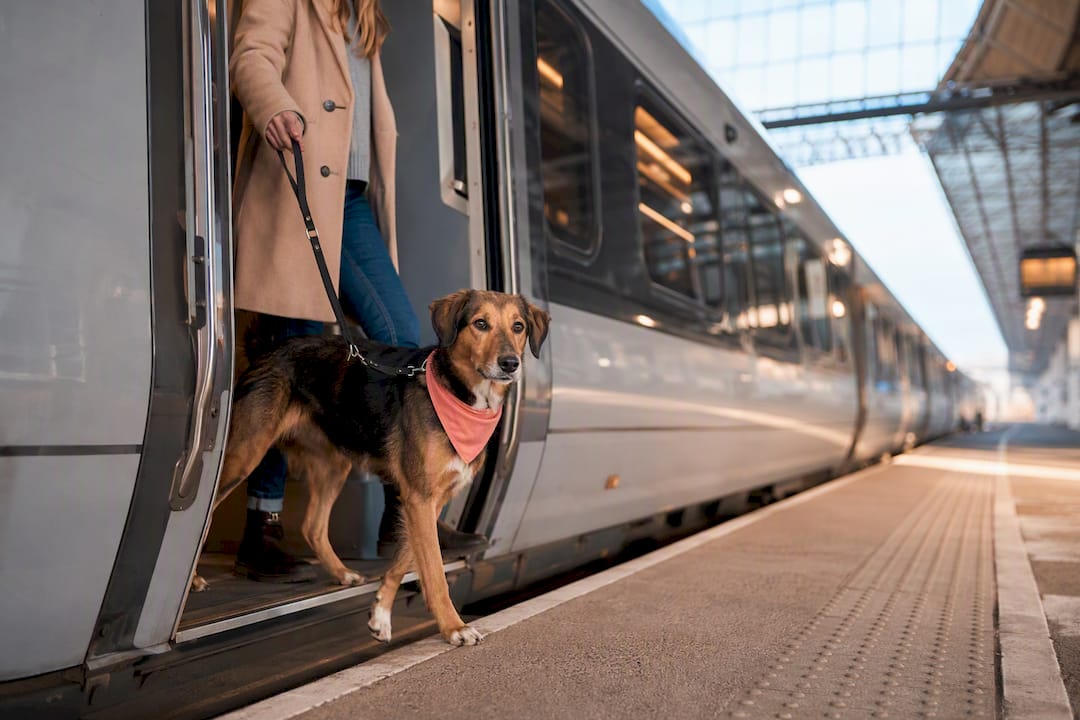
Yes, dogs are welcome on the vast majority of UK trains, and it usually will not cost you a penny. Most operators let you bring up to two dogs or small pets free of charge, provided they stay on a lead or in a secure carrier, and off the seats. Assistance dogs are exempt from most restrictions. The one thing you should never skip is checking your specific train operator’s page before you travel, since sleeper and international services play by different rules.
TL;DR:
- Most UK train operators permit up to two pets per passenger free of charge, as long as animals are kept on a lead or in a suitable carrier and do not occupy seats.
- Assistance dogs can travel for free across all services and are exempt from usual restrictions, backed by the Assistance Dogs Travel Scheme.
- Long-distance and international services, such as Eurostar and sleeper trains, have different rules, often restricting pets to specific cabins or carriers and requiring extra paperwork.
- Owners should prepare their dogs gradually for travel, carrying familiar comforts, avoiding big meals before departure, and monitoring stress signals during the journey.
- Checking the specific pet policies of your train operator before travel is essential since rules vary widely across different services and routes.
Table of Contents
- Can you take a dog on a UK train, and does it cost anything?
- Sleeper trains, Eurostar and other exceptions to know
- Getting your dog ready for the journey
- Staying safe on platforms and on board
- Crossing borders: what GOV.UK requires
- The vet-approved kit list worth packing
- What we see go wrong most often
- Shop travel essentials before your next trip
- Official resources to check before you travel
- Sources
- FAQ
Can you take a dog on a UK train, and does it cost anything?
Most journeys across the network run on the same basic principle: your dog travels with you, at no extra cost, as long as it behaves and stays under control. That baseline comes from the National Rail Conditions of Travel, which every UK train operating company signs up to.
Quick fact: Under National Rail’s guidance, passengers can usually bring up to two dogs or small pets free of charge, with animals kept on a lead or in a suitable carrier throughout the journey.
The finer detail matters more than most owners realise. Here’s what actually applies:
- Two animals per passenger travel free on most services; a third dog, or a larger animal, may attract a charge set by the individual operator.
- Dogs must be kept on a lead or inside a rigid carrier that lets them stand up, turn around, and lie down without being cramped.
- Animals are not permitted on passenger seats, whatever the breed or size.
- Restaurant and dining carriages generally exclude pets altogether, with assistance dogs the only exception.
- Staff can refuse to carry, or ask you to move, any animal that causes a nuisance or safety risk, using powers set out in railway byelaws.
Assistance dogs sit outside almost all of this. They travel free on every National Rail service and are exempt from the usual seating and carriage limits, backed by the Assistance Dogs Travel Scheme, which Assistance Dogs UK coordinates for handlers.
Sleeper trains, Eurostar and other exceptions to know
Long-distance and international services are where the standard rules stop applying, and it’s the section most owners get caught out by.
- Caledonian Sleeper allows dogs in private cabins, but may apply a cleaning charge depending on the fare and cabin type booked.
- Night Riviera typically carries dogs in a guard’s van carrier rather than the passenger cabin, so check the arrangement when you book.
- Eurostar does not accept pets in passenger carriages, with registered assistance dogs the only exception, according to Trainline’s operator guidance.
- Rules can also differ across operators such as Avanti West Coast, GWR and LNER, particularly around quiet coaches and first-class carriages, so it always pays to check the specific operator’s pet policy for your booked service before you travel.
Getting your dog ready for the journey
A dog that has never heard a station announcement or felt a train pull away is far more likely to panic on the day. Blue Cross recommends building up to it gradually, and that advice holds whether you’re planning a ten-minute hop or a cross-country trip.
- Start small. Visit a quiet station platform a few times before your travel date, letting your dog watch trains arrive without boarding.
- Build up gradually. Once your dog is relaxed on the platform, try a single short stop journey, rewarding calm behaviour with treats or praise.
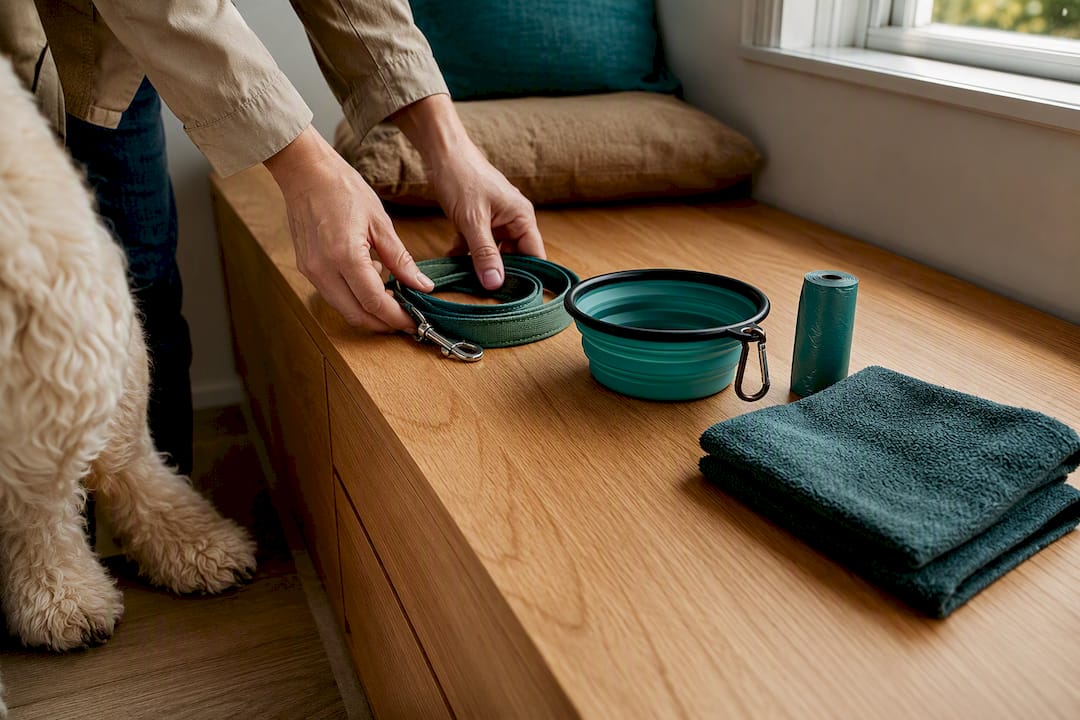
- Pack familiar comforts. A blanket or mat your dog already associates with home, a collapsible water bowl, and one quiet toy go a long way toward settling nerves.
- Skip the big meal. Avoid feeding a full meal in the hours before travel, since a queasy stomach and train motion rarely mix well.
- Watch for stress signals. Panting, pacing, or repeated lip licking mean your dog needs a break. Know your nearest stop in case you need to get off early.
Pro Tip: Keep a “getting ready” routine identical every time, same lead, same mat, same phrase before boarding, so your dog learns to associate the pattern with calm, not chaos.
For a fuller kit list, Giddy pets’ vet-approved dog travel essentials checklist covers exactly what to pack for UK rail journeys.
Staying safe on platforms and on board
Stations are busy, unpredictable places for a dog, and most incidents happen in the gap between platform and carriage rather than once you’re settled in your seat.
- Use lifts and wide-access gates rather than escalators wherever they’re available. The Royal Kennel Club recommends checking step-free access in advance, and escalators pose a genuine hazard to paws and fur.
- Carry small dogs through ticket barriers and busy concourses, and keep a short lead on anything larger.
- Once seated, keep your dog on the floor beside you rather than on the seat itself, both for hygiene and because it’s a condition of travel.
- On warmer journeys, offer water regularly and consider a cooling mat if your dog struggles with heat, particularly on delayed or crowded services.
- Remember that staff retain the right to intervene under railway byelaws if your dog blocks aisles, doorways, or causes distress to other passengers.
Pro Tip: Off-peak trains are quieter, cooler, and give your dog far more floor space than a rush-hour carriage, worth factoring into your booking time if your schedule allows it.
Crossing borders: what GOV.UK requires
Everything above applies to journeys within the UK. Bringing a dog into Great Britain from abroad is a different process entirely, governed by GOV.UK rather than any train operator.
- Your dog needs a microchip and a valid rabies vaccination, with a waiting period before travel is permitted.
- Tapeworm treatment may be required depending on your route and country of departure.
- You must travel via an approved route or carrier recognised for pet entry.
- Eurostar applies its own paperwork checks for assistance dogs on international services, on top of the standard entry requirements.
If your entire trip stays within the UK, none of this applies. It only matters when a dog is crossing into Great Britain from another country.
The vet-approved kit list worth packing
Preparation is as much about what’s in your bag as how you’ve trained your dog. A handful of items consistently make the difference between a stressful trip and a smooth one:
- A short lead for control in stations and on crowded platforms.
- A rigid carrier sized so your dog can stand, turn, and lie down, essential if you’re travelling with a smaller breed.
- A collapsible water bowl, easy to pack and quick to fill from any station tap.
- A familiar mat or blanket, giving your dog a designated “safe spot” the moment you sit down.
- A calming vest for anxious travellers, or a quiet chew toy to redirect nervous energy.
- A cooling mat for warm-weather journeys, particularly useful on delayed or overcrowded trains.
Giddy pets stocks dog backpack carriers, anxiety vests, and cooling mats sized for rail travel, alongside a broader training tools range if you’re still working on the desensitisation stage. For a more detailed anxiety-focused approach before a big trip, this guide to easing dog car anxiety from a training-focused partner covers techniques that transfer well to rail travel too.
What we see go wrong most often
The mistakes are almost always small and fixable: a dog left on the seat rather than the floor, a lead with too much slack near a platform edge. Owners who prep with a short mat, a firm lead, and one practice trip rarely have trouble on the day.
— Giddy
Shop travel essentials before your next trip
There are other ways to prepare, from training classes to borrowed kit, but if you want everything sorted in one place before your journey, essentials can be kept in stock and ready to ship, so you’re not scrambling the night before a trip.
For dogs that get anxious in new environments, the anxiety vests provide gentle calming pressure without any medication, and the dog backpack carriers are sized to meet the “stand, turn, lie down” standard operators expect. If you’re not sure where to start, browse the full dog and cat supplies range for everything from grooming to travel gear, or head straight to shop by category to find exactly what your dog needs before you book that ticket.
Official resources to check before you travel
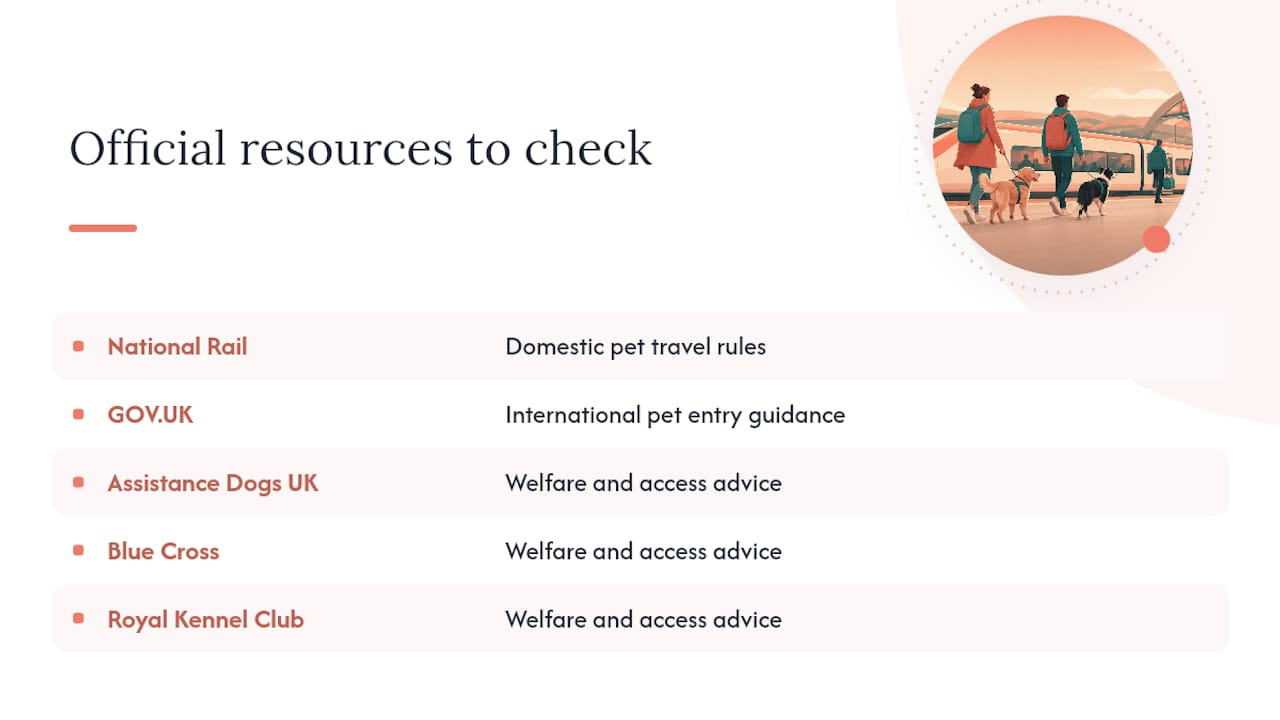
Before booking, confirm the rules for your route directly. The National Rail pet travel page covers domestic rules, GOV.UK’s pet entry guidance covers international travel, and Assistance Dogs UK, Blue Cross and the Royal Kennel Club offer further welfare and access advice.
Sources
- Train travel with pets | National Rail
- Dogs on trains | Trainline
- Taking dogs on trains | Blue Cross
- Travel advice | Royal Kennel Club
FAQ
Can my dog sit on my lap on a train?
Dogs are not permitted on seats under National Rail’s Conditions of Travel, and this generally extends to laps too. Keep your dog on the floor beside you, on a lead or in a carrier.
Do you have to book a seat for a dog on a train?
You don’t usually need to book a specific seat for your dog on most National Rail services, though sleeper services like the Caledonian Sleeper may require you to declare a dog at booking. Always check your operator’s process before travelling.
Can I take my dog on the Eurostar?
Eurostar does not accept pets in passenger carriages, with registered assistance dogs the only exception. If you’re travelling internationally with a pet dog, you’ll need a different route entirely.
Can I take my dog with me on a train in the UK?
Yes, most UK train operators allow up to two dogs per passenger free of charge, provided they’re on a lead or in a suitable carrier and kept off the seats. Assistance dogs are exempt from most of these restrictions.