








Match Your Week: Dog Energy Levels by Daily Minutes and Checklist
Match Your Week: Dog Energy Levels by Daily Minutes and Checklist
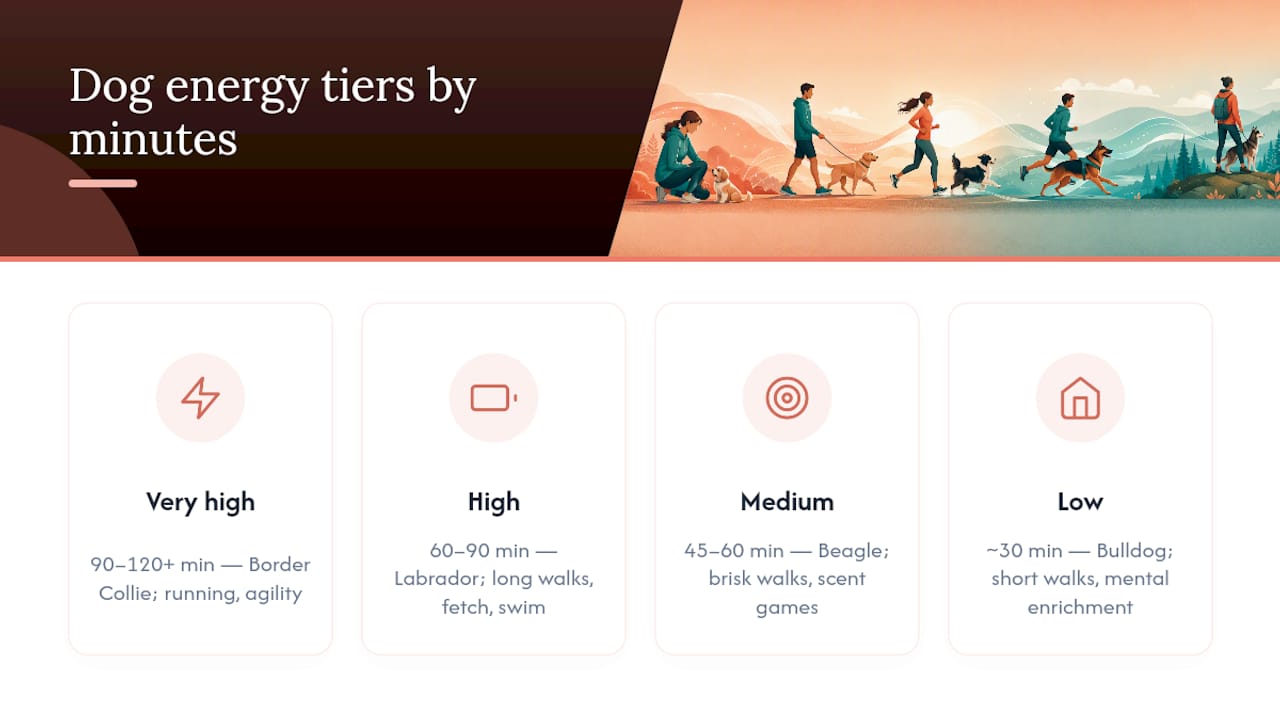
Dog breed energy levels fall into four practical tiers: very high (90 to 120+ minutes of exercise daily), high (60 to 90 minutes), medium (45 to 60 minutes), and low (around 30 minutes). Compare these ranges honestly against your own weekly schedule, not the schedule you wish you had, before choosing a breed or reassessing the one asleep on your sofa.
TL;DR:
- Most dogs need their exercise based on breed purpose, with very high energy breeds requiring over 90 minutes of activity daily.
- Accurate time audits of your weekly schedule help determine if a breed’s activity level matches your available time.
- Mental enrichment activities like nosework and puzzle feeders can be as effective as physical exercise for calming high-energy dogs.
- Puppies, seniors, and at-risk breeds need adjusted exercise routines to avoid health issues and overexertion.
- Energy levels are flexible and influenced by age, health, and mental stimulation, making routine adjustments essential for maintaining balance.
Table of Contents
- Understanding dog breed energy levels: the four tiers
- How to match a breed’s energy to your real life
- Mental enrichment matters as much as miles
- Adjusting exercise for puppies, seniors, and at-risk breeds
- The kit that helps you meet your dog’s energy needs
- Our take: stop treating energy as a fixed trait
- Sources
Understanding dog breed energy levels: the four tiers
Breed purpose predicts energy far better than size or coat length. A working dog bred to herd sheep all day carries a different engine to a companion breed bred to sit on laps, regardless of how similar they look in a park. That’s why matching activity to breed energy has to start with what the dog was originally built to do.
Very high energy: Border Collie, Australian Shepherd, Belgian Malinois, Vizsla, Weimaraner
These are working and herding breeds that need 90 to 120 minutes or more of exercise every day, and the most energetic breeds tend to be the ones bred for a job rather than a lap. A Border Collie without a task invents one, usually involving your furniture. Running, agility courses, long hikes, and herding-style games (think structured fetch with rules) all suit this tier. Flirt poles also work well here, giving intense bursts of exertion without the joint strain of miles of pavement running.
High energy: Labrador Retriever, Golden Retriever, German Shorthaired Pointer, Dalmatian, Siberian Husky
Gundogs and sporting breeds sit in the 60 to 90 minute bracket. Interestingly, a UK survey of 12,314 pedigree dogs found gundogs were the group most likely to be walked daily, which fits their reputation as biddable, exercise-hungry companions. Long walks, fetch sessions, swimming, and steady jogging all suit this bracket. Huskies in particular benefit from cooler-weather exertion, given their coat.
Medium energy: Beagle, Cocker Spaniel, Standard Poodle, Boxer
This tier needs 45 to 60 minutes, split between brisk walks and mentally engaging games. Beagles want their noses working as much as their legs, so training games and scent trails count double here.
Low energy: Bulldog, Basset Hound, Pekingese, Greyhound
Around 30 minutes suffices, though Greyhounds are the exception worth knowing: they’re sprinters, not endurance athletes, happiest with a short, fast burst followed by hours of sofa recovery. Short walks, sniffing time, and mental enrichment matter more than distance for this group.
Breed-level tier guidance from BreedTools backs this same four-tier structure, and it’s worth remembering that the same survey found many UK dogs still fall short of Kennel Club walking guidelines regardless of breed.
How to match a breed’s energy to your real life
Guess less, measure more. Before falling for a breed because of its looks or a friend’s recommendation, run an honest audit of your week.
Do a time audit first. Add up the minutes you can realistically give to exercise across seven days, not the minutes you’d give in an ideal world. Include dog walks before work, lunchtime breaks, and evening play, and be honest about the days that will get skipped.
Ask these questions before choosing or reassessing a breed:
- Do you have access to secure, off-lead space, or only pavements and a lead?
- Is your household naturally active, or does everyone prefer indoor evenings?
- Do work and family schedules leave gaps of several hours where a dog is alone?
- Can you tolerate barking, digging, or chewed shoes if energy needs aren’t fully met?
Pro Tip: If your honest weekly total sits below what a breed needs, a dog walker, doggy day care, or an older, calmer rescue dog closes that gap far more reliably than good intentions alone.
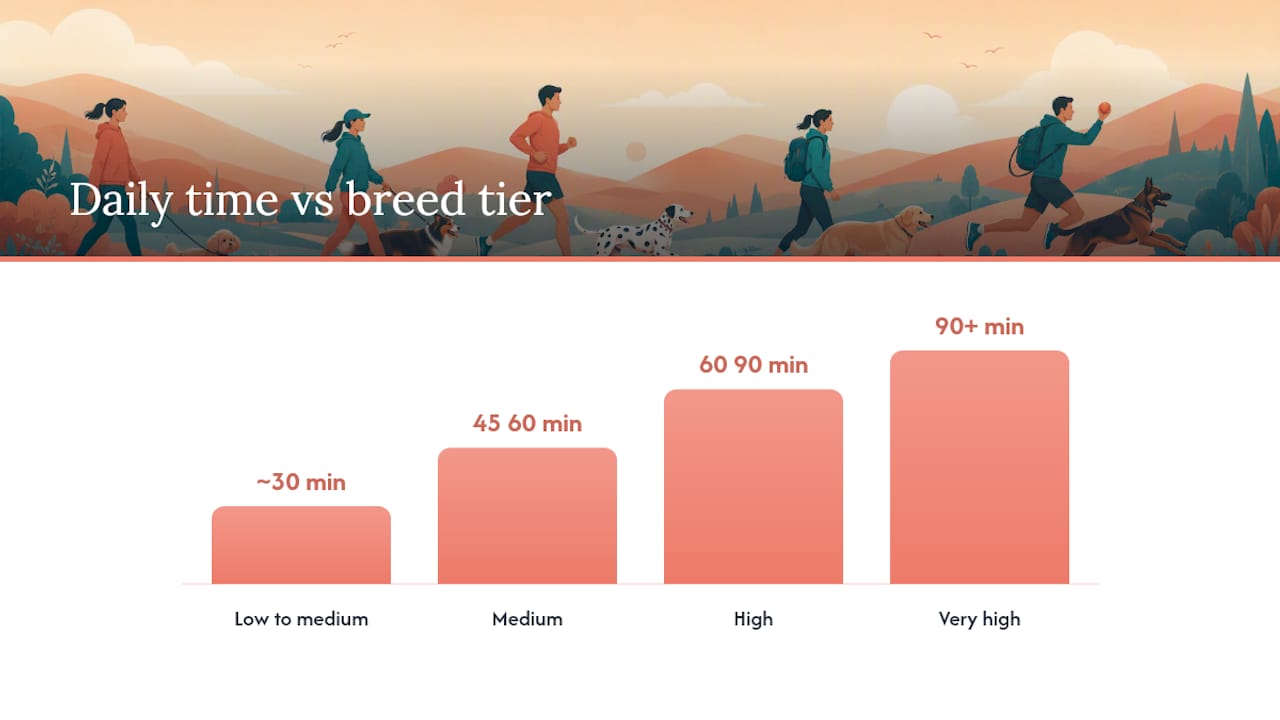
A rough time budget mapping helps translate minutes into breed suitability:
| Daily time available | Best-suited tier |
|---|---|
| ~30 minutes | Low to medium |
| 45–60 minutes | Medium |
| 60–90 minutes | High |
| 90+ minutes | Very high |
One in three UK dog owners report their dog doesn’t meet recommended exercise levels, which suggests the mismatch problem is common, not a personal failing. Smaller dogs were more likely to get adequate walks than larger, higher-drive breeds, a pattern worth remembering if you’re drawn to an impressive-looking working breed without the matching schedule.
Mental enrichment matters as much as miles
A tired dog isn’t always a well-exercised dog. Mental fatigue can settle a high-drive breed faster than another lap of the park, and enrichment activities such as nosework and puzzle feeders are often more effective at calming a wired dog than simply adding more physical exercise.
Try these, matched loosely to tier:
- Snuffle mats and scatter feeding — suits every tier, especially low and medium energy dogs needing indoor stimulation.
- Puzzle feeders — ideal for medium and high energy breeds in flats or houses without gardens.
- Nosework games — hide treats around a room; brilliant for scent hounds like Beagles.
- Short, focused training sessions — five to ten minutes of new tricks tires a Border Collie’s brain fast.
- Flirt poles and structured play — best for very high and high energy dogs needing intense, short bursts.
Pro Tip: Build a simple weekly enrichment plan: two physical-heavy days, two mental-heavy days, and three that mix both. Rotate toys weekly so nothing becomes boring background furniture.
Adjusting exercise for puppies, seniors, and at-risk breeds
Nominal tier minutes assume a healthy adult dog. Puppies need far less, and structured exercise should follow a simple rule of thumb: five minutes per month of age, twice daily, to protect growing joints from repetitive strain.
Senior dogs generally need reduced intensity but not reduced engagement. Swap running for gentle walks and keep the puzzle feeders coming.
- Puppies: short, low-impact sessions only; avoid forced running or jumping.
- Seniors: shorter, gentler outings; monitor weight and joint stiffness closely.
- Brachycephalic breeds (Bulldogs, Pugs): watch for overheating; exercise in cool hours only.
- Giant breeds: low-impact activity reduces joint stress during growth and old age.
Life-stage charts confirm energy typically peaks in adolescence before settling into an adult baseline, so a wild ten-month-old Labrador isn’t necessarily forecasting its adult temperament.
The kit that helps you meet your dog’s energy needs
Matching activity to energy tier gets easier with the right tools on hand rather than improvising with old towels and hope.
- Puzzle toys and snuffle mats suit medium and high energy dogs in flats, delivering mental fatigue without a garden.
- Agility equipment such as tunnels and weave poles gives very high and high energy breeds structured, repeatable exercise at home.
- Soft frisbees offer intense fetch play that’s kinder on teeth and joints than harder discs.
- Stuffable, treat-dispensing toys keep low-to-medium energy dogs occupied indoors between walks.
Trial any new toy or tool for three weeks before judging it. Track whether destructive habits ease and whether your dog settles faster after use, which tells you more than a single afternoon’s reaction ever will.
Our take: stop treating energy as a fixed trait
Energy level isn’t a life sentence handed down at the breeder’s. It shifts with age, health, neutering status, and how much mental work a dog gets, which means the “high energy Labrador” you inherited at eight months may settle considerably by three years old. The bigger mistake owners make isn’t choosing the wrong breed. It’s assuming today’s energy is permanent and either over-correcting with exhausting daily marathons or giving up on enrichment once physical exercise happens.
Mixed-breed dogs complicate this further, since a rescue labelled “Collie cross” could inherit stamina from one parent and a laid-back temperament from the other, so treat any breed guess as a starting hypothesis, not a fixed diagnosis. Watch the dog in front of you: restlessness, destructiveness, or excessive barking despite meeting nominal minutes usually signals a mismatch in enrichment, not just miles. Try the checklist, adjust in small steps, and browse Giddy Pets’ pet food and treats or dog toys range to build a routine that fits the dog you actually have.
— Giddy
Sources
The University of Liverpool survey of 12,314 pedigree dogs remains the clearest UK data on breed exercise gaps. BreedTools and TailorPup both offer detailed breed-by-breed minute guidance, while PAW Vet Practice provides a clinical view on tiers and daily targets.
- Variation in activity levels amongst dogs of different breeds: results of a large online survey of dog owners from the UK
- How much exercise does my dog need? | BreedTools
- Dog energy levels by breed & age: Full chart · TailorPup
- Physical vs mental dog enrichment: what your pet really needs | The Canine Cooperative
- 15 of the most energetic dog breeds | Dogster