






Neuter, Right Box, Hay: Vet Backed 4 Week UK Rabbit Litter Training
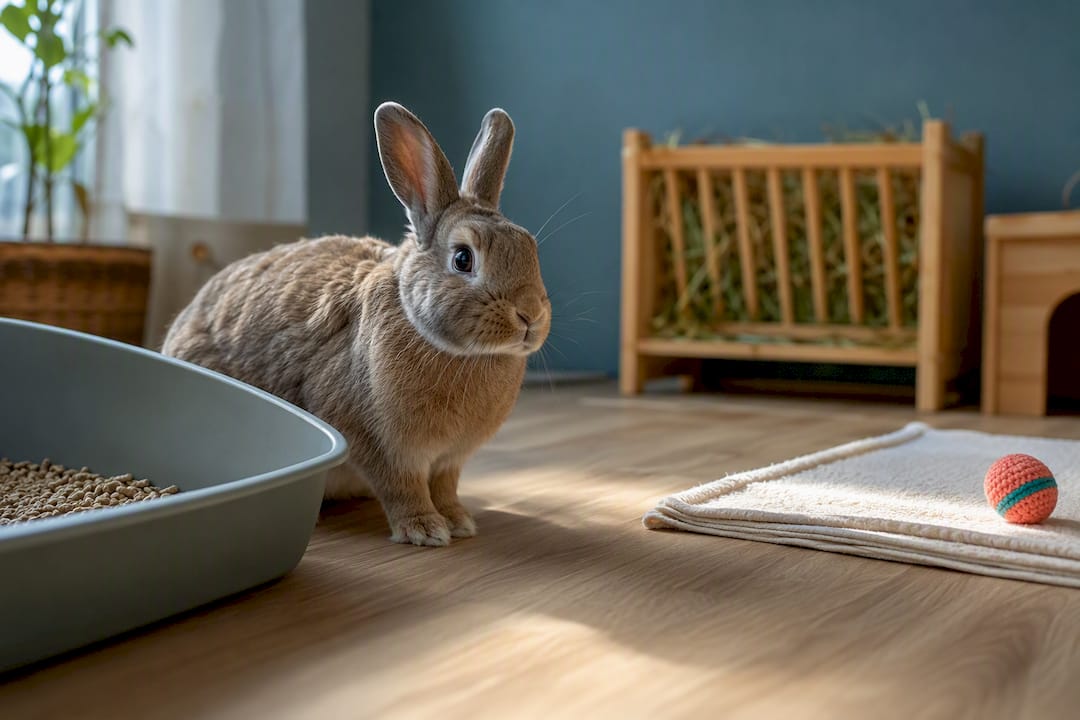
Yes, most rabbits can be reliably litter trained. The single biggest factor in success is neutering, if your rabbit isn’t already done, combined with the right box, safe litter and a generous supply of hay. Get those two things right and accidents usually drop away within a few weeks. If accidents appear suddenly, or you notice dribbling, get your rabbit checked by a vet rather than assuming it’s a training lapse.
TL;DR:
- Neutering is essential for achieving reliable litter training and significantly reduces territorial marking behaviors in rabbits.
- Using appropriately sized, low-entry, and sometimes hooded boxes alongside correct litter like paper-based pellets prevents respiratory irritation and encourages use.
- Placing the litter box in a rabbit’s natural preferred corner and gradually expanding the accessible area improves training success.
- Daily cleaning, consistent routine, and providing hay near the box reinforce good habits and minimize accidents.
- Most rabbits are fully trained within two to four weeks, with success rates around 80 to 90 percent when following a gradual, Vet-guided approach.
Table of Contents
- What you need for rabbit litter box setup
- Where should you place the litter box?
- How do you litter train a rabbit step by step?
- Why is my rabbit peeing outside the litter box?
- Keeping the litter box clean
- How long does rabbit litter training take?
- Vet-backed support for rabbit litter training
- Where to find safe litter and boxes for your rabbit
- Sources
- FAQ
What you need for rabbit litter box setup
Before you start rabbit litter training, get the right kit together. It saves you weeks of frustration and false starts.
For litter itself, stick to paper-based pelleted litter or compressed sawdust/aspen pellets. Avoid pine or cedar shavings, clay or clumping litter, and corn cob, since these can irritate the airways or cause digestive problems if nibbled. Clay-based dust in particular can trigger respiratory issues, which makes it one to avoid entirely, not just minimise.
Your essentials list:
- A box at least 1.5 times your rabbit’s length, with one low side for easy hopping in and out
- A high-sided or hooded design if your rabbit is a determined kicker
- A large storage bin as a DIY alternative for bigger breeds who outgrow standard trays
- A hay rack or pile positioned in or right beside the box
- Mild detergent or diluted vinegar for cleaning, plus a scoop for daily use
Hay matters more than most owners expect. Rabbits often eat and toilet at the same time, so placing hay in or next to the tray gives them a reason to linger there rather than elsewhere. It’s one of the simplest, most effective tricks in the whole process.
Where should you place the litter box?
Placement decides whether your rabbit uses the box or ignores it completely. Rabbits are creatures of habit, and they tend to pick their own preferred corner long before you do.
Start training in a small, controlled space, ideally an exercise pen or a single cornered room, and watch where your rabbit naturally chooses to go. That corner, not the one you’d prefer, is where the box belongs. The House Rabbit Society recommends beginning with an area roughly four feet by four feet, which is small enough to limit mistakes but large enough for your rabbit to move and stretch out properly.
Once you’ve identified the latrine spot:
- Place the main box in that corner, near food and hay
- Add a second box in any other room your rabbit will access when free-roaming
- Use urine guards or a slightly raised lip on one side to stop splashback onto carpet or flooring
- Leave enough floor space for your rabbit to lie fully stretched out, not just turn around
As your rabbit proves reliable, expand the roaming area gradually and add a box to each new zone as you go. Rushing this stage is the most common reason training stalls.
How do you litter train a rabbit step by step?
Litter box training rabbits works best as a slow, structured process rather than a single big change. Follow this rough weekly rhythm and adjust the pace to your own rabbit’s progress.
- Days 1 to 7: Confine your rabbit to the small starting area with two boxes in place. Add a scattering of droppings and fresh hay to each box as scent cues. Praise calm, unhurried box use with a soft voice or a small treat.
- Week 2: If accidents have mostly stopped, open up a little more floor space and add a fresh box in the new area. Keep observing and keep rewarding.
- Weeks 3 to 4 and beyond: Only expand access further once box use is consistent. If an accident happens somewhere new, move a box to that exact spot rather than scolding your rabbit, since punishment tends to create anxiety, not better habits.
- Ongoing: Maintain the same routine of hay, cleaning and box placement long term. Expect the occasional stray dropping even from a well-trained rabbit, and be ready to shrink the space again temporarily if habits slip.
Most rabbits pick up the basics fairly quickly once the setup is right, and consistency matters more than speed. A rabbit who’s had one confusing week rarely needs to start from scratch, just a temporary return to a smaller space.
Why is my rabbit peeing outside the litter box?
Accidents outside the box usually come down to one of two things: normal territorial behaviour, or a genuine health issue. Telling them apart matters, because the fix is completely different.
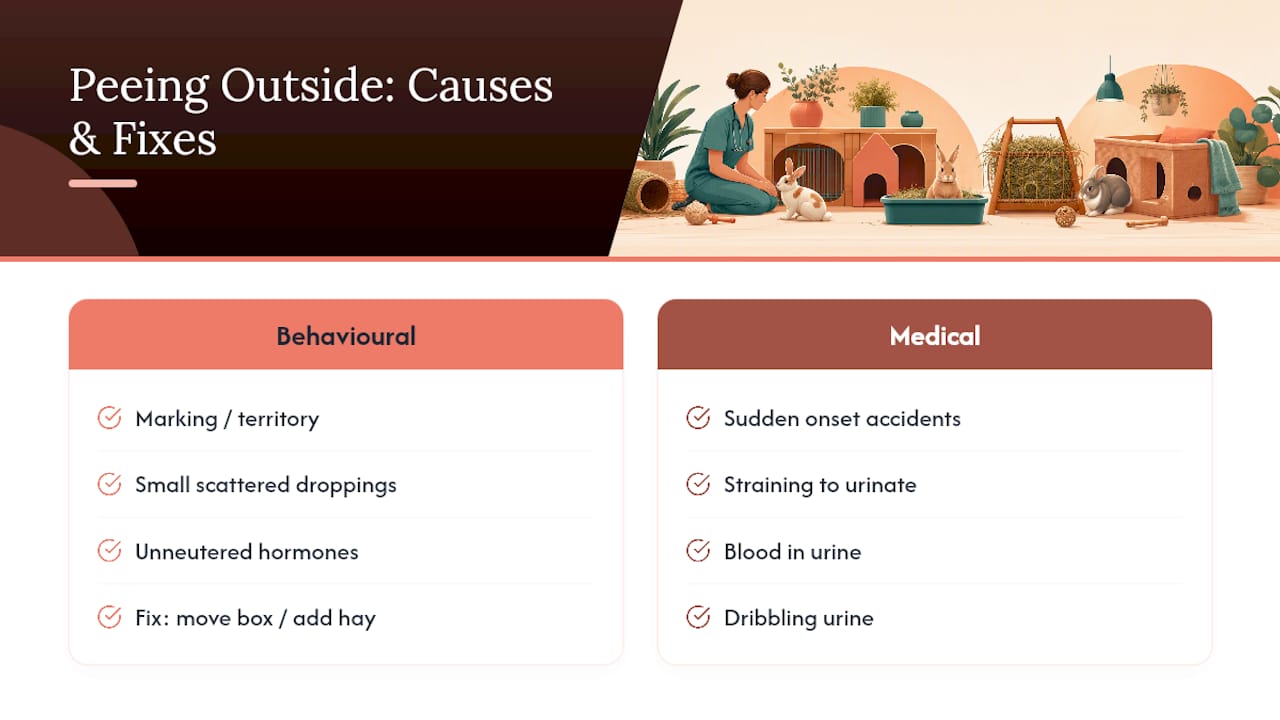
Marking behaviour, small scattered droppings near doorways or furniture, is common in unneutered rabbits and tends to improve dramatically after spaying or neutering. Hormone-driven marking is one of the main reasons vets recommend neutering from around four months of age, and it’s often the difference between a rabbit who half-tries and one who reliably uses the box.
Common behavioural fixes include moving the box to the actual accident spot, switching litter type if your rabbit seems reluctant to step in, adding more hay, and, if not already done, booking a neutering appointment.
Medical causes look different. Sudden accidents, straining, blood in urine, or dribbling urine are signs that warrant a vet visit rather than another week of training tweaks. In multi-rabbit households, give each rabbit its own box at first, since sharing can trigger territorial disputes that look like training failure but aren’t.
Pro Tip: Keep a short accident log, noting the date, location and appearance of any mess. A pattern that develops suddenly is far more useful to a vet than trying to recall it from memory weeks later.
Keeping the litter box clean
A dirty box is one of the fastest ways to undo good training. Scoop droppings and wet patches daily. Once a week, empty the box fully and wash it with diluted vinegar or a mild pet-safe detergent, then rinse thoroughly before refilling.
Leave a very light dusting of used litter behind rather than scrubbing every trace away, since the familiar scent helps reinforce the habit. For accidents on carpet, an enzyme-based or vet-checked cleaner breaks down the smell properly rather than just masking it. Paper-based litter and sawdust pellets are usually compostable, so check your local council’s garden waste rules before binning them.
How long does rabbit litter training take?
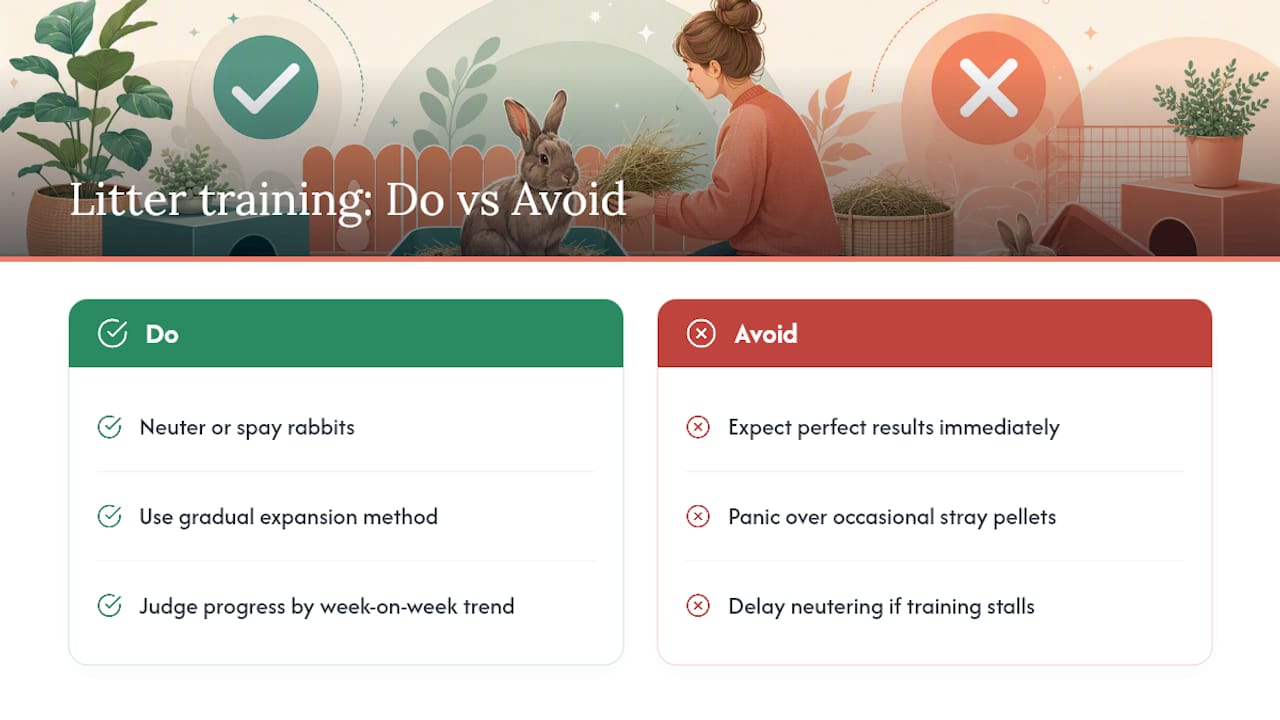
Most rabbits become reliable within a few weeks, though the exact time varies depending on age, personality and neuter status. Success rates in specialist and rescue literature sit around 80 to 90 percent when rabbits are neutered and owners stick to the gradual expansion method.
Spayed or neutered rabbits consistently do better than intact ones, so if training has stalled and neutering hasn’t happened yet, that’s usually the next step to take. Even a fully trained rabbit will drop the occasional stray pellet near the box entrance, that’s normal, not a regression. Judge progress by trend rather than perfection: fewer accidents week on week means the approach is working, even if the odd slip still happens.
Vet-backed support for rabbit litter training
We work from vet-aware guidance when recommending equipment, because getting the basics wrong (the wrong litter, an undersized box, no hay) is what derails most training attempts before they’ve properly started. The range includes paper-based litters, generously sized low-entry trays, and quality hay suited to encouraging box use.
If your rabbit’s accidents look medical rather than behavioural, always speak to a vet first. For everything else, our product pages are built to help you match the right box and bedding to your rabbit’s size and habits.
Where to find safe litter and boxes for your rabbit
Sourcing the right kit shouldn’t be the hard part of rabbit litter training. There are paper-based litters, roomy low-entry trays, and fresh hay available, delivered quickly across the UK so you’re not stuck waiting while your rabbit’s habits are still forming.

If you’re setting up a rabbit’s living space from scratch, there are guides to rabbit hutches with room to move covering sizing alongside litter box placement. The cat litter trays selection includes several high-sided and hooded designs that work well for rabbits who kick. You can browse the current selection and get a box, litter and hay sorted in one order, ready before training day one.
Sources
- Rabbit litter training — Small Pet Expert
- How To Litter Train A Rabbit — PDSA
- How to litter train your rabbit — PetMD
- Litter training the house rabbit — Lafeber Vet handout
FAQ
What is the 3-3-3 rule for rabbits?
The 3-3-3 rule is more commonly used for dogs adjusting to a new home, and there’s no equivalent standardised rule specific to rabbit litter training. For rabbits, the closer guideline is the gradual expansion method: small space first, then more room only once box use is consistent.
How long does it take to litter train a rabbit?
Most rabbits become reliable within two to four weeks, with some taking up to six or eight weeks depending on age and neuter status. Success rates sit around 80 to 90 percent when rabbits are neutered and owners follow a gradual, consistent routine.
Can rabbits be 100% potty trained?
Most rabbits can become highly reliable, but expecting zero stray pellets ever is unrealistic even for well-trained rabbits. Neutering, correct box setup and hay placement together produce the best and most consistent results.
Is it ever too late to potty train a rabbit?
No. Rabbits can be litter trained at any age, though success improves significantly after neutering, which is typically possible from around four months old.