
3 Days, 3 Weeks, 3 Months: UK Plan to Introduce Your Dog to a Baby
3 Days, 3 Weeks, 3 Months: UK Plan to Introduce Your Dog to a Baby
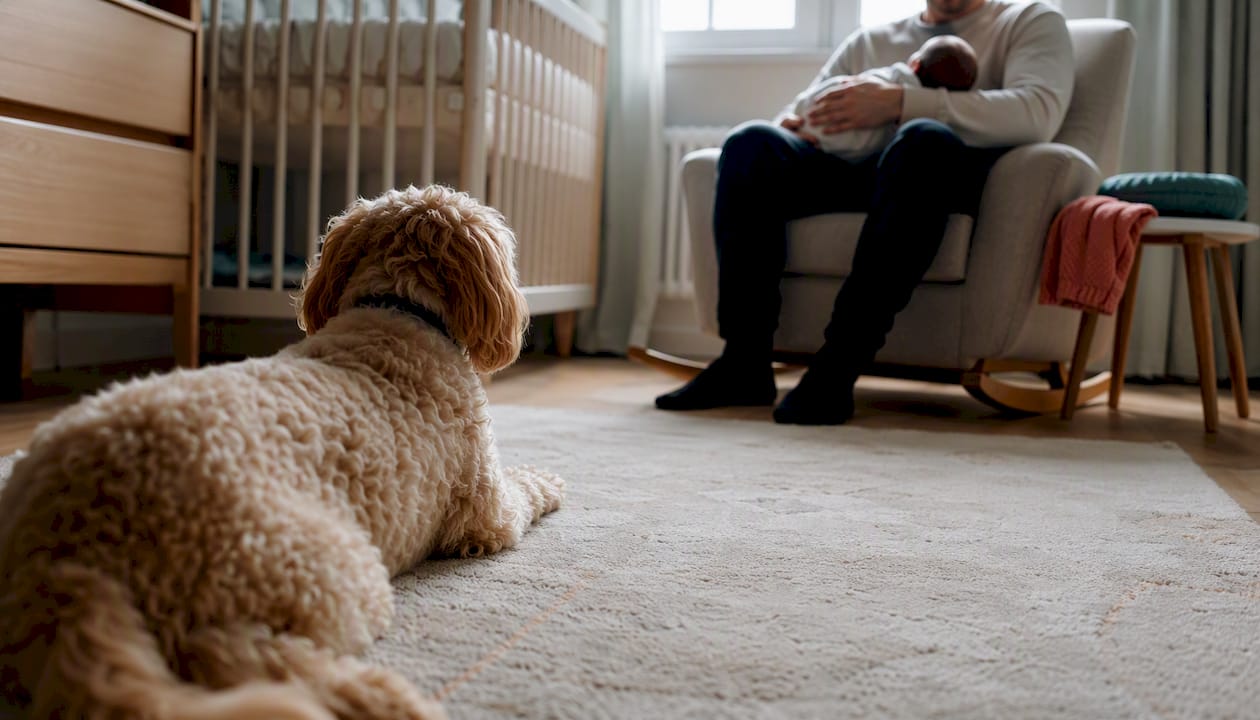
Prepare early, teach calm behaviours, and use short, controlled introductions once the baby arrives. Start settle training and scent or sound exposure months before the due date, set up a crate or gate as a positive success station, and plan a quiet, supervised first meeting. Never leave your dog and baby alone together, and call your vet or a behaviourist if your dog shows stiffening, growling, or intense fixation.
TL;DR:
- Start preparing your dog at least several months before the due date by training settle behaviors and exposing them gradually to baby sounds and smells.
- Use early success stations like crates or gates and practice commands like “settle,” “sit,” “leave it,” and “recall” to establish calm routines and manageable behaviors.
- Introduce the baby’s scent and sounds with supervised visits, and keep initial meetings brief, calm, and on the dog’s terms to set a positive tone.
- Never leave your baby and dog alone together, and manage resource guarding behaviors with barriers and calm removal of high-value items to prevent incidents.
- Maintain consistency in routines and boundaries as your baby grows, and use products like crates, playpens, and puzzle toys to support a calm household.
Table of Contents
- When should you start preparing your dog for a baby?
- How do you get your dog used to baby smells and sounds?
- Which commands matter most before the baby arrives?
- What’s the right way to introduce a dog to a newborn?
- What are the non-negotiable safety rules with dogs and babies?
- How do you keep the relationship positive as your baby grows?
- What does Giddy Pets recommend for a smooth introduction?
- A note on staying calm through the adjustment period
- Products that support a calm dog and baby household
- Sources
- FAQ
When should you start preparing your dog for a baby?
The best time to begin is the moment you know you’re expecting, not the week before the due date. Dogs pick up on household shifts long before a baby arrives, and giving yours months rather than days to adjust makes the whole process calmer for everyone. Dogs Trust notes that preparing a dog well ahead of the birth, including training settle behaviours and exposing them to baby sounds and smells, reduces the stress they experience once the infant is actually in the house.
Spreading the work out also means no single week feels overwhelming for you. Here’s a phased approach that works for most families:
- Months before (second trimester onwards): Book a vet check to rule out pain or health issues that could affect temperament, start “settle on a mat” training, and begin playing recordings of baby cries at low volume during calm moments.
- 6 to 8 weeks before: Introduce the pram, cot, and baby monitor into daily life so they become background furniture rather than novelties. Practise short separations from you if your dog tends to shadow you around the house.
- 1 to 2 weeks before: Reduce any change that can wait until after the birth. Firm up feeding times and walk schedules you intend to keep, since consistency now prevents confusion later.
- Day of birth and the first few days: Bring home a worn blanket or item of clothing from the hospital so your dog can sniff it calmly before meeting the baby in person.
- First weeks home: Keep introductions brief and frequent rather than one long session, and maintain the dog’s normal walk and mealtime routine as closely as possible.
Adjustment speed varies a lot between dogs. Some settle within days; others need several weeks of repeated, low-key exposure before they stop reacting to a crying baby or a fast-moving pram. A popular shorthand for pacing expectations, borrowed from rescue dog introductions, is the “3-3-3 rule”: roughly 3 days to decompress from a big change, 3 weeks to learn the new routine, and 3 months to feel fully settled. It’s a rough guide rather than a guarantee, but it’s a useful reminder not to judge your dog’s progress after a single wobbly afternoon.
How do you get your dog used to baby smells and sounds?
Getting this right before the birth means the actual homecoming feels far less dramatic to your dog. The goal is simple: by the time the baby arrives, nothing about them should feel new.
Start with these concrete steps:
- Set up the cot, changing table, pram, and bouncer weeks in advance and let your dog sniff and inspect each item under supervision.
- Rub a small amount of unscented baby lotion on a cloth and leave it somewhere your dog naturally rests, so the scent becomes familiar and unremarkable.
- Bring a hospital blanket or worn item of baby clothing home ahead of the infant and let your dog sniff it calmly rather than snatching it away; PetMD recommends exactly this approach for scent familiarisation.
- Play recordings of newborn crying, gurgling, and feeding sounds at a low volume for a few minutes a day, gradually increasing volume over one to two weeks as your dog stays relaxed.
- Practise pushing an empty pram past your dog during walks so the movement and noise become ordinary.
Alongside sound and scent work, build “success stations” (a crate, a baby gate, or a playpen) that your dog associates entirely with good things. Dogs Trust recommends setting these up early so the dog forms a positive association with restricted zones before the baby is mobile and before those boundaries feel urgent. A well-fitted dog crate works well for this if your dog already enjoys crate time, feed meals and give chews there so it reads as a den rather than a punishment.
Pro Tip: Never use the crate or gate as a place your dog goes only when they’ve done something wrong. If the only time they’re sent there is after barking at the baby, they’ll start to dread the space you actually need them to love.
Which commands matter most before the baby arrives?
Five behaviours make the biggest practical difference once a newborn is in the house, and none of them require advanced training experience to teach.
- Settle on a mat. This is the single most useful skill for baby life. Choose a mat or bed, reward your dog for lying on it calmly, and gradually extend the duration before the treat arrives. The VCA Hospitals guidance on training settle behaviours suggests rewarding every single instance at first, then shifting to intermittent rewards once the behaviour is reliable, and proofing it around baby-like stimuli such as a recorded cry or a moving pram.
- Sit and stay with distraction. Practise asking for a sit while you walk past with a laundry basket, drop something noisy, or have someone else move around the room. The point isn’t obedience for its own sake. It’s teaching your dog to hold still while chaos happens nearby.
- A reliable recall. Being able to call your dog away from the baby’s play area or off a sofa the baby is on matters more once mobility starts. Practise in the garden and indoors, not just on walks.
- “Leave it.” Dropped dummies, muslin cloths, and nappies are inevitable. A dog who reliably leaves an item on cue avoids a dozen small confrontations later.
- No jumping up. Even a friendly, well-meaning jump can knock over an adult holding a baby. Teach a sit-to-greet instead, well before the baby’s first day home.
Structure each session the same way: five to ten minutes, low distraction to start, one skill at a time. Once your dog nails a behaviour in a quiet room, add a new challenge, background noise, another person in the room, then a moving object, before you consider it proofed. Rushing this stage is the most common mistake parents make; a dog who can settle in a silent lounge often falls apart the first time a baby actually cries, simply because nobody practised that combination beforehand.
Reward-based training works better than corrections here, and it isn’t close. PetMD is direct on this point: don’t force interaction, and don’t correct a nervous dog, because punishment worsens fear-based reactions rather than resolving them. If you’re several weeks in and your dog still can’t hold a settle for more than a few seconds, or reacts fearfully to recorded crying, that’s the moment to bring in a qualified trainer rather than push through alone.
Pro Tip: Run a few of these sessions with a real, sleeping baby nearby (once your baby has arrived) rather than only in a baby-free training room. A dog who can settle next to a quiet baby is being taught something your empty-room sessions can’t replicate: that the baby’s presence itself means nothing changes.
What’s the right way to introduce a dog to a newborn?
The first meeting should be short, calm, and entirely on the dog’s terms, never forced. Getting this one interaction right sets the tone for everything that follows, so it’s worth slowing down and following a clear sequence rather than improvising.
Before the meeting itself:
- Make sure your dog has had a walk or some exercise beforehand so they’re not bursting with pent-up energy.
- Have a second adult present if at all possible, one to hold the baby, one to manage the dog.
- Keep small, high-value treats within easy reach for calm behaviour.
- Have your dog on a loose lead or positioned behind a baby gate for the first encounter, purely as a safety buffer rather than a restraint you expect to need.
Then work through the introduction itself:
- Let the adult holding the dog greet you and settle for a moment before the baby is even in the room. A dog who’s already relaxed handles novelty far better than one greeting you at the door mid-excitement.
- Bring the baby in and hold them at a distance the dog can see and sniff towards without direct contact at first.
- Watch your dog’s body language rather than rushing to “let them meet properly.” A relaxed, loose-wagging tail and soft eyes mean you can invite a closer approach; a stiff body, hard stare, or tucked tail means you pause and give more distance.
- If your dog is calm, allow a brief sniff of the baby’s blanket or feet, then calmly redirect and reward with a treat and quiet praise.
- End the session after a minute or two, even if it’s going well. Short and successful beats long and risky every time.
- Repeat several short sessions a day over the following days, slowly lengthening supervised proximity as your dog’s calm responses become consistent.
Your own state matters more than most parents expect. The AKC points out that dogs pick up on their owner’s tension, and a nervous, hovering parent can actually generate the anxious reaction they’re trying to prevent. Take a breath, keep your voice at its normal pitch, and let the introduction unfold at a pace that feels almost boring. Boring, in this context, is exactly what you want.
If your dog ever growls, snaps, or backs away stiffly during this process, don’t scold them for it. A growl is information, not defiance, and punishing it only teaches the dog to skip the warning next time. Separate calmly, give both baby and dog some space, and try again later at a slower pace.
What are the non-negotiable safety rules with dogs and babies?
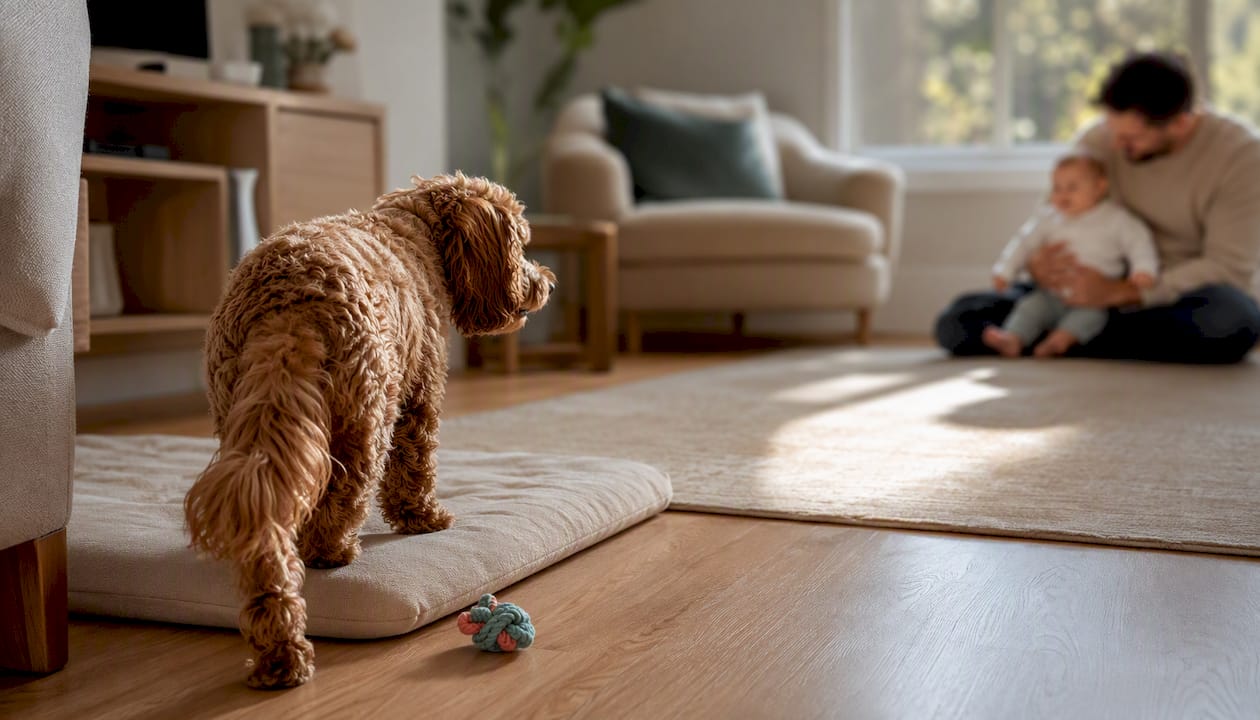
Some rules here aren’t flexible, whatever your dog’s temperament or history. The most important one, repeated by every major veterinary and welfare source on this topic, is this: never leave your baby and dog alone together, not even for a moment, not even with a dog you’d trust with your life. VCA Hospitals is blunt about why: most incidents happen in the first hours or days after introduction, often precisely because a tired, distracted parent assumes a calm dog needs no watching.
A handful of other rules matter just as much:
- Keep your dog off the baby’s cot, moses basket, or any sleeping surface, always.
- Store dog food, chews, and toys somewhere the baby can’t reach and the dog doesn’t need to guard.
- Use a physical barrier, a baby gate or closed door, whenever you can’t give the interaction your full attention.
- Treat any item linked to resource guarding (a stolen nappy, a chewed toy) as high-risk: remove it calmly rather than trying to retrieve it by force.
Watch for a specific set of red-flag behaviours, because they mean something different from ordinary dog nerves. Intense, fixed staring at the baby, a stiff or frozen body posture, low growling, guarding a resting spot near the baby, or stalking the baby’s movements around a room are all signs that need immediate management, not patience. If you see any of these, calmly remove the dog to their success station, secure the baby elsewhere, and don’t attempt to push through the moment.
A significant portion of reported dog bites to children occur within the home, from dogs the family knows well, which is why supervision rules always apply even to dogs with a long history of being gentle.
Formal training and, where needed, a veterinary behaviourist’s input are strongly recommended for any dog with a history of aggression, resource guarding, or high anxiety, according to VCA Hospitals. In the UK, that means asking your vet for a referral to a clinical animal behaviourist, or seeking a trainer accredited through a recognised body such as the CPDT, rather than relying on generic online advice for a dog already showing warning signs.
How do you keep the relationship positive as your baby grows?
The work doesn’t stop once the first nervous weeks are behind you. Dogs thrive on predictability, and a baby who’s suddenly crawling, then walking, then grabbing at ears, changes the rules again just as your dog was settling into the old ones.
Protect your dog’s normal life as much as you can. Daily walks, regular feeding times, and some one-to-one play or training each day matter more now, not less, because these routines are what tell your dog that life is still fundamentally stable. As your child gets old enough to understand instructions, start teaching them simple, consistent rules alongside your dog’s training:
- Never approach the dog while they’re eating or sleeping.
- Call the dog to you rather than crawling or running towards them.
- Never take a toy, chew, or bone directly from the dog’s mouth or paws.
- Always ask a parent before stroking, hugging, or picking things up near the dog.
Give your dog outlets that keep them mentally occupied during the busiest parts of your day, a stuffed chew, a snuffle mat, or a puzzle feeder can buy you ten calm minutes during nappy changes or feeds. Keep baby gates and crate access in place for as long as your child is too young to reliably respect boundaries; there’s no fixed age to remove them, and many families keep some form of barrier in place until a child is at school age.
Plan ahead for the moments that catch families out: a babysitter who doesn’t know the household rules, visiting relatives who ignore “don’t approach the dog while eating,” or a toddler’s friend who’s never been taught pet manners. Briefing anyone who spends time in your home, even briefly, closes a gap that causes a surprising number of avoidable incidents. If you want a broader read on managing everyday household risks with pets and small children underfoot, this guide to fall prevention while caring for pets covers ground that overlaps usefully with baby proofing.
What does Giddy Pets recommend for a smooth introduction?
Good preparation and good equipment work together, not as substitutes for each other. Expert advice consistently points back to the same principle running through this whole guide: give your dog a predictable, positive space of their own, and build calm habits well before you need them under pressure.
A few product pairings map directly onto the steps above:
- A properly sized dog crate supports the success station approach, provided it’s introduced as a calm, voluntary space long before the baby arrives, never as a place the dog is banished to mid-tantrum.
- A playpen gives you a flexible, open alternative to a crate for dogs who prefer to see the room rather than be enclosed, useful during feeding or nappy changes when you need your hands free.
- Long-lasting stuffable and treat-dispensing toys keep a dog settled and occupied during the exact windows, feeding, settling, night wakings, when your attention is fully on the baby.
- If your dog shows signs of low-level anxiety during the adjustment period, our guide to separation anxiety covers signs worth watching for and simple ways to help.
None of this replaces the training and desensitisation work covered earlier. Products help you manage the gaps in a busy day; they don’t teach a settle cue or fix a fearful reaction. Before buying anything, check sizing carefully against your dog’s current and expected weight, and always sit with a new chew or toy the first few times to confirm it’s safe for your dog’s particular chewing style.
A note on staying calm through the adjustment period
Every dog adjusts at their own pace, and that’s genuinely fine. Some settle within days of meeting the baby; others need a slower, more repetitive build over weeks. Neither speed says anything about whether the relationship will end up a good one.
What matters more than speed is consistency: the same supervision rules every day, the same success station used the same way, the same calm tone from you whether the introduction is going brilliantly or a little wobbly. Dogs read routine as safety, and a predictable household does more for a nervous dog than any single perfect training session.
If something feels off, persistent avoidance, stiffening around the baby, or any of the red flags covered earlier, trust that instinct and speak to your vet or a qualified behaviourist rather than waiting to see if it resolves alone. Resources are available to support that process, not to replace it.
— Giddy
Products that support a calm dog and baby household
There’s no single product that manages a dog and newborn introduction for you, but the right equipment removes friction from the routines this guide has walked through. A dog crate or playpen gives your dog a genuine retreat rather than a corner they’ve simply been pushed into, and that distinction is what makes a success station actually work.
For the settling and enrichment side of things, puzzle toys and snuffle mats keep an anxious or bored dog occupied during the exact stretches of the day, feeds, nappy changes, nap windows, when you have the least spare attention. If your dog tends to run hot during changeable weather while you’re also managing a newborn’s routine, our winter pet care hub has practical seasonal adjustments worth a look too. Whatever you choose, check the sizing guidance on each product page against your dog’s current weight and chewing strength before buying, since a crate or toy that’s the wrong fit undoes the calm association you’re trying to build. Browse the full range in our shop and pick the pieces that match where your dog needs the most support right now.
Sources
- How to introduce your dog to your new baby | Dogs Trust
- Children and pets - infants and dogs | VCA Hospitals
- How to Introduce a Dog to Your New Baby | PetMD
- How to introduce your dog to your new baby | AKC
FAQ
How long does it take a dog to get used to a baby?
It varies widely, but many dogs show clear signs of adjustment within a few days to a few weeks of consistent, calm exposure. A rough guide some trainers use is the 3-3-3 rule, roughly 3 days to decompress, 3 weeks to learn the new routine, and 3 months to feel fully settled, though every dog moves through it at their own pace.
When can I introduce my dog to my newborn?
You can introduce them as soon as you bring the baby home, provided your dog has already had weeks or months of preparation through scent, sound, and settle training. The first meeting itself should be brief, calm, and supervised, then repeated in short sessions over the following days.
What is the 3-3-3 rule with dogs?
The 3-3-3 rule is a rough timeline used to set expectations for a dog adjusting to a major change: around 3 days to decompress, 3 weeks to settle into a new routine, and 3 months to feel fully at home. It’s a guideline rather than a fixed schedule, and some dogs move faster or slower through each stage.
What should you avoid when introducing a dog to a baby?
Never force contact or physically correct a dog who backs away or growls, since PetMD notes this worsens fear-based reactions rather than resolving them. Avoid long, unsupervised first meetings, and never leave the baby and dog alone together, even briefly, in those early days.
How do I stop my dog being jealous of the baby?
Jealousy usually shows up as attention-seeking or clinginess rather than aggression, and it eases when you keep the dog’s walks, feeding times, and play sessions as close to normal as possible. Involving your dog in low-risk parts of baby care, sitting calmly nearby during feeds, joining a pram walk, helps them feel included rather than replaced.