
Vet Backed 5 Step Protocol to Introduce Cats Safely for UK Owners

Vet Backed 5 Step Protocol to Introduce Cats Safely for UK Owners
The safest way to introduce cats is a slow, scent-first protocol: a transition room, gradual scent swapping, then a barrier-based visual introduction before any face-to-face meeting. Success looks like relaxed body language, both cats eating normally, and calm, short supervised sessions that grow longer over days or weeks. The AAFP’s 2024 guidelines and charities like Cats Protection back this staged approach, and products such as Feliway diffusers can support it at every stage.
TL;DR:
- Successful introduction relies on a slow, staged process that prioritizes scent exchange, resource management, and gradual visual contact over face-to-face meetings.
- Both cats should be vetted first for health, vaccination, and parasites, especially if one is frail or recovering from illness, to prevent health issues from complicating introductions.
- Resources such as multiple litter trays and separate feeding stations are essential to reduce territorial stress and prevent toileting or food guarding problems.
- Consistent routines for feeding and enrichment must be maintained for both cats to promote stability and minimize stress during the transition.
- Introduction timelines vary from days to several months, and progress should be dictated by relaxed body language rather than strict schedules or deadlines.
Table of Contents
- Are both cats healthy enough to start introductions?
- How do you set up a transition room properly?
- What is scent swapping and how do you do it?
- How do you feed and play across a closed door?
- When should cats see each other for the first time?
- How do you manage the first face-to-face meeting?
- How long does introducing cats really take?
- When should you call a vet or behaviourist?
- How do you spot and ease stress during introductions?
- How do you handle territorial aggression?
- How do you keep routines stable during introductions?
- Do you need extra vet checks before introducing cats?
- Giddy Pets perspective: what actually earns your patience
- Helpful products to support introductions
- Primary sources and further reading
- Sources
- FAQ
Are both cats healthy enough to start introductions?
Before you introduce a single scent cloth, book a vet check for the newcomer. A new cat needs to be screened for contagious illnesses such as feline herpesvirus, calicivirus, and parasites before it shares any airspace with your resident cat, let alone a room. This isn’t just about ruling out visible illness. Some conditions incubate quietly for days and only show once stress from the move triggers symptoms.
Your resident cat’s situation matters just as much. A senior cat with arthritis, a cat recovering from illness, or one that has never lived with another animal will need a different pace, and sometimes a different decision entirely.
Ask yourself these questions before committing to a timeline:
- Has the new cat had a full vet check, including vaccination status and a parasite treatment, in the last few weeks?
- Is your resident cat currently dealing with any medical condition, chronic pain, or recent stress (a house move, a bereavement, a change in routine)?
- Is your resident cat elderly, or has it shown intolerance to other animals in the past?
- If compatibility feels genuinely uncertain, would adopting a bonded pair of cats who already get along be a better route than introducing a solo newcomer?
If your resident cat is frail, very old, or has a history of severe stress-related illness (cystitis flare-ups are a common one), it’s worth delaying the introduction or seeking a behaviourist’s opinion first. There’s no shame in waiting a few extra weeks to get this right. Rushing past a health issue to stick to a plan is one of the most common ways introductions go wrong before they’ve even started.
How do you set up a transition room properly?
A transition room is the newcomer’s own space for the first stage of settling in, and it does two jobs at once: it gives the new cat somewhere to decompress without the pressure of exploring a whole house, and it protects your resident cat’s territory from a sudden invasion of smells it doesn’t recognise.
Pick a room that can be closed off, ideally one your resident cat doesn’t consider essential territory (a spare bedroom or study works better than the main living room). Fill it with:
- A litter tray, positioned away from food and water
- Separate food and water bowls
- At least one hiding spot, such as a covered bed or cardboard box
- A vertical perch or shelf, since cats feel safer with height options
- A few toys and a bed with familiar bedding smells
The resource rule that matters most across the whole introduction period, not just this room, is one litter tray per cat plus one extra. Two cats need three trays somewhere in the house, and each cat needs its own feeding station. Skimping on this is a leading cause of stress-related toileting problems later.
A plug-in pheromone diffuser in the transition room, dim lighting rather than harsh overheads, and keeping the door shut against household noise all help the newcomer settle faster.
Pro Tip: Set the diffuser going 24 to 48 hours before the new cat even arrives, so the room already smells calm rather than sterile and unfamiliar on day one.
What is scent swapping and how do you do it?
Cats read the world primarily through scent, which is why the first real step of introduction has nothing to do with sight. Scent swapping lets each cat learn the other’s smell as something ordinary, long before they’re in the same room.
Here’s the routine that works:
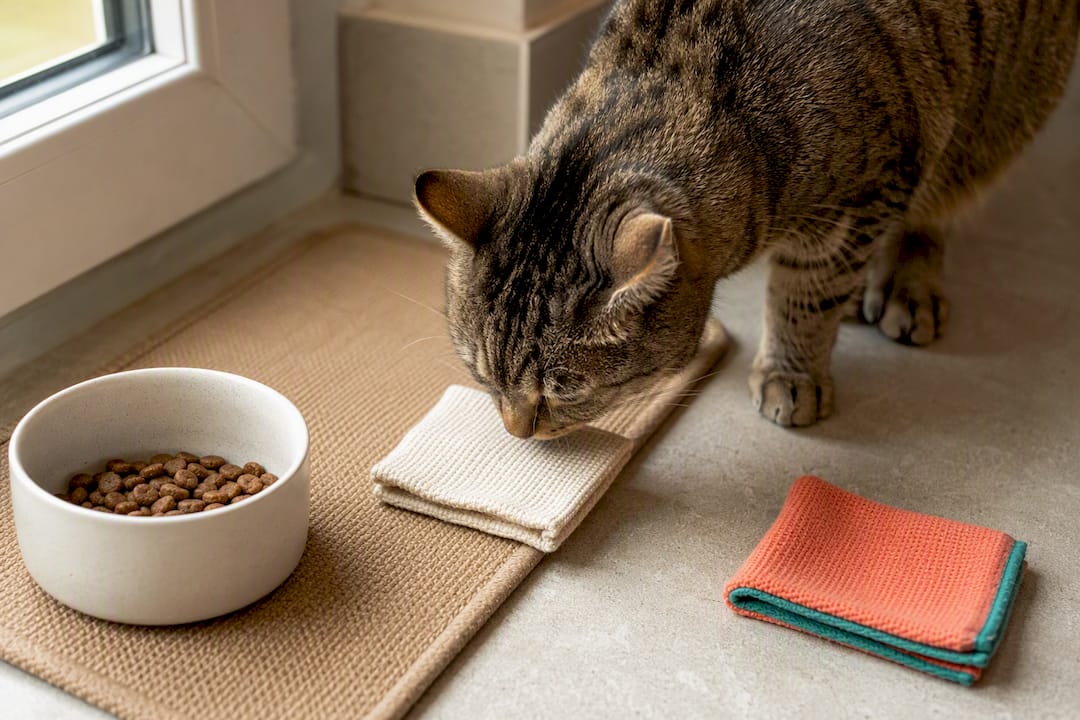
- Take a soft cloth or small blanket and gently rub it over the new cat’s cheeks, chin, and the base of its tail, where scent glands concentrate.
- Do the same with a separate cloth for your resident cat.
- Swap the cloths so each cat has access to the other’s scent near their food or bed, somewhere positive rather than threatening.
- Repeat this daily, rotating fresh cloths so the scent stays present without becoming overwhelming, as recommended in UC Davis’s introduction guidance.
- Watch each cat’s reaction: sniffing calmly and moving on is good; hissing, growling, or avoiding the area means you slow down and repeat the step for longer.
Pheromone products can run alongside this from the start. Cats Protection recommends starting diffusers such as Feliway 24 to 48 hours before the new cat even arrives, running them in both the transition room and shared living spaces, and repeating scent-swap sessions multiple times a day rather than once.
There’s no fixed number of days this stage should take. Some cats stop reacting to a scent cloth within two or three days; others need a week or two of repetition before they’re relaxed. The point isn’t to tick a box, it’s to watch for genuine indifference. A cat that sniffs a cloth and walks away to eat its dinner is telling you it’s ready for the next stage. A cat that still bolts from the smell after a week isn’t failing, it just needs more time at this step before you move on.
How do you feed and play across a closed door?
Once scent swapping is going smoothly, you can start pairing the presence of the other cat, still unseen, with something each cat genuinely enjoys. Feeding either side of a closed door does exactly this, and the San Francisco SPCA recommends it as a core step in the sequence.
Practical points that make this work:
- Feed both cats at roughly the same time, bowls placed a short distance from the closed door on each side.
- Start with the bowls further from the door than feels necessary. You can move them closer over several sessions as both cats stay relaxed.
- Use a wand toy or a puzzle feeder during play sessions rather than food alone, since focused play burns nervous energy and keeps attention on the game rather than on scratching at the door.
- Keep early sessions to five or ten minutes. Extend gradually only if neither cat shows pawing at the gap, growling, or refusing to eat.
- If either cat won’t eat with the other cat’s presence detectable through the door, move the bowls further apart and try again the next day rather than pushing through it.
A cat that eats calmly, tail relaxed, with the other cat audibly nearby is building a genuinely positive association, not just tolerating a routine.
When should cats see each other for the first time?
Visual contact through a secure barrier is the bridge between scent and physical meeting, and getting the barrier right matters more than owners often expect. Avoid crisscross lattice baby gates. Cats can and do climb them, which turns a safety barrier into a launchpad. A tall pet gate with vertical bars, or a glass door left ajar with a secured screen, works far better.
For the sessions themselves:
- Keep the first visual contact brief, no more than a minute or two, and reward calm behaviour on both sides with treats or a favourite toy the moment they notice each other.
- End the session before either cat becomes fixated or tense, not after.
- Gradually increase the duration over several sessions, always ending on a calm note rather than pushing until something goes wrong.
- Stay close enough to intervene, but resist the urge to force either cat to look at or approach the other.
Pro Tip: A slow blink, a relaxed tail, or one cat simply lying down near the barrier are strong “advance” signals. A flattened body, dilated pupils, or a fixed stare mean it’s time to end the session and try a shorter one tomorrow.
How do you manage the first face-to-face meeting?
The first proper meeting should feel almost anticlimactic. Keep it short, keep exits open for both cats, and never hold or restrain either one to force an interaction.
- Choose a moment when both cats are calm, ideally after play or a meal, and open the barrier for a supervised few minutes.
- Have a few tools ready in case tension rises: a large piece of cardboard or a towel to block sightlines without touching either cat, and a carrier with the door removed nearby as a retreat option.
- Watch for stillness, sniffing, or mutual indifference. That’s success. A short hiss followed by both cats walking away is also manageable, not a disaster.
- If a real scuffle breaks out, separate them calmly using the cardboard or a towel thrown gently between them, never your hands.
- Once separated, check both cats over for scratches or bite wounds, which can become infected quickly if missed.
- Give the household several calm days before restarting, and go back to whichever earlier step was working well, whether that’s the barrier stage or feeding across the door.
One escalated meeting doesn’t undo the weeks of scent work before it. It just means the pace needs to slow down again.
How long does introducing cats really take?
There’s no fixed calendar for this. The Cat Vets Step-by-Step Guide is explicit that timelines range from a few days to several months, and that forcing progress to hit a personal deadline tends to backfire badly.

You’ve probably seen the “3-3-3 rule” mentioned online: three days to decompress, three weeks to settle, three months to feel fully at home. Treat it as a loose orientation point, not a schedule. Some cat pairs are calmly sharing a sofa within a fortnight. Others need three months just to tolerate being in the same room without tension. Both outcomes are normal.
What actually predicts success isn’t speed, it’s whether each cat’s body language is genuinely relaxed at the current step before you move to the next one. A slower introduction that never has to backtrack beats a fast one that stalls out at week six.
When should you call a vet or behaviourist?
Some situations go beyond what patience and a good routine can fix, and knowing when to bring in professional help early saves weeks of stalled progress.
Call your vet or a qualified behaviourist if you see:
- Fighting that causes visible wounds, not just noise and posturing
- A sudden increase in house-soiling outside the litter tray, especially spraying
- Either cat going off food for more than a day, which can become medically serious quickly in cats
- One cat hiding constantly and refusing to eat, drink, or use the tray at all
Before your appointment, film a short clip of any incident if it’s safe to do so, and jot down what triggered it (a doorway, a food bowl, a sudden noise). A behaviourist’s assessment usually involves mapping out the exact sequence of events, the environment, and each cat’s history, so specific notes are far more useful than a general “they don’t get along.”
How do you spot and ease stress during introductions?
Stress in cats rarely looks dramatic, which is exactly why it gets missed until it’s entrenched. Watch for reduced appetite, more time spent hiding than usual, over-grooming to the point of bald patches, or a cat that suddenly stops using the litter tray reliably.
Dilated pupils, flattened ears, a tucked-under body, or a swishing tail during a session are all signs the current step is too much, too soon. The fix is almost always the same: step back to the previous stage, shorten the session length, and give the cat more control over when to approach.
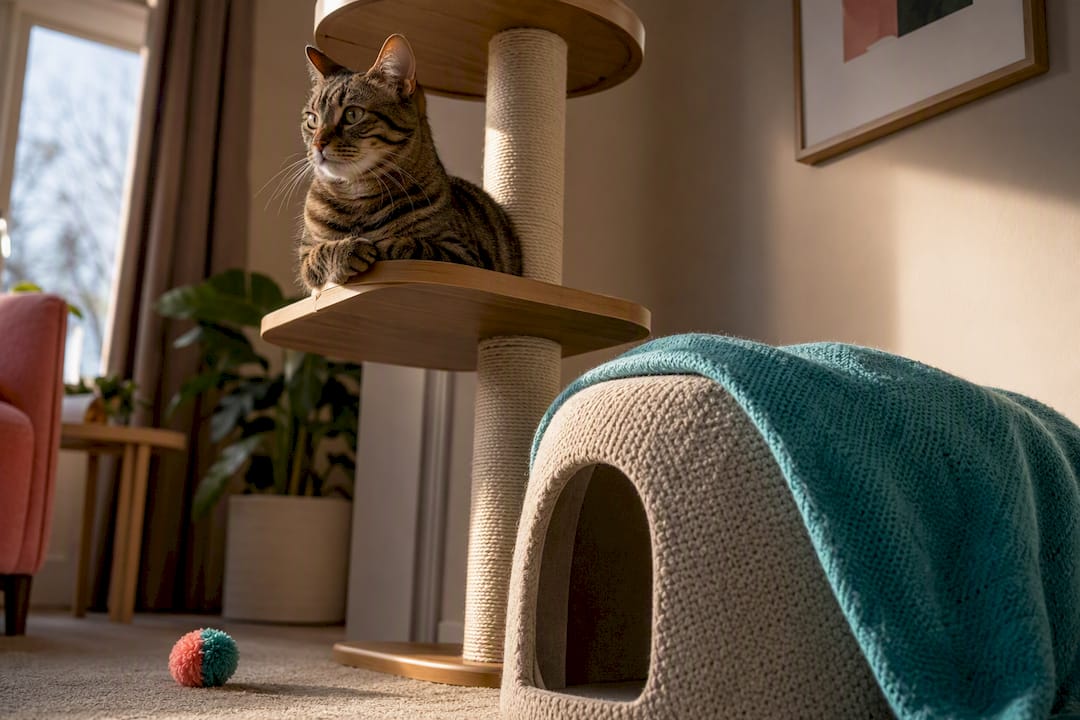
Enrichment helps enormously here. A cat with access to climbing space, hiding spots, and regular short bursts of play has an outlet for adrenaline that would otherwise come out as tension around the newcomer. Keep both cats’ normal enrichment running throughout, rather than pausing it “until things settle,” since boredom compounds stress rather than easing it.
Consistency in your own behaviour matters too. Speaking in a calm, low voice, avoiding sudden movements around either cat, and not hovering anxiously over every interaction all help. Cats pick up on human tension surprisingly well, and a jumpy owner can make a neutral moment feel like a threat.
Never punish a hiss, a growl, or a swipe. Punishment during introductions doesn’t teach a cat to like the other cat, it just teaches it that the situation itself is dangerous, which entrenches exactly the hostility you’re trying to avoid.
How do you handle territorial aggression?
Territorial aggression usually shows up as blocking doorways, staring down the other cat from across a room, or guarding a food bowl or litter tray with stiff, deliberate body language. It’s different from fear-based hissing, and it needs a slightly different response.
The first fix is almost always resources, not behaviour. If cats are competing over one litter tray, one water bowl, or one favoured perch, adding more of each in separate locations often resolves the tension without any direct intervention at all. Territorial cats are frequently reacting to scarcity, real or perceived, rather than genuine dislike of the other cat.
Where guarding continues despite ample resources, go back to rewarding calm proximity: treats delivered the moment the guarding cat relaxes near the resource, rather than when it’s actively blocking access. Never intervene by picking up or restraining the aggressor, which can redirect the aggression onto you or worsen the association with that space.
If one cat consistently controls key resources and the other is visibly avoiding entire rooms, that’s worth escalating to a behaviourist rather than waiting it out, since entrenched territorial patterns rarely resolve on their own once established.
How do you keep routines stable during introductions?
It’s tempting to overhaul everything when a new cat arrives, but your resident cat’s sense of security depends heavily on its existing routine staying intact. Keep feeding times, play sessions, and favourite resting spots exactly as they were before the newcomer arrived.
This matters more than most owners expect. A resident cat that suddenly finds its dinner late, its favourite windowsill occupied, or its owner’s attention monopolised by the new arrival is far more likely to associate the change with the newcomer, and resent it. Protect one-on-one time with your resident cat deliberately, even if it’s just ten minutes of the same game you always played.
The new cat needs its own predictable routine too, built inside the transition room before it ever expands to the rest of the house. Feeding it at consistent times, in the same spot, with the same person delivering food, builds the security that makes every later step of introduction easier.
Do you need extra vet checks before introducing cats?
Beyond the initial health check, make sure vaccinations are fully up to date for both cats, including boosters if either has had a gap in their schedule. Feline herpesvirus and calicivirus spread easily between cats sharing a household, and an unvaccinated or partially vaccinated cat is at real risk once the transition room’s closed door starts opening.
Parasite treatment (fleas and worms) should be current for both cats too, since close contact during supervised sessions is exactly when these problems jump between animals. If either cat is due a routine vaccination or treatment, it’s worth timing it to complete before the barrier and face-to-face stages begin, not during them, since a cat feeling unwell from a jab reaction is not a cat ready to meet a stranger calmly.
A cat coming from a shelter or rescue may already have documentation of this. Ask for it, and if anything is missing, get it confirmed before pushing introductions past the scent-swapping stage.
Giddy Pets perspective: what actually earns your patience
The protocol here isn’t complicated: transition room, scent swapping, feeding across a door, barrier visuals, then short supervised meetings. What’s harder is resisting the urge to skip ahead because the cats seem fine, or because you’re tired of managing two rooms. Every piece of guidance from the AAFP to Cats Protection agrees on the same underlying point: speed is not the goal, and a slow success beats a fast failure every time.
We’d add one thing the guidelines don’t always say plainly. The right supplies don’t replace this process, but they make it noticeably easier to stick to. A good pheromone diffuser, a proper wand toy for play across a door, enough litter trays that resources are never a flashpoint. None of that does the behavioural work for you, but it removes the friction that makes owners rush.
— Giddy
Helpful products to support introductions
Getting the environment right takes real pressure off the behaviour work, and the right gear at each stage genuinely helps. A pheromone diffuser is worth having running from before the new cat even arrives, and if you’re comparing options, our guide to calming diffusers covers what actually works versus what’s just marketing.

For the feeding-across-the-door stage, interactive cat toys that reward focus, like wand toys and puzzle feeders, keep sessions positive rather than tense. If mealtime speed is part of the stress picture (a cat that scoffs its food fast tends to be a more anxious cat generally), a slow feeder can help calm that particular habit down alongside the introduction work. And since the one-tray-per-cat-plus-one rule is non-negotiable once you have two cats, it’s worth sorting your litter tray setup properly from day one rather than adding trays reactively later.
None of these replace patience or a properly paced protocol. They just remove some of the friction that tempts owners to rush. Browse the current range at Giddy Pets and pick out what your household actually needs for this stage.
Primary sources and further reading
For deeper reading, the AAFP’s 2024 intercat tension guidelines offer the fullest clinical breakdown of the staged protocol, while Cats Protection’s introduction advice and the Cat Vets step-by-step guide both walk through timing and troubleshooting in practical detail.
Sources
- Step-by-step guide: How to introduce a new cat to other cats in your home
- 2024 AAFP intercat tension guidelines: recognition, prevention and management
- How To Introduce Cats Step-by-Step - San Francisco SPCA
FAQ
What is the 3-3-3 rule for introducing cats?
It’s a loose guide suggesting three days to decompress, three weeks to settle, and three months to feel fully at home. Treat it as orientation, not a deadline. Real timelines vary from days to several months.
What should you never do when introducing cats?
Never force a face-to-face meeting before earlier steps are calm, never punish hissing or growling, and never let visual contact happen too early without a secure barrier in place first.
How do I introduce my two cats safely?
Set up a transition room, work through scent swapping, then feeding across a closed door, then barrier-based visual contact, and only then short supervised meetings, moving to the next step only once each cat is relaxed at the current one.
Can you introduce two cats immediately?
No. Skipping the staged sequence significantly raises the risk of fear or aggression taking hold, which is far harder to undo than a slower, scent-first introduction from the start.