
Two 10–15 Minute Play Sessions: Indoor Cat Enrichment for Busy Owners
Two 10–15 Minute Play Sessions: Indoor Cat Enrichment for Busy Owners
Indoor cats thrive on four things: short daily interactive play, at least one foraging meal, vertical territory to survey their world from, and a scratching post that gives them a proper stretch. Aim for two 10 to 15 minute play sessions, one puzzle-fed meal, and a rotating toy box, and you will head off most boredom-driven behaviour before it starts. Advice on cat enrichment is built around exactly this, backed by guidance from bodies like the VCA and the American Association of Feline Practitioners.
TL;DR:
- Consistent daily routines using two 10 to 15-minute play sessions and one puzzle-fed meal can reduce boredom-driven behavior.
- Including vertical spaces like wall shelves, window perches, and sturdy cat trees provides cats with safe vantage points that lower stress.
- Regular rotation of four to six toys every three to four days maintains engagement and prevents habituation.
- Proper scratching posts, tall and sturdy, placed near common activity areas, are essential to redirect scratching from furniture.
- Combining play, foraging, vertical space, and sensory enrichment minimizes behavior issues without needing excessive gadgets or complex setups.
Table of Contents
- What does indoor cat enrichment actually involve?
- Interactive play: how to mimic the hunt and schedule sessions
- Foraging and puzzle feeders: turning mealtimes into enrichment
- Vertical space and window perches: why height matters
- Scratching: the right posts, the right places
- Sensory enrichment: catnip, silvervine, sound and safe smells
- Toys, rotation and novelty: staying interesting without overspending
- Daily routine and troubleshooting
- Giddy pets: practical, vet-approved help for enrichment at home
- Why routine beats another trip to the toy aisle
- Ready to build your cat’s routine? Start with these essentials
- Sources
- FAQ
What does indoor cat enrichment actually involve?
Indoor cat enrichment means recreating, indoors, the sensory and physical challenges a cat would meet outdoors: hunting, climbing, scratching, exploring new smells, and choosing when to be sociable. Cats kept purely indoors do not lose those instincts just because there is no garden to patrol. A combination of physical, mental, sensory, social and predatory outlets, addressed daily rather than occasionally, prevents the bulk of behaviour problems that owners bring to vets and behaviourists: scratched furniture, night-time zoomies, over-grooming, and food-bowl scoffing.
None of this demands a spare room full of gadgets. It demands a routine you can actually stick to on a Tuesday evening when you are tired. The sections below break that routine into its working parts, starting with the one owners get wrong most often: play that looks busy, but never finishes the job.
Interactive play: how to mimic the hunt and schedule sessions
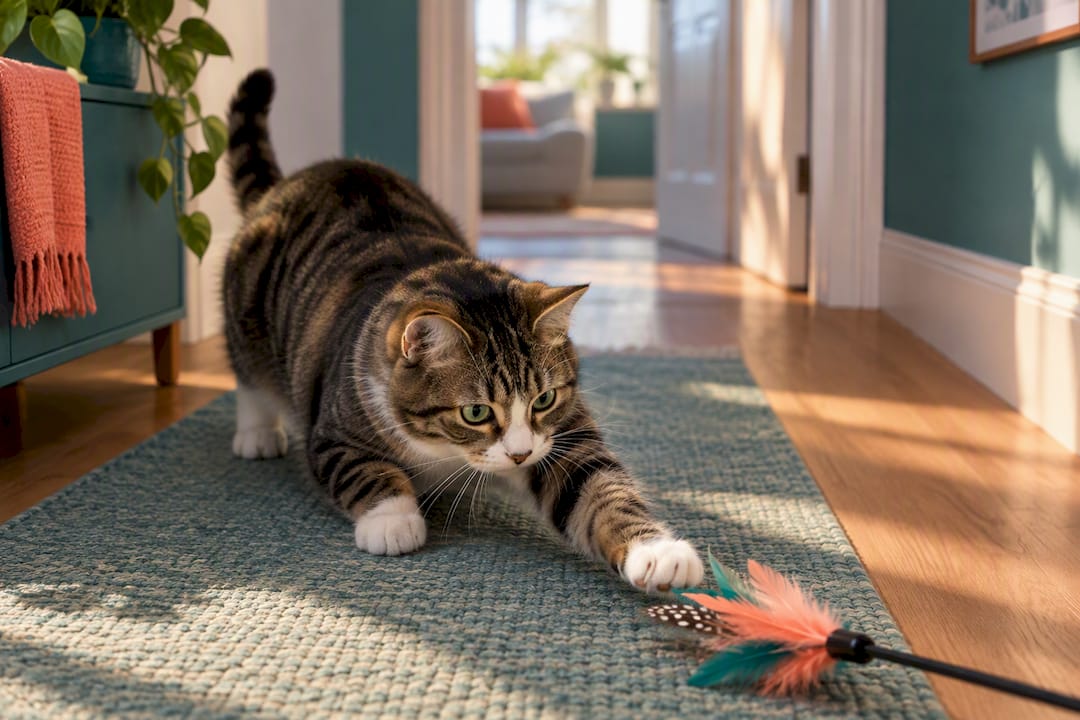
A cat’s play instinct follows a fixed sequence: stalk, chase, pounce, and catch. Skip the “catch” and you leave the cat wound up with nowhere to put that energy, which is a common reason cats zoom around at 2am. Finishing a session with an actual catch, followed by a small meal or treat, taps into the natural hunt-eat-sleep cycle and settles a cat far more reliably than an endless, catch-free chase.
Two sessions a day of 10 to 15 minutes each is the guideline most vets and behaviourists work to, or 15 to 30 minutes total. Kittens usually want more, in shorter, more frequent bursts, since their attention spans are shorter but their energy reserves seem bottomless.
- Move the toy like prey, not like a windscreen wiper: dart, pause, hide behind furniture, then dart again.
- Let your cat win regularly. A predator that never catches anything gives up.
- End on a catch, then offer dinner. That sequence mimics a real kill and helps night-time settling.
- Watch for glazed eyes, dilated pupils or a flicking tail. That is overstimulation, not enjoyment.
Pro Tip: Never leave a wand toy or string lying around unattended between sessions. Cats can swallow string, and it’s one of the more common causes of emergency intestinal surgery in indoor cats. Pack the toy away the moment play ends.
Retire anything with frayed cord, loose feathers, or a cracked handle rather than patching it up. A good interactive wand toy earns its keep over months, not years, and a damaged one is a hazard, not a bargain.
Foraging and puzzle feeders: turning mealtimes into enrichment
Cats are built to hunt for their food, not have it appear in a bowl in four seconds flat. Puzzle feeders replicate that foraging instinct, and the VCA notes that even one puzzle-fed meal a day gives a cat genuine problem-solving work, while stretching a meal that would normally vanish in under a minute into ten or fifteen minutes of engagement.
- Start easy. Choose a feeder with large, obvious openings so your cat succeeds quickly and doesn’t give up before the sofa scratching resumes.
- Increase the challenge gradually. Once your cat is confident, move to smaller openings or a multi-compartment design.
- Try free DIY versions first. Scatter feeding across the kitchen floor, a cut-open egg carton with kibble tucked into the cups, or a toilet-roll tube folded at both ends all work, and low-cost DIY enrichment has been shown to hold a cat’s attention as well as shop-bought versions when it’s rotated.
- Check total calories. A puzzle feeder changes how a cat eats, not how much it should eat. Keep total daily food the same and simply split it across bowl and feeder.
For overweight or fast-eating cats, a slow feeder bowl at breakfast paired with a puzzle feeder at dinner covers both physical pacing and mental stimulation without any extra planning.
Vertical space and window perches: why height matters
Height gives a cat something a flat floor never can: a vantage point where nothing can surprise it. That sense of security lowers baseline stress, and in multi-cat households it gives each cat somewhere to retreat without needing to pass another cat’s territory, which cuts down on the low-level tension that shows up as hissing at doorways or blocked litter trays.
- Cat trees work best against a wall rather than in the middle of a room, so a nervous cat has its back covered.
- Wall-mounted shelves suit small flats where floor space for a tree simply doesn’t exist, and a staggered “climbing wall” of two or three shelves gives most of the benefit of a full tree.
- Window perches placed where birds or passing traffic are visible offer strong passive stimulation for very little effort. A window perch with outdoor activity in view can hold a cat’s attention for long stretches with no owner input at all.
- Check every fixing. A shelf that wobbles under a jumping cat will get avoided fast, and a fall from height can cause real injury.
If you’re short on wall space, a single sturdy cat tree positioned near a window often does the job of three separate pieces of furniture.
Scratching: the right posts, the right places
Scratching is not naughtiness. It stretches the spine and shoulders, conditions the claws by shedding the outer sheath, and leaves scent from glands in the paws, which is a cat’s way of marking territory as safe. Furniture gets scratched when there is no acceptable outlet nearby, not because a cat has decided to be destructive.
The VCA’s guidance is specific: a post needs to be tall enough for a full stretch, with a base sturdy enough that it doesn’t tip mid-scratch, and sisal rope or fabric holds up far better than carpet offcuts.
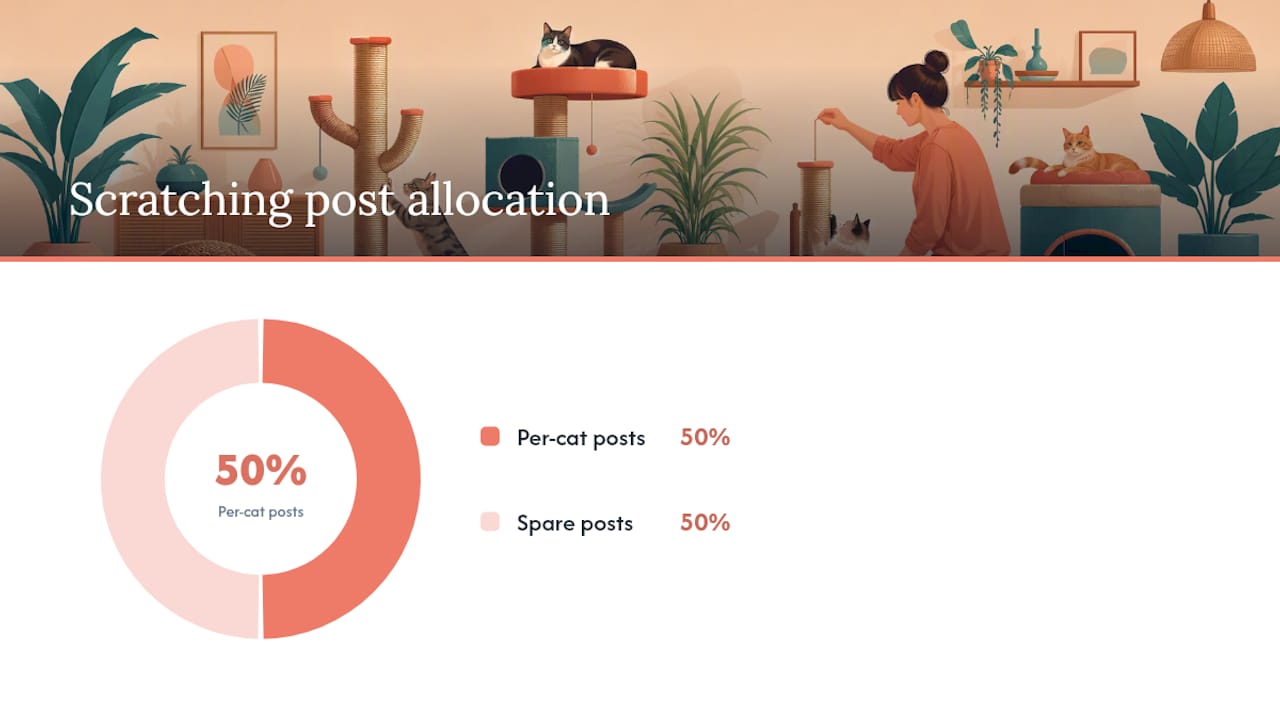
- Provide one scratching post per cat, plus one spare, echoing the same “one resource per cat plus a spare” rule that applies to litter trays and beds.
- Offer both vertical and horizontal options, since some cats strongly prefer one over the other.
- Place posts near sleeping areas and family rooms, not tucked away in a spare bedroom nobody visits.
- If a cat is scratching the sofa arm, put a tall sisal post directly beside it, then gradually move it into position over a week or two.
- Reward any use of the post with a treat or praise in the first few weeks to build the habit.
Pro Tip: If you’re using a calming pheromone spray to ease a scratching transition, spray the new post itself rather than the furniture you want protected. Spraying the sofa can accidentally make it more appealing, not less.
Sensory enrichment: catnip, silvervine, sound and safe smells
Roughly one in three cats doesn’t respond to catnip at all, since sensitivity is genetic. Silvervine works for many of those non-responders and is worth trying as an alternative rather than assuming a cat “doesn’t like enrichment herbs” after one catnip toy falls flat.
- Rotate catnip and silvervine rather than leaving either out permanently. A two to three week rest period between exposures keeps the response strong instead of fading.
- Soft nature or bird-sound playlists can settle an anxious cat during fireworks or building work, though they’re no substitute for the real visual stimulation of a window perch.
- Cat grass and safe herbs like cat thyme give a cat something to chew and forage for, and rotating bedding or blankets between rooms introduces novel scent without any cost at all.
- Never use essential oil diffusers, potpourri, or scented candles around cats. Many essential oils are toxic to them even in small, ambient amounts, and this applies whatever the enrichment goal.
A lick mat smeared with a cat-safe wet food or pâté combines sensory and foraging enrichment in one go, and works well as a calm, low-arousal activity before bedtime rather than after a high-energy play session.
Toys, rotation and novelty: staying interesting without overspending
A toy left on the floor permanently stops being interesting within days. Cats habituate to static objects fast, which is why the same mouse toy that got chased across the kitchen on day one gets ignored by day four.
- Keep a working set of four to six toys and box the rest away completely, out of sight and out of smell.
- Rotate every three to four days. This single habit, more than any individual toy’s price tag, is what keeps engagement high over time.
- Prioritise three categories: a wand toy for supervised hunting play, small prey-sized soft toys for solo batting, and a food-dispensing toy for independent foraging.
- Raid the recycling bin. A plain cardboard box, a paper bag with the handles removed, crumpled paper balls, and a cardboard scratcher cost almost nothing and rival shop-bought puzzles for engagement, according to ASPCA guidance on DIY feline enrichment.
- Retire anything frayed, cracked, or missing small parts. Loose bells, googly eyes and small plastic pieces are choking hazards once a toy starts falling apart.
Daily routine and troubleshooting
A workable day looks something like this: puzzle-fed breakfast, free access to a window perch through the morning, then two evening play sessions bookending dinner, with the second session finishing on a catch right before the food bowl comes out.
- Adults: 15 to 30 minutes of active play total, plus one enriched meal.
- Kittens: shorter, more frequent bursts through the day rather than two long sessions.
- Seniors: gentler movement, lower jumps on cat trees, and puzzle feeders with larger openings if arthritis makes fine paw movements harder.
- Multi-cat homes: play with each cat separately at least once daily, and double up on vertical space and scratching posts to avoid competition.
Boredom and illness can look similar, so it pays to know the difference. A cat that’s simply understimulated tends to overact toys once play resumes and settles well afterwards. Sudden litter tray changes, a drop in appetite, or new over-grooming warrant a vet visit rather than an extra toy, since these can signal pain, stress, or an underlying medical issue rather than plain boredom. A structured daily routine covering 30 to 60 minutes of combined physical, mental and sensory activity is the benchmark many behaviourists work towards, and most cats need nowhere near a full hour to see a real change in settledness.
If a fix is needed fast: add one short extra play session, add a second vertical perch, or duplicate a contested resource such as a food bowl or scratching post. Small adjustments usually beat buying something new.
Giddy pets: practical, vet-approved help for enrichment at home
The cat range follows the same routine-first thinking this article sets out, rather than a random shelf of gadgets. Every enrichment product is accompanied by vet-informed guidance, so a slow feeder or puzzle bowl comes with weight-management and pacing advice, not just a product description.
The categories map directly onto the routine above: slow feeders and puzzle bowls for foraging meals, interactive wand and electronic toys for daily hunt-style play, cat trees and scratchers for vertical territory and claw care combined, and cardboard scratchers for owners who want a low-cost, recyclable option to try first.
If you’re not sure where to start, or your cat’s age or personality doesn’t fit the standard advice, support is available to help you find a personalised starting combination rather than leaving you to guess from a category list.
Why routine beats another trip to the toy aisle
The pattern that shows up again and again in feline behaviour advice is this: consistency outperforms novelty. A cat that gets two proper 10-minute play sessions and one foraging meal every single day, using the same four toys on rotation, tends to settle better than a cat whose owner buys something new every fortnight but plays with them erratically.
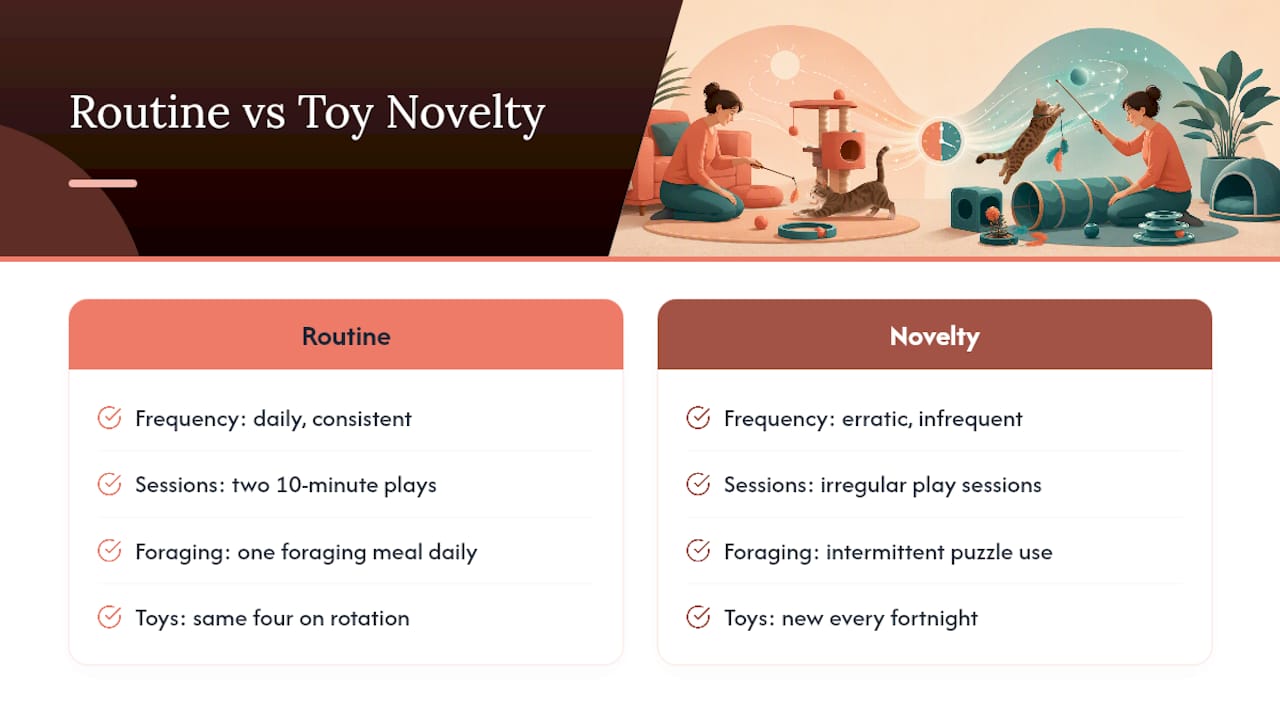
Owners often treat enrichment as a shopping problem. It’s mostly a scheduling problem. The instinct to buy a cleverer puzzle feeder or a taller cat tree is understandable, but a cheap cardboard box used consistently beats an expensive gadget used once and forgotten in a cupboard.
Watch your own cat rather than following a script rigidly. Some cats want two intense sessions and then complete peace; others prefer several short bursts through the day. Adjust the timing, not the underlying principles, and you’ll get further than any single product ever will. If you want more ideas along the way, a community shares what’s actually working for other owners, not just what’s for sale.
— Giddy
Ready to build your cat’s routine? Start with these essentials
The site exists because working out which enrichment products actually earn their place in a busy household shouldn’t take hours of research. Every product recommendation carries vet-informed guidance, and UK orders can arrive fast enough that you’re not left improvising with cardboard boxes for a long time while you wait.
Start with the two categories that matter most based on everything above: a slow feeder or puzzle bowl to turn one meal a day into real foraging enrichment, and an interactive wand toy built to survive daily hunt-style play rather than falling apart within a week. Pair either with a cat tree and scratcher combination if vertical space and scratching outlets are still missing from your setup. Browse the full shop by category, and if you’re unsure what suits your cat’s age or personality, get in touch with the Giddy pets team for a personalised recommendation rather than guessing from a product page alone.
Sources
- Enrichment for indoor cats | VCA Animal Hospitals
- Feline DIY enrichment | ASPCA
- 20+ Indoor cat enrichment ideas that actually work | Indoor Living Cat
FAQ
What can I do to stimulate my indoor cat?
Give your cat two short interactive play sessions a day, one puzzle-fed meal, access to vertical space such as a cat tree or window perch, and at least one sturdy scratching post. Rotating four to six toys every three to four days keeps all of it feeling new.
What is the 3-3-3 rule of cats?
The 3-3-3 rule is usually cited for newly adopted cats settling into a home, not daily enrichment: roughly 3 days to decompress, 3 weeks to learn the routine, and 3 months to feel fully settled. It’s a general guideline rather than a fixed timeline, and some cats adjust faster or slower.
What does cat splooting mean?
Splooting is when a cat lies flat on its stomach with its back legs stretched out behind it, often to cool down or stretch tight muscles after activity. It’s a normal, comfortable posture rather than a sign of anything wrong, and it’s common after a good play session.
How do I make my indoor cat not bored?
Boredom usually comes from a routine that’s too predictable and too passive, so the fix is a mix of hunting-style play, foraging meals, and rotated toys rather than any single product. Giddy pets’ slow feeders and interactive toys are built around exactly that combination if you want a practical starting point.
How much playtime does an indoor cat actually need each day?
Most adult cats do well on 15 to 30 minutes of active interactive play daily, split into two sessions, plus passive stimulation from window perches or puzzle feeders throughout the day. Kittens and very playful cats may want more, in shorter bursts.