


Dog crate size guide: how to measure and buy right
Dog crate size guide: how to measure and buy right
Getting dog crate size right comes down to one simple formula: measure your dog from nose to base of tail, add 2–4 inches (5–10 cm), then measure from the floor to the top of the head (or tallest ear), and add another 2–4 inches. That gives you the minimum interior length and height. Width should be at least enough for your dog to lie on their side with legs extended, generally about half the crate length. RSPCA guidance is clear: a crate must let your dog stand fully upright, turn around comfortably, and lie fully stretched out.
For puppies, buy for the expected adult size and use an adjustable divider panel to reduce the space while they are small. Giddypets stocks a range of dog crates and playpens for UK buyers, including options with divider panels included.
A few red flags to watch for straight away:
- Too small: your dog cannot stand, turn, or stretch without touching the sides or ceiling
- Too large for housetraining: a puppy with too much space will use one corner as a toilet
- Wrong material for chewers: fabric crates are not safe for dogs that chew or scratch persistently
Pro Tip: Always measure your dog rather than relying on breed or weight guides alone. Two Labradors of the same breed can differ by several inches, and PetMD confirms that measurements are the only reliable basis for choosing the right crate.
Key takeaways
The single most reliable rule for choosing a crate: measure your dog’s nose-to-tail length and floor-to-head height, add 5–10 cm to each, and match those figures to a crate’s interior dimensions, not its exterior label.
| Point | Details |
|---|---|
| Measurement formula | Nose to base of tail + 5–10 cm for length; floor to top of head + 5–10 cm for height; check width too. |
| Puppies need a divider | Buy for adult size from day one and use an adjustable divider panel, moving it back every few weeks as your puppy grows. |
| Material matches the dog | Wire for home training and chewers; hard plastic for airline travel; fabric only for calm, trained adults on short trips. |
| Interior dimensions only | Always verify interior length, width, and height on the product page; nominal crate sizes refer to exterior measurements. |
| Giddypets for UK buyers | Giddypets stocks wire crates with divider panels and travel options, with UK delivery and a clear returns policy. |
Table of Contents
- How do you measure your dog for a crate?
- Quick crate size chart: standard lengths in inches and centimetres
- Sizing for puppies: why you should buy for adult size from day one
- Which crate type suits your dog: wire, plastic, or soft-sided?
- What changes when you choose a travel or airline crate?
- A humane crate-training checklist (RSPCA-aligned)
- Where should you place a crate at home, and how do you keep it safe?
- What to check before you buy: a quick buying checklist
- What vets say about crate materials: the evidence behind the advice
- The one thing most crate guides get wrong
- Giddypets has the right crate for your dog, ready to deliver across the UK
- Sources
How do you measure your dog for a crate?
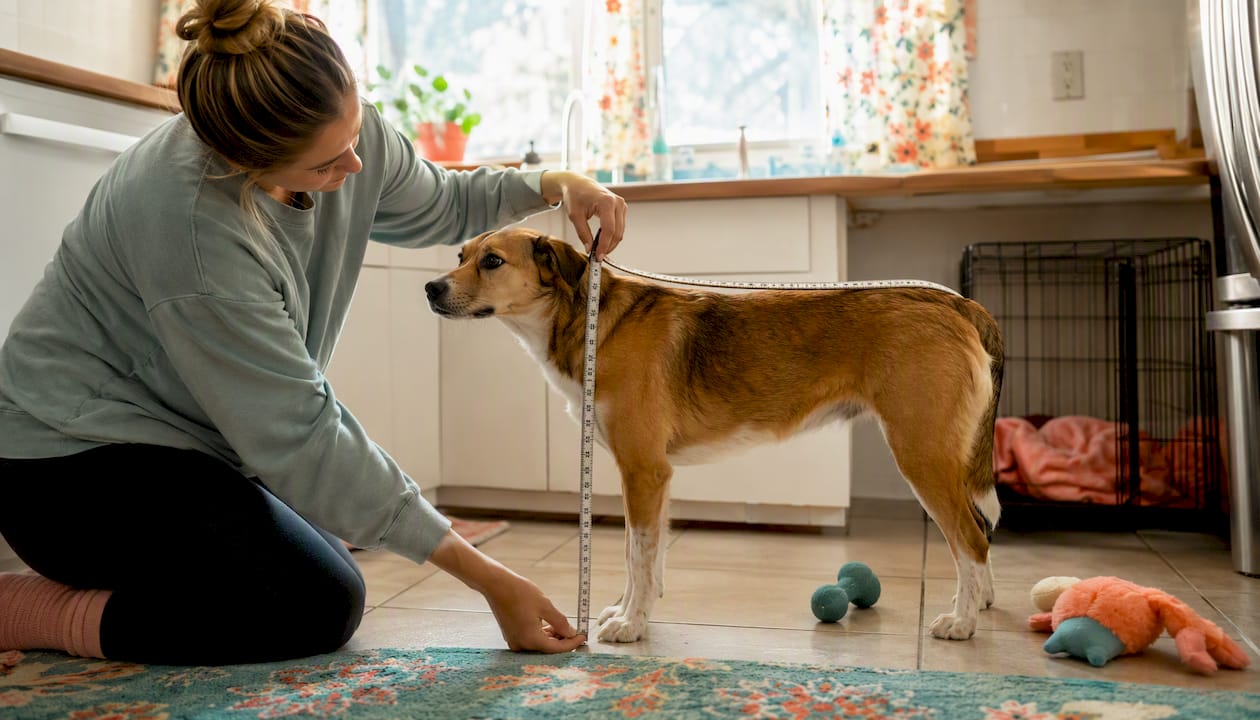
Accurate measurement takes less than five minutes and saves you from a costly return. Here is the step-by-step method, aligned with the approach recommended by PawBench and widely used by vets and retailers.
- Settle your dog on a flat surface. Have them stand naturally on all four paws. A helper is useful here to keep them still and calm.
- Measure length. Run a soft tape measure from the tip of the nose to the base of the tail (not the tip of the tail). Note this figure in centimetres and inches.
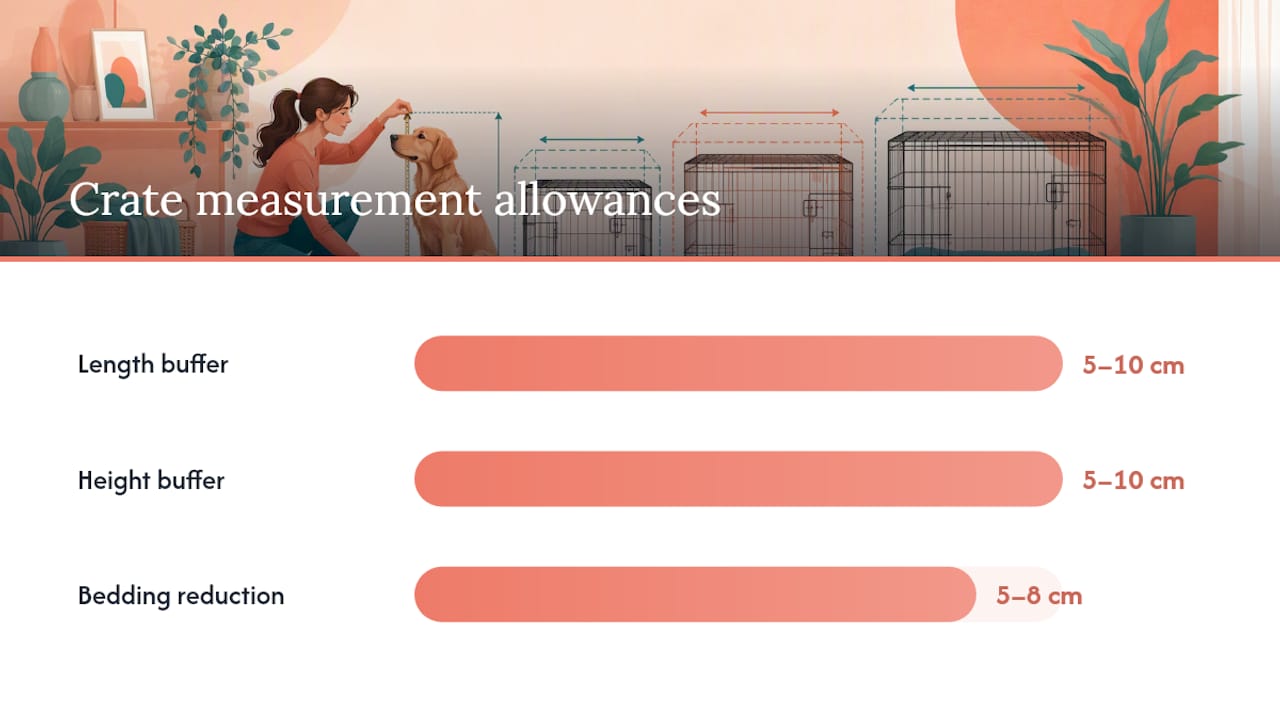
- Add 5–10 cm (2–4 inches) to the length. This buffer gives your dog room to turn around and shift position without feeling cramped.
- Measure height. With your dog standing, measure from the floor to the top of the head. If your dog has upright ears (German Shepherd, Corgi), measure to the tip of the tallest ear instead.
- Add 5–10 cm (2–4 inches) to the height. The RSPCA specifies that a dog must be able to stand fully upright inside the crate without their head touching the roof.
- Measure width. Measure across the widest part of your dog’s body, usually the chest or shoulders. The crate should be wide enough for your dog to lie on their side with legs comfortably extended.
Once you have those three figures, match them to the nearest standard crate size that meets or exceeds all three dimensions.
Practical notes to keep in mind:
- Bedding reduces interior height. A thick orthopaedic mat can take 5–8 cm off the usable headroom, so factor that in before you buy.
- Breeds with unusual proportions need extra care. A Dachshund is long relative to its height; a Greyhound is tall and deep-chested. Always check all three dimensions, not just length.
- Blue Cross advises checking interior dimensions specifically, since nominal crate sizes (e.g. “36 inch”) refer to exterior measurements and the usable interior is always smaller.
Pro Tip: Write your dog’s three measurements on your phone before you shop. Interior dimensions are sometimes buried in product listings, and having your numbers to hand means you can compare quickly without guessing.
Quick crate size chart: standard lengths in inches and centimetres
The table below maps standard crate lengths to typical dog sizes and example breeds. All measurements are interior dimensions; always verify the product listing confirms interior figures before purchasing.
| Crate length (in) | Crate length (cm) | Typical dog weight | Example breeds |
|---|---|---|---|
| 20 in | 51 cm | Up to 5 kg | Chihuahua, Yorkshire Terrier |
| 26 in | 66 cm | 5–10 kg | Pomeranian, Shih Tzu |
| 26 in | 66 cm | 5–15 kg | Cavalier King Charles Spaniel, Miniature Schnauzer |
| 30 in | 81 cm | 15–25 kg | Cocker Spaniel, Whippet, Beagle |
| 36 in | 96 cm | 20–40 kg | Labrador Retriever, Border Collie, Dalmatian |
| 42 in | 112 cm | 35–50 kg | German Shepherd, Golden Retriever, Boxer |
| 48 in | 127 cm | 45–60 kg | Great Dane, Bernese Mountain Dog, Irish Wolfhound |
| 56 in | 142 cm | 65 kg | Giant breeds, extra-large Mastiffs |
A few points worth noting before you use this chart:
- Weight is a guide, not a rule. A lean 30 kg Greyhound may need a longer crate than a stocky 30 kg Bulldog. Always cross-reference with your measured length and height.
- Check interior dimensions on the product page. A “42 inch crate” typically has an interior of around 40–41 inches; the difference matters for larger breeds.
- Metric users: the cm figures above are rounded to the nearest whole centimetre. Pawculate’s sizing calculator notes that some calculators apply a proportional buffer (length × 1.25) rather than a flat addition, which can produce slightly different results for very large or very small dogs. Either method is valid; the key is that your dog’s measured length and height both fit inside the chosen crate with the buffer included.
Sizing for puppies: why you should buy for adult size from day one
The most common and expensive mistake puppy owners make is buying a crate that fits their puppy now. Eight weeks later, the dog has outgrown it. The correct approach is to buy the crate size your dog will need as an adult, then use an adjustable divider panel to section off the right amount of space for their current size.
A divider panel sits across the width of the crate (not the length) and creates a smaller, snug sleeping area. As your puppy grows, you slide the divider back every few weeks to give them more room. This approach keeps housetraining on track because puppies are reluctant to soil the area where they sleep; too much space removes that instinct.
Signs it is time to move the divider back:
- Your puppy can stand, turn, and lie down but has very little room to spare
- They are sleeping pressed against the divider
- Accidents are happening in the far corner of the current space (the space is already too large)
Red-flag situations that need a different response:
- Your puppy is growing faster than expected and is approaching the crate’s maximum interior length. At that point, upgrade to the next size up rather than stretching the divider to its limit.
- Persistent destructive chewing of the divider or crate panels. This is a signal to review the crate material (see the section below on crate types) and consult your vet about anxiety.
- Chronic accidents despite correct divider placement. Rule out a medical cause and revisit your housetraining routine.
Pro Tip: If you are unsure of your puppy’s adult size, ask your vet or breeder for an adult weight estimate, then use that figure alongside your puppy’s current proportions to project the adult length. Most puppies reach close to their adult length before their adult weight.
For owners who want more flexibility during the puppy months, a dog playpen can complement crate training by giving supervised free space without the full run of the house.
Which crate type suits your dog: wire, plastic, or soft-sided?
Crate material is not just a style choice. It affects ventilation, safety, durability, and whether the crate is suitable for travel or airline use. Cornell University’s veterinary guidance is direct on this point: wire and solid crates are preferred for ventilation and durability, while soft-sided fabric crates are suited to short-term travel and are not appropriate for puppies or persistent chewers.
Wire crates
Wire crates offer the best ventilation of any type, with airflow on all four sides. Most come with a removable tray for easy cleaning and, crucially, a divider panel for puppy use. They fold flat for storage. The main drawbacks are weight and noise; some dogs find the open sides unsettling at first, though a crate cover resolves this quickly.
Plastic airline-style crates
Solid-sided plastic crates feel more den-like, which many dogs find calming. They are the standard choice for air travel because they meet IATA structural requirements (more on this below). Ventilation comes through slatted vents on the sides and door, so airflow is more limited than wire. They do not fold flat, which makes storage and transport bulkier.
Soft-sided fabric crates
Lightweight and portable, fabric crates are genuinely useful for calm, settled dogs during short car journeys or camping trips. They are not a safe long-term option for puppies, chewers, or any dog that has not already been fully crate-trained. A determined chewer can be through the mesh in minutes, and the lack of structural rigidity means they offer no meaningful protection in a vehicle collision.
Safety notes that apply to all crate types:
- Check that latches are secure and cannot be nudged open from the inside
- Inspect the floor tray or base for sharp edges, especially on older or second-hand crates
- Ventilation should never be blocked by bedding pushed against the sides
- Fabric crates in warm weather can trap heat quickly; monitor your dog’s comfort closely
Pro Tip: For a dog that is anxious in an open wire crate, drape a breathable blanket over the top and three sides rather than buying a solid-sided crate. You get the ventilation of wire with the den-like feel of plastic, at no extra cost.
What changes when you choose a travel or airline crate?
A crate for home use and a crate for travel serve the same basic purpose but have meaningfully different requirements. Getting this wrong can mean your dog is refused at check-in or is unsafe in the car.
For car travel, the key differences are:
- The crate must be secured so it cannot slide or tip in braking or a corner. A loose crate in the boot is a hazard to your dog and to you.
- Position matters: the boot of an estate or hatchback is the safest location. Avoid placing a crate on a rear seat without a proper restraint system.
- Ventilation is more critical in a car than at home. Parked cars heat up rapidly, and even a well-ventilated crate offers no protection if the car is left in sun.
- Bring a portable water bottle and plan comfort stops every two hours on longer journeys.
For car travel where a full crate is impractical, dog car seats and travel restraints are a complementary option for smaller dogs.
For air travel, follow these steps:
- Check the specific airline’s pet policy before booking. IATA (International Air Transport Association) publishes live animal regulations, but individual airlines set their own size limits and breed restrictions on top of those.
- Measure your dog using the standard method above, then check the airline’s maximum crate dimensions. Most airlines require the dog to stand, turn, and lie down inside the crate with the door closed.
- Choose a hard-sided plastic crate with a secure metal door, ventilation on at least three sides, and no wheels (most airlines require wheels to be removed or crates to be wheel-free).
- Line the base with absorbent bedding. Puppy pads work well for longer flights.
- Attach water and food dishes to the inside of the door so airline staff can access them without opening the crate.
- Label the crate clearly with your contact details, destination, and the dog’s name.
Pro Tip: Book a practice session at home before any flight. Put your dog in the travel crate for a few hours on several days running, so the crate feels familiar rather than alarming on travel day.
A humane crate-training checklist (RSPCA-aligned)
A crate is only as good as the training behind it. Used well, it becomes a calm retreat your dog chooses voluntarily. Used poorly, it causes anxiety and erodes trust. The RSPCA frames the crate as a safe haven and stresses that humane training and age-appropriate confinement times are non-negotiable.
- Introduce the crate gradually. Place it in a quiet corner with the door open and let your dog explore at their own pace. Do not push them inside.
- Use positive reinforcement from the start. Toss treats or a favourite toy inside. Feed meals near the crate, then eventually inside it.
- Build duration slowly. Start with the door closed for 30 seconds while you stay in the room. Increase to a few minutes, then longer, over several days.
- Never use the crate as punishment. Sending a dog to their crate when you are angry teaches them to associate it with distress.
- Match confinement time to age and bladder control. A young puppy cannot hold their bladder for more than a couple of hours. Adult dogs can manage longer, but extended confinement every day is not appropriate for any dog.
- Provide enrichment. A stuffable toy filled with a small amount of food gives your dog something positive to focus on when the door closes.
Key safety rules:
- Never leave a dog crated for the majority of the day on a regular basis
- Remove collars and harnesses before crating to prevent snagging
- Always ensure fresh water is accessible, especially for longer periods
If your dog is showing signs of distress (excessive barking, destructive behaviour, or toileting despite correct sizing), revisit the training steps and speak to your vet or a qualified behaviourist.
Where should you place a crate at home, and how do you keep it safe?
Placement and setup have a bigger effect on your dog’s comfort than most owners expect. A well-sized crate in the wrong spot can still cause stress.
Placement guidance:
- Choose a spot that is part of the household’s activity without being in the middle of heavy foot traffic. Most dogs settle best where they can see and hear the family without being constantly disturbed.
- Avoid direct sunlight, draughts, and proximity to radiators. Temperature extremes are uncomfortable and, in summer, genuinely dangerous.
- Keep the crate on a stable, flat surface. A crate that rocks or slides when your dog moves inside will unsettle them quickly.
Bedding and ventilation:
- Use bedding that fits the crate floor without bunching up against the sides, which can restrict airflow. For wire crates, this is rarely an issue; for plastic crates with limited vents, keep bedding away from the side panels.
- Thick orthopaedic mats reduce interior height. If your dog is close to the maximum height for their crate, choose a thinner mat or measure with the mat in place. Large dog beds designed for crate use are worth checking for breeds where headroom is tight.
- Blue Cross specifically highlights the importance of checking interior dimensions rather than trusting nominal size labels, and the same logic applies to bedding: measure the mat’s compressed thickness, not just its listed depth.
Cleaning and safety inspection checklist:
- Check latches weekly. A latch that sticks or can be nudged open is a safety risk.
- Inspect panels and welds for chew damage or sharp edges, particularly on wire crates used by puppies.
- Wash removable trays and fabric liners regularly. A clean crate is more inviting and reduces the risk of skin irritation.
Pro Tip: Place a worn T-shirt or a small piece of your bedding inside the crate when you first introduce it. Your scent is genuinely calming for most dogs and makes the space feel safe from day one.
What to check before you buy: a quick buying checklist
Whether you are shopping online or in a pet shop, these are the points to confirm before you commit.
Must-check specs:
- Interior length, width, and height (not exterior). If the listing only shows exterior dimensions, contact the retailer or look for a different product.
- Divider panel included (or available separately). Confirm it fits across the width of the crate and is adjustable.
- Material and latch type. Wire for home training and ventilation; plastic for airline travel; fabric for short-term travel with a calm, trained dog only.
- Weight capacity. Some crates list a maximum dog weight. Check this against your dog’s current or expected adult weight.
- Foldability. If storage or transport is a priority, confirm the crate folds flat and that the folded dimensions fit your car boot or storage space.
- Returns policy. A crate is a significant purchase. Check the retailer’s return window before buying.
Red flags to walk away from:
- Only exterior dimensions listed with no interior figures available
- No interior height measurement given (common with cheaper listings)
- A fabric crate recommended for a puppy or a chewer
- No information on latch type or structural material
Pro Tip: Before ordering online, measure your doorways and the route from your front door to where the crate will live. A 48-inch crate assembled is wider than most interior doorframes, and some need to be partially assembled in the room where they will be used.
What vets say about crate materials: the evidence behind the advice
The question of which crate material to choose is not just a matter of preference. Veterinary guidance from Cornell University’s College of Veterinary Medicine makes the case clearly:
Wire and solid crates are preferred for their ventilation and durability. Soft-sided fabric crates are best suited to short-term travel and are not recommended for puppies or dogs that chew persistently, as they offer insufficient structural integrity and can be breached quickly.
This matters practically because many owners choose fabric crates for their appearance or price point, then find themselves dealing with an escaped or injured dog. The structural difference between a wire crate and a fabric one is not subtle.
Practical recommendations based on this guidance:
- Puppies: choose a wire crate with a divider panel. The ventilation supports healthy airflow, and the divider gives you full control over usable space as they grow.
- Chewers: wire or robust hard plastic only. Inspect welds and panel joins regularly for damage.
- Calm, trained adult dogs travelling short distances: a fabric crate is acceptable, but supervise closely and never leave the dog unattended in one.
- Airline travel: hard-sided plastic with IATA-compliant ventilation and a secure metal door.
UK buyers can browse Giddypets’ dog crate and cage range to find wire and solid options with divider panels, suitable for both home training and travel use.
The one thing most crate guides get wrong
Most crate guides lead with breed charts. Pick your breed, find the recommended size, buy that crate. It feels simple, and it is almost always slightly wrong.
Breed charts are averages. Your dog is not average. Two Cocker Spaniels from the same litter can differ by 8 cm in body length, and a rescue dog of unknown parentage has no breed chart at all. The measurement method described in this guide exists precisely because it accounts for the actual dog in front of you, not a statistical midpoint.
There is a second problem with breed-first thinking: it encourages owners to skip the width measurement entirely. Length and height get all the attention, but a dog that cannot lie on their side with legs extended is not comfortable, even if they can stand and turn. Width is the forgotten dimension, and it is the one most likely to be undersized in cheaper crates marketed to a specific breed.
The other piece of conventional advice that deserves scrutiny is the idea that a larger crate is always kinder. For housetraining, it is actively counterproductive. A puppy with too much space will simply designate a toilet corner and sleep at the other end. The divider panel is not a compromise; it is the correct tool for the job. Kindness during the puppy stage means snug and secure, not spacious.
Giddypets has the right crate for your dog, ready to deliver across the UK
Finding the right crate is straightforward once you have your measurements. The harder part is finding a UK retailer with the right size, a divider panel included, and a returns policy you can trust if the dimensions turn out to be slightly off.

Giddypets’ dog crate and cage range covers sizes from small breeds up to large and giant dogs, with wire options that include adjustable divider panels for puppies. All orders are delivered to UK addresses, and the returns process is straightforward if your first choice does not fit. For travel, the carriers and crates section includes options suited to car journeys and short trips. Measure your dog today using the formula in this guide, then check the interior dimensions on the product page before adding to your basket.
Sources
- How to crate train a puppy | RSPCA
- Dog crates: when to use them and how to pick one | Cornell University
- Crate sizing for dogs: How to pick the right one | PetMD
- How to Choose the Right Dog Crate Size | PawBench
- Dog crate size calculator — Pawculate