





Measure First: Dog Bed Size for UK Owners (Add 10–30cm)
Measure First: Dog Bed Size for UK Owners (Add 10–30cm)
Measure your dog from the tip of their nose to the base of their tail while they lie in their normal sleeping position, then add a suitable allowance depending on whether they sprawl out or curl up tight. That figure, not the size label on the packaging, is what actually matters. Check it against the bed’s internal sleeping area rather than its outer footprint. Below you’ll find the exact steps, a quick size chart, and a pre-purchase checklist.
TL;DR:
- Measure your dog lying in their natural sleep position from nose to tail base and add 15 to 30cm if they sprawl or curl up tightly.
- Always compare measurements against the bed’s internal sleeping area, not external dimensions, to ensure proper fit.
- For sleep style, sprawlers need more length and width, while snug curlers benefit from raised bolsters and a tighter allowance.
- Size guides based on breed and weight are rough estimates; the actual measurement is more reliable, especially for active or flexible dogs.
- Prioritize the internal sleeping space over breed labels or size names, and include allowances for seasonal or mood-based changes in sleep postures.
Table of Contents
- How do I measure my dog for a bed?
- Dog bed size chart by weight and breed
- Does my dog’s sleeping style change the size I need?
- What size and features suit senior or arthritic dogs?
- How do you size a donut or bolster dog bed?
- What are the most common dog bed sizing mistakes?
- Why trust this dog bed size guidance?
- Our take: measure first, worry about breed labels second
- Ready to shop by size, not guesswork
- Sources
How do I measure my dog for a bed?
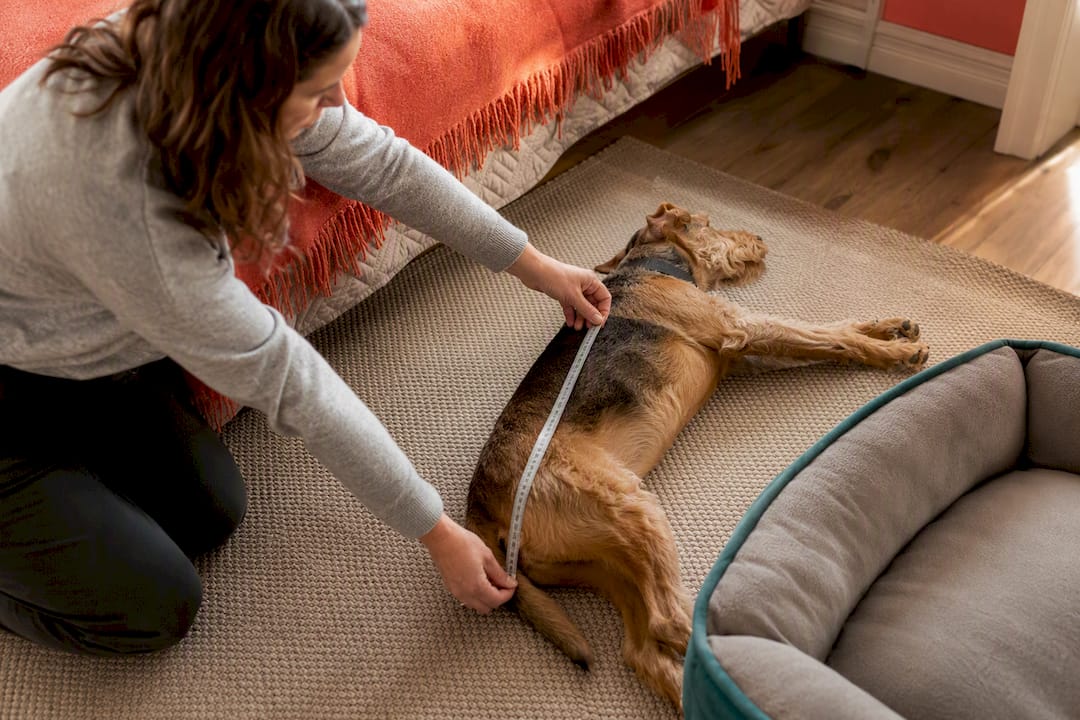
The biggest sizing mistake happens before you even open a tape measure: measuring a standing dog. A dog stood upright has a shorter, more compact body line than one relaxed and stretched out, which is exactly the position they’ll be sleeping in. Measure your dog while they’re lying stretched out in their favourite resting spot, ideally when they’re drowsy and unlikely to shift about.
Here’s the method that gives you a reliable, repeatable number:
- Wait for a calm moment. Catch your dog mid-nap or settled after a walk, when they’re naturally relaxed rather than alert and fidgeting.
- Measure length first. Run a soft tape measure from the tip of the nose to the base of the tail, where the tail meets the body. Don’t include the tail itself.
- Measure width or curl diameter. For a dog lying flat, measure across the widest point of the body. For a dog curled into a ball, measure the diameter of that curled shape.
- Add your allowance. Add 15 to 30cm for dogs who sprawl and stretch, or 10 to 15cm for dogs who curl tight, giving them room to shift position without spilling off the edge.
- Photograph the tape measure against your dog before you put it away. It’s a small habit that saves a return trip to the loft for the tape when you’re comparing three different bed listings online.
A helper makes this far easier with a wriggly or excitable dog, one person holding the tape steady while the other keeps the dog calm. Measuring inside an open crate can also help settle a nervous dog long enough to get an accurate read.
Once you have your number, compare it against the interior sleeping area listed on the product page, not the bed’s overall external dimensions, which usually include a raised rim or bolster that eats into usable space.
Dog bed size chart by weight and breed
Breed and weight bands give you a useful starting point if measuring feels like a two-person job you can’t organise this week. Just treat these as rough guidance, not gospel. Bed height at the withers tells you almost nothing useful for sizing a bed; body length lying down is what counts.
- Extra small (up to 4.5kg): nose to tail typically 30 to 40cm. Suits Chihuahuas, Yorkshire Terriers, and Toy Poodles. Look for an interior sleeping area of at least 45 x 45cm.
- Small (4.5 to 10kg): nose to tail roughly 40 to 55cm. Suits Dachshunds, Pugs, and French Bulldogs. Interior area of around 60 x 45cm is a sensible minimum.
- Medium (10 to 25kg): nose to tail around 55 to 75cm. Suits Cocker Spaniels, Border Collies, and Staffordshire Bull Terriers. Look for at least 75 x 60cm.
- Large (25 to 40kg): nose to tail roughly 75 to 95cm. Suits Labradors, German Shepherds, and Boxers. Interior area of 100 x 70cm or more works well.
- Giant (40kg and above): nose to tail 95cm plus. Suits Great Danes, Newfoundlands, and Mastiffs. You’re looking at 120 x 80cm interior space as a baseline, often more.
Size names like “large” and “extra-large” aren’t standardised across manufacturers, so one brand’s large can be another’s medium. Always cross-check the centimetre figures on the listing against your own measurement rather than trusting the label alone.
Does my dog’s sleeping style change the size I need?
It changes it considerably, and this is where most bed-buying advice falls short by focusing purely on breed weight. A sprawler, the dog who stretches flat with legs splayed, needs generous length and width, with that fuller 15 to 30cm allowance applied on both dimensions. A curler, who tucks into a tight ball, needs a smaller footprint but benefits from raised bolster sides to lean against, with a tighter 10 to 15cm allowance on the curled diameter. Plenty of dogs switch between the two depending on the season or their mood, in which case size for the sprawl, since a bed that’s too small for a stretch is far more of a problem than one that’s slightly roomy for a curl.
A few scenario-specific pointers worth keeping in mind:
- Two dogs sharing a bed: measure both dogs stretched out side by side and buy one bed sized for the pair, rather than two beds each individually undersized.
- Beds inside crates: measure the crate’s interior floor space first, and never squeeze in a bed that forces your dog to curl up smaller than they’d choose to naturally.
- Long-backed breeds like Dachshunds should have length prioritised over width.
- Heavy or arthritic dogs need mattress thickness prioritised over exact shape.
What size and features suit senior or arthritic dogs?
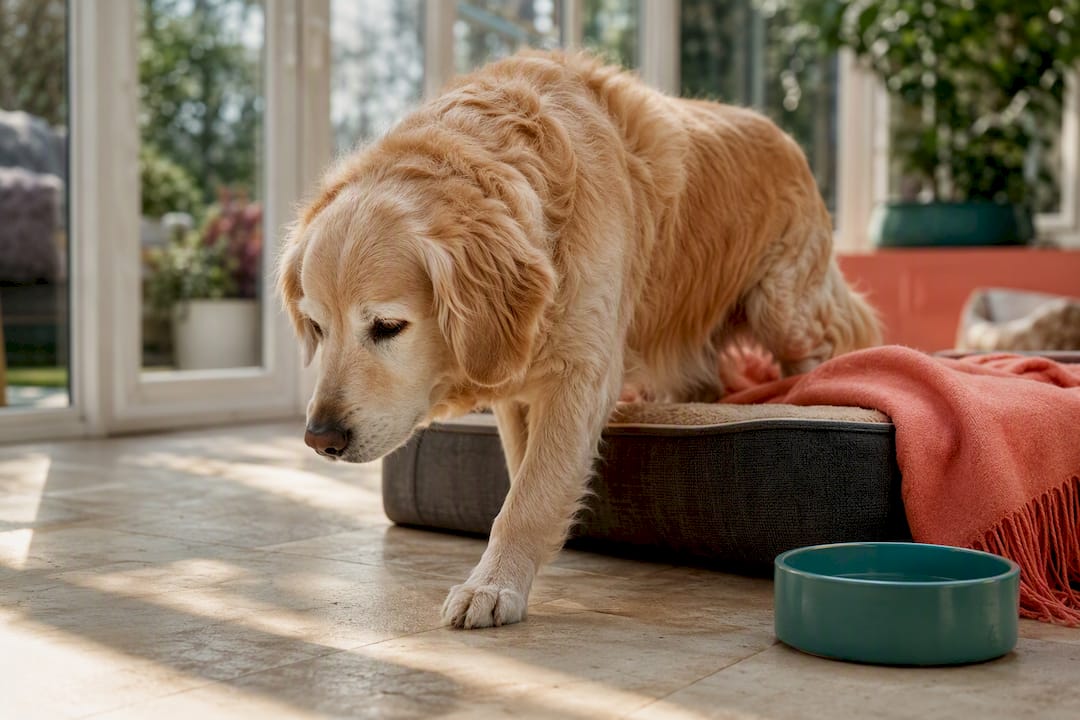
Older dogs generally need more room, not less, along with support that younger dogs can comfortably do without. A stiff-jointed dog struggles to reposition on a cramped surface, so size up from your measured figure where you can, and pair that extra space with a low entry edge that doesn’t demand a jump or awkward step over a raised rim.
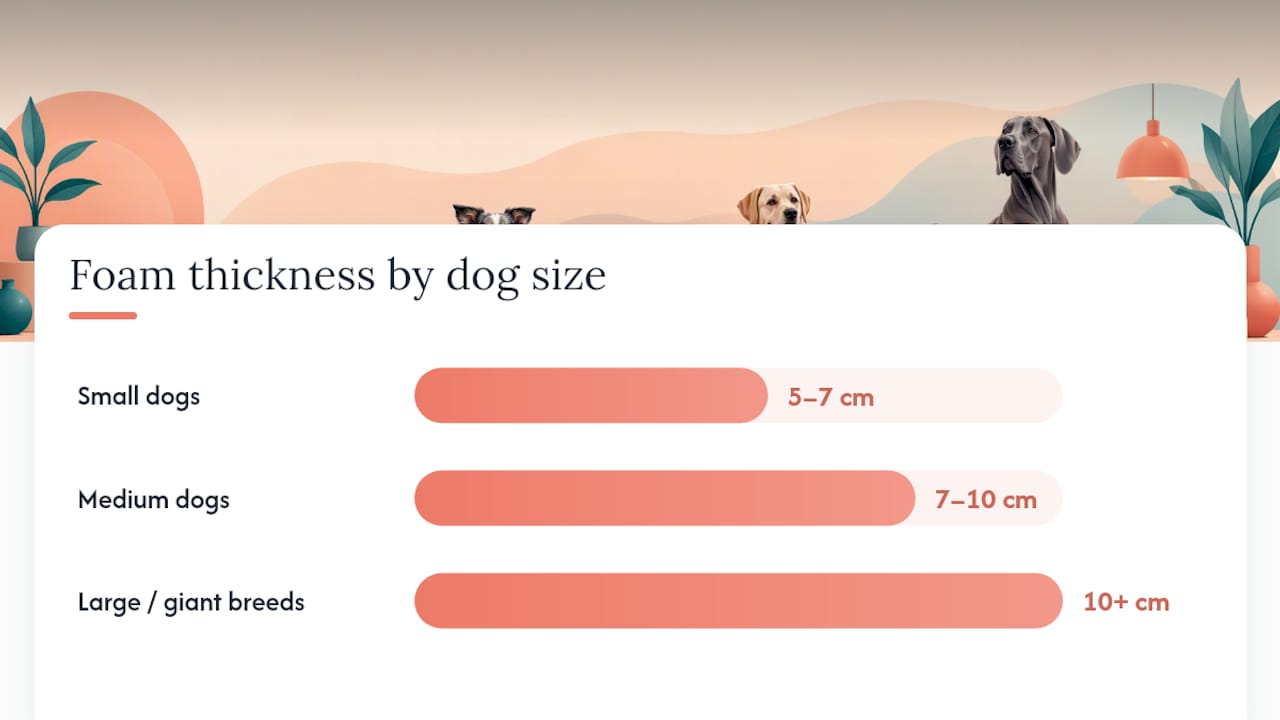
Recommended foam thickness for orthopaedic beds rises with the dog’s weight: as a rough guide, small dogs generally do fine with 5 to 7cm of supportive foam, medium dogs benefit from 7 to 10cm, and large or giant breeds often need 10cm or more to properly cushion hips and elbows. This thickness guidance comes from bed manufacturers’ own practical testing rather than a formal veterinary standard, so treat it as a sensible starting point rather than a fixed rule.
The RSPCA’s guidance on choosing a dog bed is clear that dogs need enough space to stretch out or curl up comfortably, wherever they’re placed in the home. For dogs with diagnosed arthritis or joint pain, it’s worth asking your vet whether a specific orthopaedic or memory-foam construction suits their condition, since supportive fill often matters more than getting the exact shape spot on.
An orthopaedic dog bed built with proper memory foam and a low-entry design tends to serve senior dogs better than a standard cushion bed sized up alone.
How do you size a donut or bolster dog bed?
Donut beds, snugglers, and bolster-sided beds work differently from flat mattresses because the raised rim is part of the design, not wasted space. Size these against the curled diameter you measured, plus a smaller allowance of 10 to 15cm, so your dog can settle inside without their nose or paws hanging over the edge.
- Match the bed’s internal circular sleeping area to your curled measurement plus allowance, ignoring the outer diameter that includes the bolster.
- Going too large backfires with anxious or small curlers, who often feel more secure pressed against a snug bolster than adrift in the middle of an oversized cushion.
- Check both the internal and external measurements on the product listing before buying; retailers list both, but the internal figure is the one that decides fit.
A well-sized donut dog bed gives an anxious curler that pressed-in, secure feeling that a flat mattress simply can’t replicate.
What are the most common dog bed sizing mistakes?
Getting the size wrong is the single most frequent complaint in dog bed reviews, and it’s almost always a case of under-sizing rather than over-sizing.
- Measuring a standing dog instead of one lying relaxed, which shortens the reading.
- Trusting the size name alone (“large”, “extra-large”) without checking the actual centimetre dimensions.
- Ignoring sleep style, buying a snug curler-style bed for a dog who actually sprawls flat most nights.
- Underestimating puppy growth, buying to fit a puppy’s current size rather than their expected adult length.
Before you check out, run through this: measure your dog lying down, compare that figure to the bed’s internal sleeping area, size up if you’re between two bands, and check the return policy in case the fit’s still off. Photograph your tape measure reading and keep it on your phone. Keep the original packaging until you’re confident the size works, since most retailers ask for it with a return.
Pro Tip: If your dog is between two size bands, size up rather than down. A bed that’s slightly too roomy costs you nothing in comfort; one that’s too small gets abandoned in favour of the sofa.
Why trust this dog bed size guidance?
Giddy Pets stocks beds across every size band, from compact curler cushions to large dog beds built for giant breeds, alongside orthopaedic and donut ranges designed around exactly the sizing principles set out here. The measuring method above lines up with RSPCA guidance that dogs need enough room to stretch out or curl up freely, and it reflects standard practice recommended across pet-care charities more widely.
Giddy Pets combines vet-approved product information with tailored pet profiles, so the sizing advice you read here is the same logic built into the recommendations on the shop itself.
Our take: measure first, worry about breed labels second
Breed charts are comforting because they feel authoritative, a neat table that promises to do the thinking for you. They’re also the reason so many dogs end up on beds that are technically “the right size for a Labrador” and still too small for that particular Labrador, who happens to sprawl like a starfish every night.
The conventional advice treats breed and weight as the starting point and measuring as an optional extra for the fussy. We’d flip that entirely. Weight bands are a fallback for when you can’t get a tape measure near your dog; the measurement, taken lying down, is the actual answer. Sleep style deserves far more weight in the buying decision than it currently gets, because a sprawler and a curler of identical weight need meaningfully different beds.
If you take one thing from this guide, prioritise the internal sleeping area over every other number on the listing. Everything else, the bolster height, the outer footprint, the fabric, is secondary to whether your dog’s actual measured body fits inside that space with room to move.
— Giddy
Ready to shop by size, not guesswork
Giddy Pets makes it straightforward to shop by the numbers you’ve just measured rather than squinting at vague size labels. Whether that’s a large dog bed for a sprawling Labrador, an orthopaedic bed for a stiff-jointed senior, or a donut bed for a tight curler who likes to feel held, every category is built around the same measure-first logic covered above.

Before you buy, run through the quick checklist one more time: measure lying down, add your allowance, then check the interior sleeping area against your figure rather than the label. If you’re also stocking up for a growing puppy, the the Puppy Waste Bag range from ZERO is worth adding to your basket while you’re there. Head to the full range of dog beds at Giddy Pets and pick the size that actually matches your dog, not just their breed.
Sources
- Dog bed size guide: How to measure by breed
- Choosing the perfect dog bed
- Orthopedic dog bed size chart: By weight, breed, and sleeping style
- Dog bed buying guide: How to choose the right bed for your pup