






Two Week Day by Day Crate Training for First Time Puppy Owners
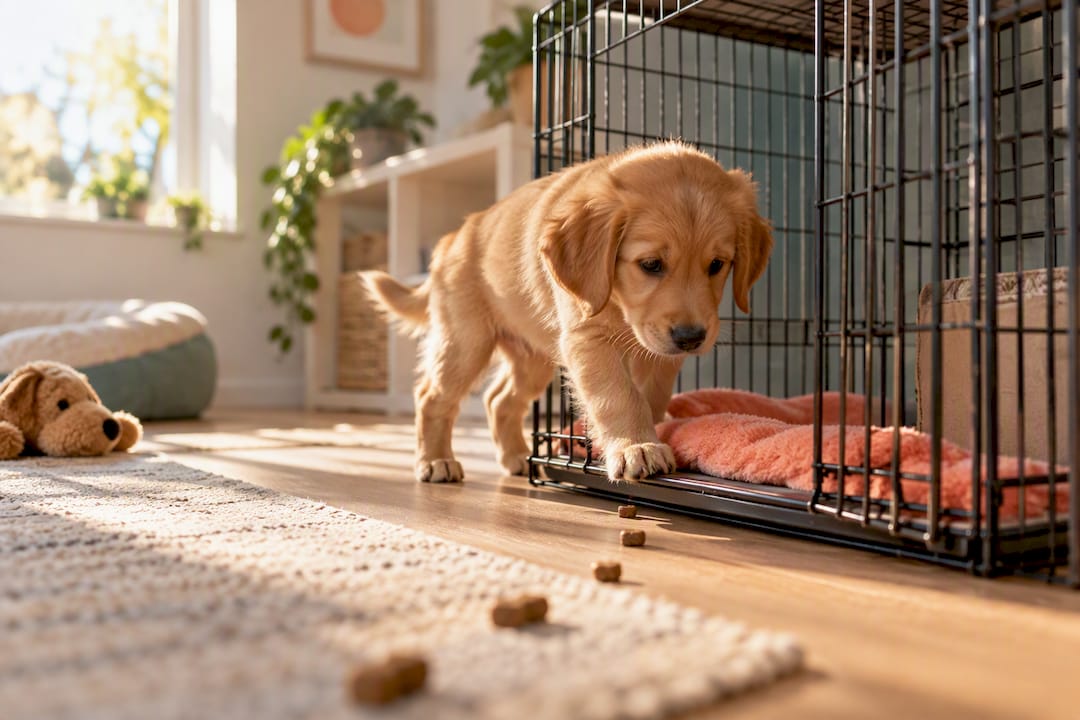
Yes, crate training is safe and effective when you introduce it with short, reward-based sessions rather than shutting the door and hoping for the best. Start today by setting the crate up as a cosy, open-door treat zone and letting your puppy wander in and out on their own terms. Most puppies settle within a week or two, though some need longer. Begin from around eight weeks old, always respecting age-based bladder limits.
TL;DR:
- Proper crate size, positioning, and a gradual, positive introduction are essential to avoid setbacks and foster a positive association for your puppy.
- Puppies can generally hold their bladder for about their age in months plus one hour during the day, but never more than eight hours, even for older dogs.
- It takes most puppies between one week and several months to become reliably comfortable in a crate, depending on individual progress and patience.
- Whining in the crate can be either need-based or protest, so wait for calm moments before rewarding to prevent reinforcing unwanted behaviors.
- Transition to less crating should be gradual, with house training and calm behavior establishing the puppy’s readiness for increased independence.
Table of Contents
- What is crate training a puppy and why does it help?
- What you need before you start crate training
- How do I crate train my puppy step by step?
- How long can you crate a puppy at each age?
- How do I stop my puppy crying in the crate?
- When can you stop crating a puppy?
- Giddy Pets resources for crate training success
- A word for first-time owners feeling stuck
- Kit that makes crate training easier
- Sources
- FAQ
What is crate training a puppy and why does it help?
A crate is not a cage for storing your puppy while you get on with life. Done properly, it becomes a den, a safe, enclosed space your puppy chooses to retreat to when the world feels a bit much. Dogs are naturally drawn to small, secure spots to rest, which is why crate training taps into an instinct rather than fighting one.
The practical upsides stack up quickly once you start using a crate properly:
- House-training support: puppies rarely soil the space they sleep in, so a correctly sized crate speeds up toilet training.
- Safety net: a crated puppy cannot chew through electrical cables or swallow something dangerous while you nap or shower.
- Travel and recovery: a puppy already comfortable in a crate settles faster in the car, at the vet, or during post-surgery rest.
- Calmer sleep: many puppies sleep more deeply in an enclosed space than sprawled in an open room.
There’s one rule that overrides everything else here: never use the crate as punishment. The moment a crate becomes where the “naughty” puppy gets sent, it stops being a safe den and starts being something to fear and resist.
What you need before you start crate training
Get the setup right first, and the training itself gets far easier. Rushing this stage with the wrong crate or a chaotic first session is one of the most common reasons owners hit early setbacks.
The core kit list is short:
- A correctly sized crate with a divider panel, so you can shrink the space for a young puppy and expand it as they grow, rather than buying multiple crates.
- Washable bedding that can survive an accident and a hot wash without falling apart.
- Safe, stuffable chew toys to occupy your puppy during closed-door sessions.
- Small, high-value treats kept purely for crate sessions, so they carry extra novelty.
- No collar while your puppy is in the crate. Tags and collar buckles can catch on wire mesh, which is a genuine strangulation risk.
Placement matters more than most owners expect. Put the crate in a family area during the day, somewhere your puppy can still see and hear you, and move it beside your bed at night for the first week or two. Total isolation at this stage often causes more distress than it solves.
Pro Tip: Buy the crate divider panel even if your puppy looks tiny in the full-size crate. A crate that’s too large lets your puppy toilet in one corner and sleep in the other, which quietly undoes your house-training progress.
A crate sizing guide is worth checking before you buy, since the right dimensions depend on your puppy’s expected adult size, not just their current size.
How do I crate train my puppy step by step?
This is the part most guides rush. A phased, calm-only progression, where you only advance once your puppy is relaxed at the current step, reliably builds a positive crate association without the tears (yours or theirs). Here’s a realistic two-week structure.
Days 1 to 2: door tied back, treats everywhere
Prop the crate door fully open so it cannot swing shut and startle your puppy. Scatter treats just inside the entrance, then a little further in each time, letting your puppy choose to walk in. Keep sessions to a few minutes, several times a day. No door closing yet. No pressure. This is purely “the crate equals good things happen here.”
Days 3 to 4: meals move inside
Start feeding full meals inside the crate with the door still open. Once your puppy eats calmly, introduce a cue word (“crate” or “bed”) as they walk in, said in the same warm, neutral tone every time. Towards the end of day four, try closing the door for a few seconds while they finish eating, then open it again before they notice much.
Days 5 to 7: the door starts to matter
Close the door for slightly longer while you sit nearby with a book or your phone. Give your puppy a stuffed chew toy to work on. If they’re calm, extend the duration in small increments. According to training guidance from the American Kennel Club, it helps to move the door only an inch or two at a time rather than swinging it fully shut in one motion, so a sudden clunk never spooks your puppy mid-session. Only latch the door once your puppy is genuinely unbothered by it moving.
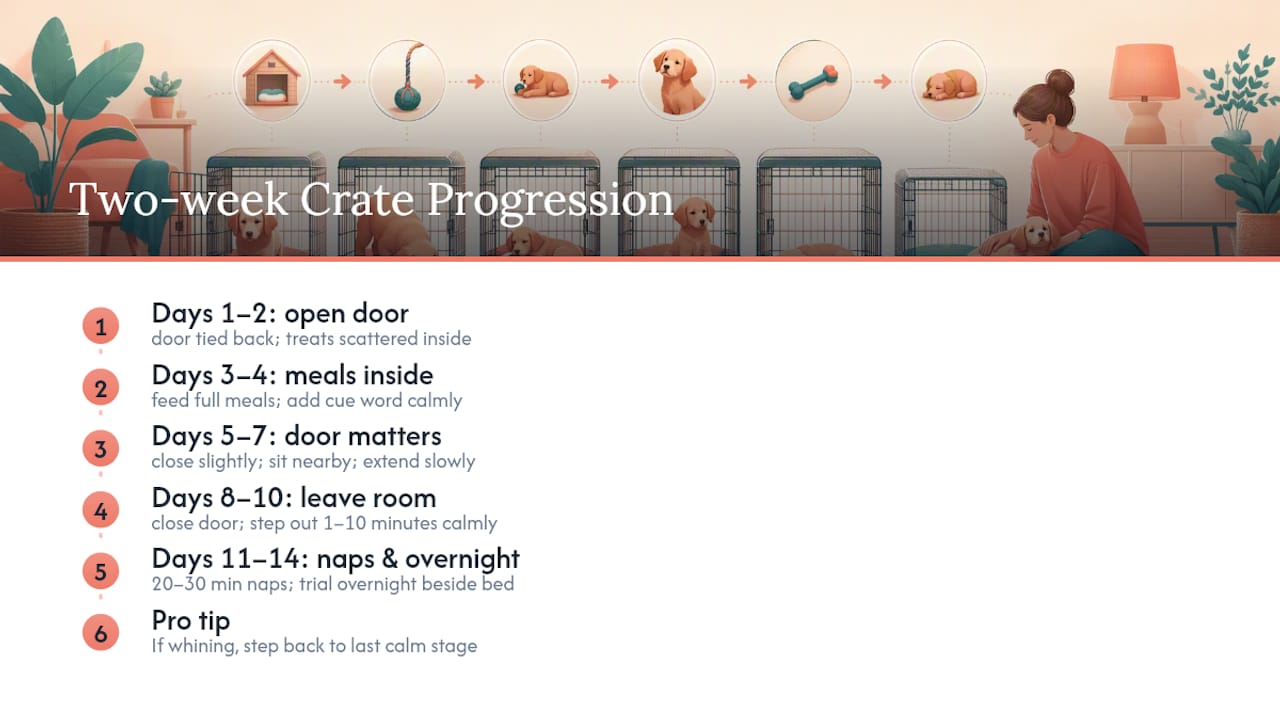
Days 8 to 10: you leave the room
Give a busy chew, close the door, and step out of the room for one minute. If your puppy stays settled, stretch this to five, then ten minutes across the following sessions. Return calmly and quietly. No big fuss, no dramatic “well done!” outburst. Calm departures and calm returns teach your puppy that nothing exciting or scary happens either way.
Days 11 to 14: naps and the first overnight stretch
Extend daytime sessions to 20 or 30 minutes, timed around your puppy’s natural nap windows after play or feeding. Begin using the crate overnight, positioned beside your bed, expecting at least one toilet break for very young puppies during the night.
Pro Tip: If whining or scratching shows up at any point, don’t push through it. Go back to the last duration where your puppy was calm and rebuild from there. Rushing the ladder is the single biggest reason crate training stalls.
Past day 14, keep extending duration gradually and start practising crating at different times of day, not just bedtime, so the crate becomes a normal part of the routine rather than a night-only ritual.
How long can you crate a puppy at each age?
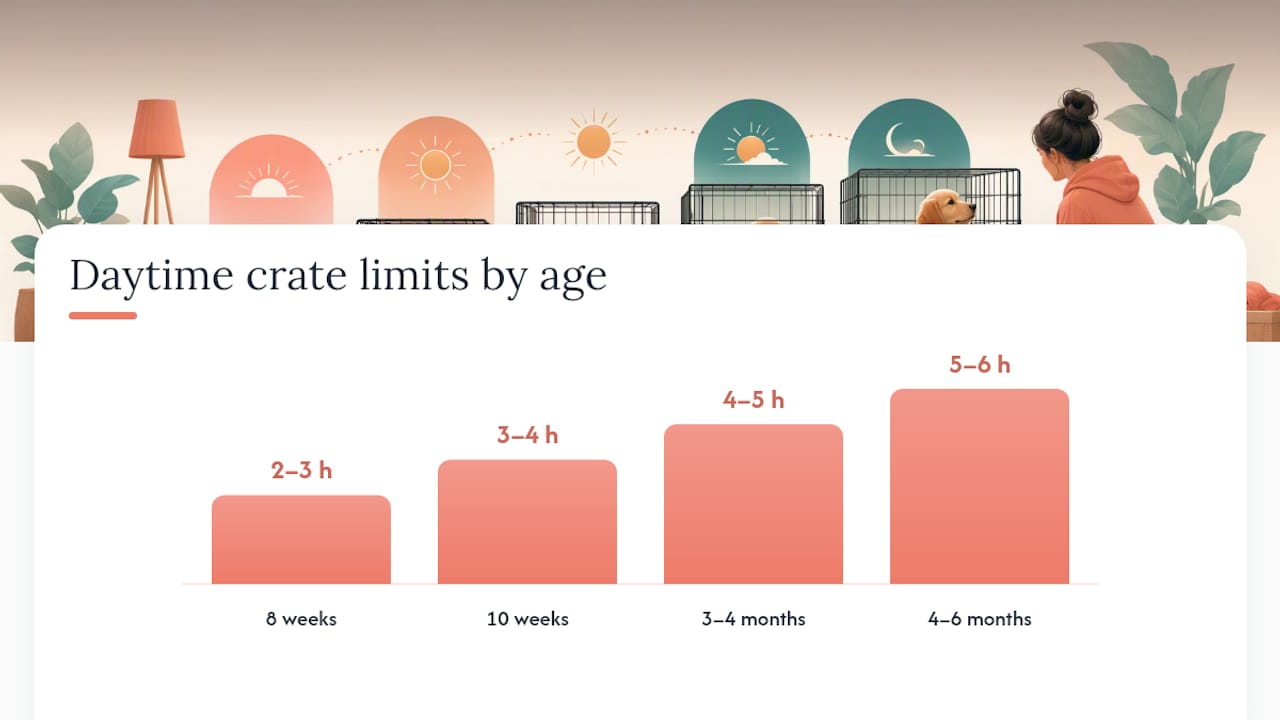
Bladder control is physical, not a matter of stubbornness or bad training. The commonly used RSPCA guideline is your puppy’s age in months plus one hour, as a rough ceiling on daytime crate stretches.
An eight-week-old puppy (two months) can typically hold on for roughly 2 to 3 hours. By six months, most puppies stretch to around 5 to 6 hours. No puppy, at any age, should be left in a crate for more than eight hours, and that maximum only applies to fully house-trained adolescents, not young pups.
| Age | Daytime crate stretch | Overnight expectation |
|---|---|---|
| 8 weeks | 2–3 hours | At least one night wake for toileting |
| 10 weeks | 3–4 hours | Likely one toilet break |
| 3–4 months | 4–5 hours | Possible toilet break |
| 4–6 months | 5–6 hours | Usually settles through most of the night |
Build your daily routine around these windows rather than your own schedule. A puppy crated too long doesn’t learn patience, they simply learn to soil the crate, which then undoes weeks of house-training progress.
How do I stop my puppy crying in the crate?
Whining falls into two very different categories, and mixing them up is where a lot of owners go wrong. Need-based whining is short, sudden, and usually means “I need the toilet.” Protest whining tends to start the moment the door closes and often has a demanding, repetitive edge to it.
The practical test: if your puppy has just been to the toilet, eaten, and had exercise, a burst of crying in the first few minutes is very likely protest. Wait for a few seconds of quiet before letting them out, so you’re not accidentally rewarding the noise. If the whining is genuinely urgent or persistent, take them for a calm, business-only toilet trip, then settle them back down without excitement.
- Forcing a puppy in: physically pushing or shoving a reluctant puppy poisons the crate as a safe space almost instantly.
- Closing the door too fast: one sudden clunk can undo days of careful, positive association.
- Ignoring bladder limits: leaving a puppy far beyond their age-appropriate window guarantees accidents and stress.
- Punishing crate use: shouting or shutting a puppy in as a “time out” for bad behaviour turns the den into a threat.
If whining escalates into persistent panic, drooling, frantic scratching, or genuine attempts to escape, stop the session. According to VCA Animal Hospitals, these are signs that call for a chat with your vet or a qualified behaviourist rather than more repetitions of the same approach. Training simply doesn’t stick when a puppy is in a state of real distress, and pushing on regardless can make the crate a lasting source of fear.
Timelines here vary hugely between individual puppies. PDSA notes that some settle within a week while others take several weeks or even months, so don’t judge your progress against someone else’s.
When can you stop crating a puppy?
You’ll know your puppy is ready for more freedom when house-training feels genuinely reliable, they stay relaxed when loose in a room, and destructive chewing has largely stopped being a worry.
Widen their world in stages rather than all at once:
- Start with open-door naps in the crate room, so it’s available but no longer closed.
- Move to supervised time in one puppy-proofed room with the crate door left open.
- Gradually increase unsupervised freedom as good habits hold steady across several weeks.
Keep the crate available even after you stop using it for daily management. Most dogs continue choosing it as a den for years, long after the structured training itself has finished.
Giddy Pets resources for crate training success
Giddy Pets is a UK-based online pet supplies store built around quality products paired with genuinely useful, vet-informed advice, not just a shop window. The goal is to make the practical side of pet ownership simpler, from picking the right kit to knowing how to use it.
A few categories worth browsing while you’re setting up:
- Dog crates & cages with divider panels for correctly sizing the space as your puppy grows.
- Puppy teething toys for safe, stuffable chews that occupy sore gums during closed-door sessions.
- Puppy pads for backup house-training support while bladder control is still developing.
- Dog separation anxiety guidance if your puppy’s crate distress looks more like a wider anxiety pattern.
A word for first-time owners feeling stuck
Some puppies breeze through this in days; others take weeks and test your patience along the way. Both are normal. Celebrate the small wins, a calm five minutes, a quiet meal behind a closed door, rather than measuring yourself against someone else’s timeline. Use the schedule, trust the process, and if red flags appear, ask for help. Today, just try one five-minute session.
— Giddy
Kit that makes crate training easier
There are other ways to muddle through crate training with whatever’s lying around the house, but the right kit removes most of the friction that causes setbacks. A well-sized crate with a divider panel means you buy once and adjust as your puppy grows, rather than replacing kit every few months.
Stuffable chew toys turn a closed door into a non-event because your puppy is busy working on a treat rather than watching the latch. Stuffable dog toys are worth having a small rotation of, so sessions never feel repetitive. Washable bedding survives the inevitable early accidents without falling apart in the wash, and puppy pads give you a safety net during the early weeks when bladder control is still catching up with intentions. If you want a steady supply of small, high-value rewards for those first treat-lure sessions, it’s also worth reading up on how to time and deliver training treats properly, since timing matters almost as much as the treat itself.
Browse the dog crates & cages range to find the right size and divider setup for your puppy’s current stage, and build the rest of your crate-training kit from there.
Sources
- RSPCA — Crates and playpens: advice
- PDSA — Crate training your dog
- Petful — Crate training a puppy (day-by-day plan)
- VCA Animal Hospitals — Crate training overview
- AKC — Crate training step-by-step
FAQ
Should I put my 8-week-old puppy in a crate at night?
Yes, provided the crate is beside your bed and you expect at least one toilet break during the night. An eight-week-old puppy typically manages 2 to 3 hours between toilet trips, so plan overnight breaks around that window rather than expecting a full night’s sleep straight away.
Can you leave a puppy in a crate for 4 hours?
It depends entirely on age. A puppy of around three to four months can generally manage four hours, but an eight-week-old puppy cannot, since their bladder limit sits closer to 2 to 3 hours. Always crate to your puppy’s current age, not the schedule you’d prefer.
How long does it take for a puppy to get used to a crate?
It varies a lot between individual dogs. Some settle within a week of following a phased, calm-only plan, while others take several weeks or months. Steady, unhurried progress matters more than speed here.
When can you stop crating a puppy?
Once house-training feels reliable, your puppy stays calm when loose, and destructive chewing has largely stopped, you can start easing off structured crate time. Widen freedom gradually through open-door naps and supervised room time rather than removing the crate all at once, and keep it available as a den long after daily crating ends.