


Cat dental care: your practical guide to healthy teeth

Cat dental care: your practical guide to healthy teeth
Between 50% and 90% of cats over four years old have some form of dental disease, and most of it is preventable. The single best thing you can start today is regular toothbrushing: daily is ideal, three times a week is the minimum that actually disrupts plaque. If your cat won’t tolerate a brush, an enzymatic gel or water additive still helps, alongside a vet check.
- Best action: brush daily with a cat-specific enzymatic paste, or three times weekly minimum
- Backup plan: gels, water additives or dental treats if brushing fails
- See a vet promptly if: you notice bad breath, drooling, bleeding gums, reluctance to eat, or pawing at the face
Key takeaways
Daily brushing with an enzymatic toothpaste, backed by annual veterinary checks, remains the most effective way to prevent feline dental disease.
| Point | Details |
|---|---|
| Prevalence is high | Between 50% and 90% of cats over four have some form of dental disease, often by age three. |
| Brushing frequency | Daily is ideal; three times weekly is the minimum to meaningfully disrupt plaque. |
| Tartar needs a vet | Plaque hardens into tartar within 36 to 72 hours and can only be removed by professional scaling. |
| Anaesthesia is essential | Full dental assessment requires general anaesthetic and x-rays; anaesthesia-free dentals miss hidden disease. |
| Start with Giddy Pets | Giddy Pets’ dental care range and cat dental treats offer a practical starting point for building a home routine. |
Table of Contents
- Common dental problems in cats: gingivitis, periodontitis and tooth resorption
- How to check your cat’s mouth and spot early warning signs
- Brushing technique, frequency and realistic alternatives
- What veterinary dental treatment actually involves
- A realistic prevention schedule you can actually stick to
- Choosing the right starter products for your cat
- Breeds that need extra dental attention
- What happens if dental disease is left untreated
- Introducing a dental routine without a fight
- Where prevention actually pays off
- Building a starter dental kit with Giddy Pets
- Frequently asked questions
- Sources
Common dental problems in cats: gingivitis, periodontitis and tooth resorption
Three conditions account for most feline dental disease, and they tend to progress in sequence if left alone. Gingivitis is inflammation of the gum margin, usually the first visible sign of plaque build-up, showing as a red line along the gum edge. Left untreated, it develops into periodontitis, where the infection moves below the gumline and destroys the ligaments and bone holding teeth in place. This stage is often irreversible.
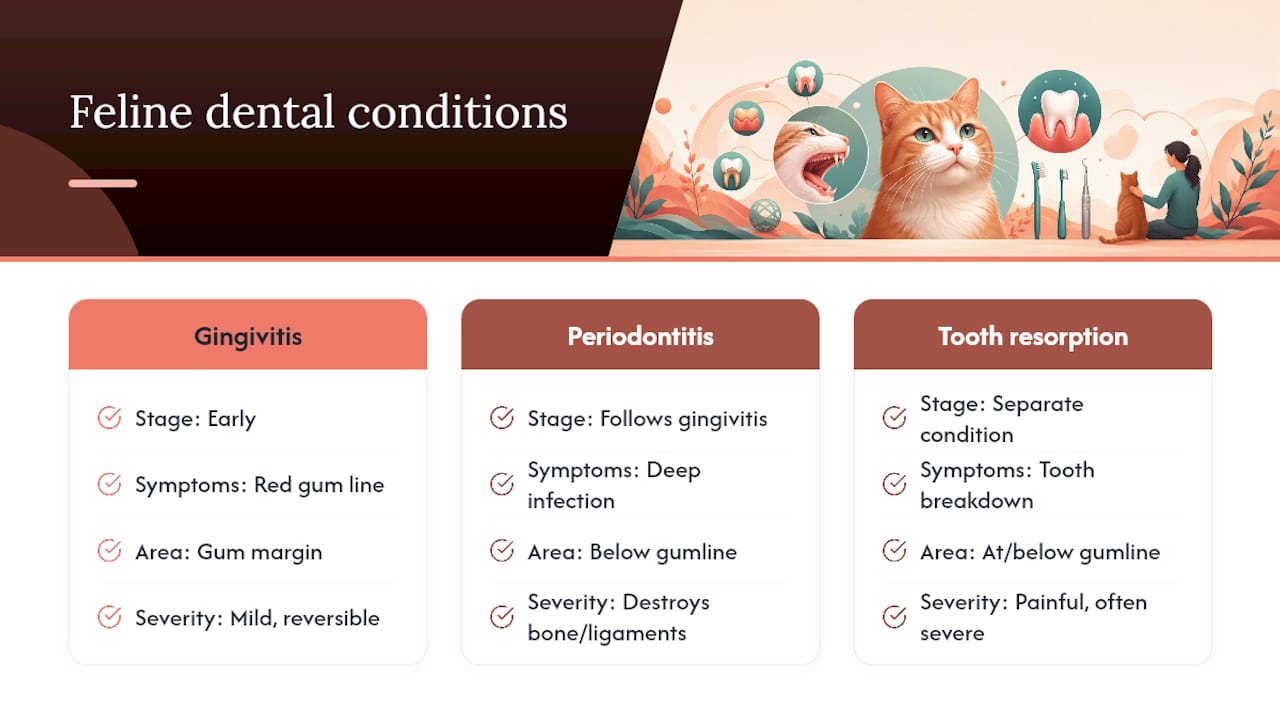
Tooth resorption is a separate and surprisingly common problem, unique to cats, where the tooth’s own structure is gradually broken down and absorbed, frequently at or below the gumline. It is intensely painful, yet many cats show no obvious behaviour change because they instinctively hide oral pain.
The scale of this is worth sitting with: Cornell University’s Feline Health Center reports that signs can appear by age three, and by four years old most cats have some degree of disease. Beyond the mouth, chronic oral infection has been linked to wider inflammatory strain on the body, which is exactly why dental care sits alongside diet and vaccination as a core part of preventive health, not an optional extra.
How to check your cat’s mouth and spot early warning signs
Cats hide pain well, so a five-minute check every couple of weeks catches problems long before they’re obvious. Do it when your cat is relaxed, ideally after a meal.
- Gently lift the lip on each side and look along the gumline for redness, swelling, or a brownish tartar crust near the gum edge.
- Smell the breath. Mild “cat breath” is normal; a sharp, rotten odour usually signals infection.
- Watch how your cat eats over the next few days: dropping food, chewing on one side only, or avoiding dry kibble are all worth noting.
- Check for drooling, pawing at the mouth, or reluctance to be stroked near the face.
Contact your vet promptly if you see bleeding gums, loose or broken teeth, visible pink lesions on the teeth (a sign of resorption), or sudden weight loss. Because dental disease is often silent until it’s advanced, don’t wait for obvious pain before booking an exam. Keeping a phone note with dates, photos of the gums, and any eating changes makes your vet appointment far more useful than trying to remember details on the day.
Brushing technique, frequency and realistic alternatives
Daily brushing with a cat-specific enzymatic toothpaste is the gold standard; the RVC sets three times weekly as the minimum frequency needed to meaningfully disrupt plaque before it hardens. That timing matters more than owners realise: plaque mineralises into tartar within roughly 36 to 72 hours, and once it’s tartar, brushing won’t shift it. Only a professional scale will.
Getting there takes patience, not a single brave attempt with a toothbrush:
- Start by simply handling your cat’s mouth for a few seconds a day, lifting the lip and rewarding calmly.
- Let them lick a small amount of enzymatic paste from your finger so the flavour becomes familiar before any brushing happens.
- Move to a finger brush or a small, soft-bristled cat toothbrush once they’re relaxed with your fingers near their mouth.
- Brush at a 45 degree angle, focusing on the outer, cheek-facing surfaces of the canine and back teeth. The tongue does most of the work on the inner surfaces, so you don’t need to fight for access there.
- Keep sessions under a minute at first, always ending on praise or a treat, and stop immediately if your cat seems in pain rather than just annoyed.
Pro Tip: Brush at the same time each day, right after a feed, so it becomes a predictable routine rather than a surprise ambush.
If brushing genuinely isn’t achievable, don’t abandon dental care altogether. Enzymatic gels using the dual-enzyme system found in products like C.E.T. can be applied directly to the gums with a finger and are safe to swallow. Water additives, VOHC-accepted dental treats, and textured dental diets or chew toys all provide a measurable, if smaller, reduction in plaque and tartar build-up when used consistently as part of a wider routine.
What veterinary dental treatment actually involves
A proper dental assessment happens under general anaesthetic, and there’s no shortcut around that. Cats won’t hold still for probing or x-rays, and anaesthesia-free “dentals” offered outside a veterinary setting are a genuine welfare concern: they’re cosmetic scaling at best, and they miss disease hiding below the gumline entirely.
Once your cat is under anaesthetic, the vet will probe each tooth, scale both above and below the gumline, and take intraoral radiographs to see the roots and bone. This is where tooth resorption and hidden periodontal pockets actually get diagnosed, since neither shows up on a visual exam alone. Depending on what the x-rays reveal, treatment might extend to extractions of badly affected teeth, or occasionally a crown amputation where a resorbed tooth root has already fused to the bone and full extraction would cause more trauma than leaving the root in place.
Recovery is usually quick. Most cats eat soft food that evening or the next day and are back to normal within a few days, sometimes with a short course of pain relief or antibiotics. Costs vary considerably depending on how many extractions are needed and where you’re based, so it’s worth asking your vet for an estimate before the procedure and checking whether your pet insurance covers dental work, since many policies exclude it once disease is already diagnosed.
A realistic prevention schedule you can actually stick to
The best time to start is kittenhood, when mouth handling is easiest to introduce, but an adult cat can still learn with patience.
- Begin gentle mouth handling and taste-testing paste as early as possible, ideally from the first few months.
- Brush daily where you can manage it; treat three times weekly as your non-negotiable floor.
- Book an annual vet check for a general oral exam, more often if your cat already shows early gum changes.
- Layer in a dental diet, VOHC-accepted treats, or chew toys as backup, never as a full replacement for brushing or professional cleaning.
Choosing the right starter products for your cat
Giddy Pets’ dental care category covers pastes, sprays and finger brushes, while the cat dental treats range supports brushing rather than replacing it. If your cat resists a brush, try a gel or spray first, then work towards a finger brush once they’re comfortable with the flavour and handling.
Breeds that need extra dental attention
Flat-faced breeds carry more risk here than most owners realise. Persians and other brachycephalic cats have crowded, often misaligned teeth because their jaw is shortened relative to a standard feline skull, which leaves less room for teeth to sit properly and traps more plaque between them. Siamese and other Oriental breeds are frequently reported to develop tooth resorption and gingivitis earlier and more severely than average, for reasons that aren’t fully understood but appear to have a genetic component.
Maine Coons and other large breeds don’t carry a specific dental predisposition, but their sheer size means a full dental under anaesthetic can take longer, so book with a practice experienced in larger cats. Older cats of any breed accumulate risk simply through time. If you own a brachycephalic or Oriental breed, treat brushing as non-negotiable from kittenhood rather than optional, and flag the breed to your vet at annual check-ups so they know to look more closely for early resorption lesions, which are easy to miss on a quick visual exam.
What happens if dental disease is left untreated
Untreated gingivitis doesn’t stay contained to the gums. It progresses to periodontitis, where bacteria work their way into the bloodstream through inflamed tissue, and that has knock-on effects beyond the mouth: added strain on organs already working hard, particularly in older cats with existing kidney or heart concerns. Bone loss around the tooth roots is often irreversible by the time it’s spotted on an x-ray.
The pain itself causes real behavioural fallout. Cats in chronic oral pain often eat less, become more withdrawn, or turn uncharacteristically irritable when handled near the face, and owners frequently mistake this for “just getting old” rather than a treatable problem. Tooth resorption left unaddressed can eventually fracture the tooth at gum level, leaving a painful root fragment that keeps causing problems until it’s surgically removed.
Abscesses are another real risk, particularly around the roots of the large carnassial teeth, and can require emergency drainage rather than a routine appointment. The longer disease progresses, the more teeth typically need extracting in one sitting, which means a longer anaesthetic and a longer recovery than if the same problem had been caught a year earlier. None of this is inevitable. It’s simply what happens when the silent early stages go unnoticed for long enough, which is precisely why regular checks matter more than waiting for obvious symptoms.
Introducing a dental routine without a fight
Rushing this is the single most common mistake owners make, and it usually backfires by turning the whole mouth area into something the cat actively avoids. Give the process two to three weeks before expecting cooperation, and treat every session as optional from your cat’s point of view, not something to force through.

Start with nothing more than touch: stroke around the cheeks and chin during a calm moment, like after a meal when your cat is naturally relaxed, and stop before any sign of tension. Once that’s comfortable, introduce the taste of enzymatic paste on a fingertip, letting your cat lick it off rather than trying to apply it to teeth straight away. Positive reinforcement and short sessions work best, so a small treat or extra fuss immediately after each step builds a genuine positive association rather than tolerance under protest.
Only introduce an actual brush once your cat accepts finger contact inside the mouth without pulling away. Keep the first few brushing sessions to a handful of seconds on just one or two teeth, and resist the temptation to do the whole mouth on day one simply because it went well. If your cat becomes distressed at any stage, go back a step rather than pushing through, and never restrain a cat forcefully to brush its teeth: it teaches them to associate the whole routine with fear, which makes every future session harder.
Where prevention actually pays off
The gap between what owners think dental care requires and what it actually takes is wider than most guides admit. You don’t need a perfect daily routine to make a real difference. Consistency across weeks and months matters more than any single session going well, and a cat who tolerates a gel three times a week is in a far better position than one whose owner gave up after a bad first attempt with a brush.
What’s underappreciated is how much dental health interacts with everything else you already do for your cat, from diet texture to enrichment toys that encourage chewing. Prevention isn’t a separate task bolted onto pet ownership. It’s part of the same attentiveness that catches a limp early or notices a change in appetite, and it rewards owners who start before there’s a visible problem to react to.
Building a starter dental kit with Giddy Pets
Giddy Pets is the practical shortcut past the trial-and-error most owners go through alone, with a curated dental care range chosen specifically for cats rather than adapted from dog products.

A sensible starter kit is a cat-specific enzymatic toothpaste, a soft finger brush, and a spray or gel as backup for days when brushing isn’t happening. If your cat is particularly resistant to handling near the face, pair that with something from the interactive cat toys range to build positive associations with attention around the head first. Once your cat tolerates a paste flavour, the cat dental treats range makes a solid maintenance layer between brushing sessions. Browse the dental care category today and put together a starter kit that matches how much handling your cat will actually accept, rather than the routine you’d ideally want to run.
Frequently asked questions
How often should I brush my cat’s teeth? Daily is the gold standard, but three times a week is the minimum frequency needed to disrupt plaque before it hardens into tartar.
What are the first signs of dental problems in cats? Bad breath, a red line along the gums, mild drooling, and dropping food while eating are usually the earliest visible signs.
Can I clean my cat’s teeth without a vet visit? You can maintain teeth at home with brushing, gels or treats, but you cannot remove existing tartar or diagnose hidden disease without a professional dental exam under anaesthetic.
Is cat toothpaste safe if swallowed? Yes, enzymatic pet toothpastes are formulated to be safe if swallowed, unlike human toothpaste, which should never be used on cats.
How much does a professional cat dental clean cost? Cost varies by practice and how many extractions or x-rays are needed, so it’s best to get a direct estimate from your vet and check your pet insurance policy for dental cover.
Sources
- Feline dental disease | Cornell University College of Veterinary Medicine
- Cat Dental Issues and Services | RVC
- Dental disease in cats | VCA Animal Hospitals
- Enzymatic Toothpaste for Dogs & Cats - Virbac UK