


Budgie cage size: minimum dimensions and space guide
Budgie cage size: minimum dimensions and space guide
The minimum internal dimensions for one budgie are 18 × 18 × 18 inches (45 × 45 × 45 cm), though the MSD Veterinary Manual recommends slightly more generous minimums of 20 × 20 × 30 inches. The single most important number in that trio isn’t height. It’s width and depth, the two measurements that give your budgie room for horizontal flight.
That’s the detail most first-time owners miss. A tall, narrow cage might look impressive in a shop, but a budgie flies in short, flapping bursts across open space, not upward like a helicopter. Give it height without width and you’ve built a very expensive perch stand.
Quick answer for a single budgie:
- Minimum: 18 × 18 × 18 inches (45 × 45 × 45 cm)
- Better: 30 × 18 × 18 inches (76 × 45 × 45 cm) or larger
- Priority order: width and depth first, height last
Two caveats worth holding onto as you read on. Bigger is nearly always better, budgies rarely suffer from too much room. And bar spacing, perch placement, and clutter inside the cage all eat into that usable flight space, so the printed dimensions on a box don’t tell the whole story.
Key Takeaways
The single most important rule in choosing a budgie cage is that width and depth, not height, determine whether your bird can actually fly.
| Point | Details |
|---|---|
| Minimum size | One budgie needs at least 18 × 18 × 18 inches (45 × 45 × 45 cm), with wider cages preferred. |
| Priority dimension | Width and depth matter more than height because budgies fly horizontally, not vertically. |
| Bar spacing | Keep bar spacing at ½ inch (1.27 cm) or less to prevent head entrapment. |
| Multiple budgies | Add roughly 30 × 18 × 18 inches of space per extra bird rather than simply doubling volume. |
| Where to shop | Giddy Pets’ small pet care range stocks feeders, perches and enrichment pieces sized for the setup above. |
Table of Contents
- What’s the ideal budgie cage size for flight?
- How big a cage do you need for 1, 2, 3 or 4 budgies?
- What bar spacing and materials are safe for budgies?
- How should you set up and maintain a budgie cage?
- How do you measure your cage and spot the warning signs?
- Does cage size really affect a budgie’s health?
- Frequently asked questions
- Sources
What’s the ideal budgie cage size for flight?
Budgies are built for horizontal movement. In the wild, they travel in flocks across open Australian scrubland, covering distance in fast, low, straight lines rather than climbing tall trees or hovering. A cage that mimics that shape, wide and deep rather than tall, lets a budgie do what its body is designed for: several short flaps of proper flight, not just a hop between two perches stacked one above the other.
This matters for more than boredom. Regular flight maintains pectoral muscle tone, supports healthy weight, and gives a naturally curious bird the mental stimulation it needs to stay settled. A cramped, vertical cage restricts all of that at once.
The RSPCA’s housing guidance for pet birds states that enclosure dimensions should allow a bird room to fly, with width, depth and height ideally several times the bird’s wingspan. For a budgie, whose wingspan runs to roughly 12 inches, that principle rules out any cage where the horizontal measurements aren’t generous.
- Horizontal flapping flight, not vertical climbing, is the natural movement pattern
- Muscle tone and weight management depend on regular flight, not just perch-hopping
- Mental stimulation drops sharply in cages that only offer height
How big a cage do you need for 1, 2, 3 or 4 budgies?
Cage size guidance for multiple budgies isn’t simply “double the volume per bird.” Budgies are sociable, and a flock benefits from shared flying space, but every extra bird also adds mess, noise, and competition for perches and feeding stations. The right approach is to treat the numbers below as a floor, then go bigger whenever your space and budget allow.
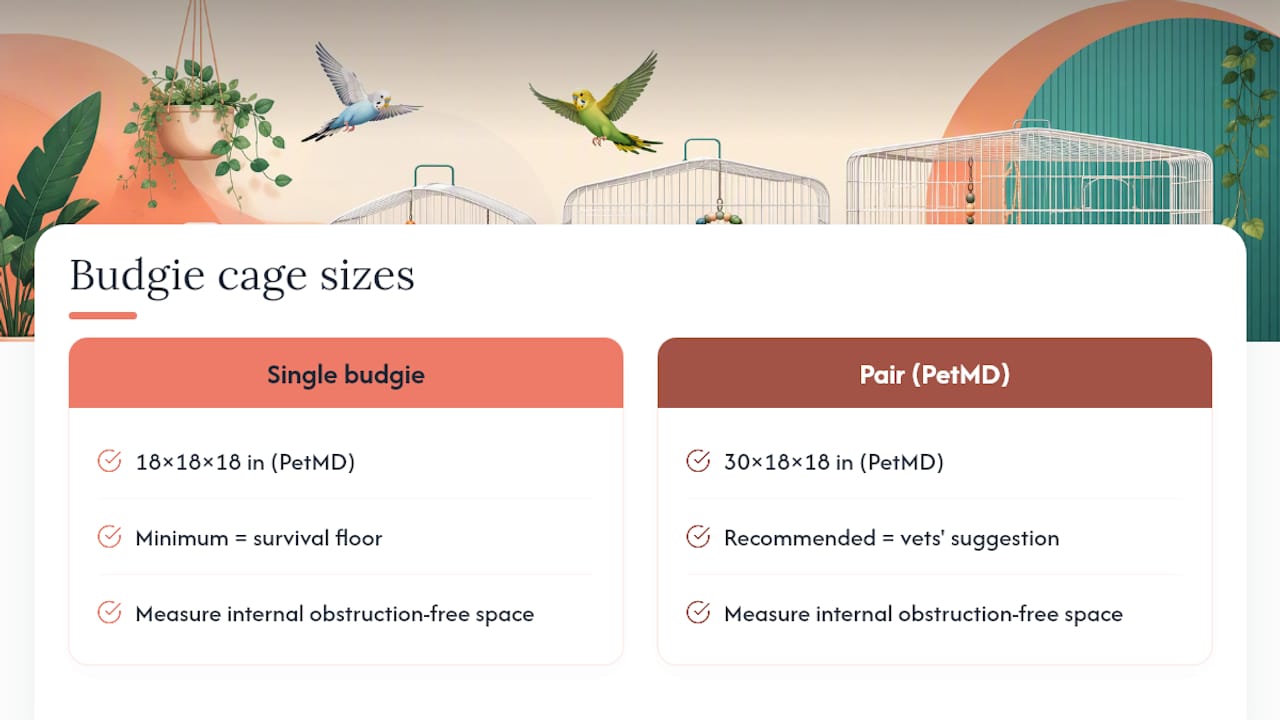
Sources vary slightly here. PetMD puts the single-budgie minimum at 18 × 18 × 18 inches and recommends 30 × 18 × 18 inches for a pair, while MSD’s veterinary table and the Centre for Animal Rehabilitation’s guidelines suggest slightly roomier baselines. Treat the higher figure as the safer target.
Two of these figures need context. The “minimum” column is a survival floor drawn from veterinary and rescue guidance, not a comfortable long-term home. The “recommended” column reflects what most avian vets and breeders actually suggest once you factor in perches, toys, and feeding stations that quietly reduce your bird’s usable flying room. Always measure the internal, obstruction-free space, not the box the cage came in.
Pro Tip: When comparing two cages of similar advertised volume, pick the one that’s wider and deeper over the one that’s taller. A 90cm‑wide, 45cm‑tall cage gives far more usable flight space than a 45cm‑wide, 90cm‑tall one, even though the total volume is identical.
What bar spacing and materials are safe for budgies?
Bar spacing sits at roughly half an inch (1.27 cm) across every major source, from PetMD to the MSD Veterinary Manual to avian veterinary guidance. That consistency isn’t a coincidence. Anything wider risks a budgie getting its head trapped between bars while trying to squeeze through, a genuine and fairly common injury in cages built for larger parrots.
Material choice matters just as much as spacing. Stainless steel and good-quality powder-coated metal are the safe standards. Avoid anything containing lead, zinc, or untreated galvanised wire, since budgies chew and peck at bars constantly, and heavy-metal poisoning from cage material is a well-documented risk in pet birds.
- Bar spacing: approximately half an inch (around 1.27 cm) or less
- Safe materials: stainless steel, powder-coated metal
- Avoid materials containing lead, zinc, or untreated galvanised finishes
Shape counts too. A long, wide rectangular cage with perches set from front to back, rather than side to side or stacked vertically, gives your budgie an actual flight path rather than a series of short hops. Round or dome-topped cages look charming but waste corner space and disrupt a bird’s sense of direction, since budgies navigate by straight lines and clear sightlines, not curves.
Pro Tip: Place your two main perches at opposite ends of the longest dimension, never directly above one another. That single adjustment turns a static cage into one your budgie actually flies across.
How should you set up and maintain a budgie cage?
Getting the size right is only half the job. How you fill that space determines whether your budgie can actually use it.
- Line the base with a tray or paper liner that’s easy to slide out for cleaning.
- Install two to three perches of varying diameter, positioned front to back rather than stacked, to keep muscles and grip flexible.
- Set food and water stations at opposite ends from the main perches, away from anywhere droppings might fall.
- Add foraging toys and swings in the remaining space, without blocking the main flight path down the middle.
- Position the cage in a bright room away from direct draughts, out of full sun, and somewhere your budgie can see household activity without feeling cornered.
A sturdy feeder and water bowl set makes daily refills far quicker, and choosing washable stainless steel over plastic cuts down on bacterial build-up between cleans.
Daily and weekly checklist:
- Spot-clean droppings and food debris every day
- Refresh water and check feeders daily
- Replace the tray liner fully once or twice a week
- Disinfect perches and bars weekly with a bird-safe cleaner
- Rotate or wash toys every one to two weeks
How do you measure your cage and spot the warning signs?
Measuring a cage properly means ignoring the box dimensions and getting a tape measure onto the actual usable interior.
- Measure width and depth at the widest open point, not at the base if the cage tapers.
- Measure height from the tray to the highest perch a budgie would realistically use, not to the roof.
- Subtract the space taken up by feeders, toys, and perch mounts from your total, since these all reduce flyable room.
- Compare the result against the recommended ranges for your flock size.
Some signs your current cage has fallen short show up in behaviour long before you’d notice from the measurements alone.
- Lethargy or reluctance to move between perches
- Feather plucking or over-preening
- Repetitive pacing along one section of a perch
- Reduced vocalisation, or unusually frequent aggression toward cage mates
Physical clues matter too: uneven perch wear, a single overused corner, or a budgie carrying visible extra weight all point to a cage that’s holding your bird back. If you spot two or more of these, upgrade the cage, add supervised free-flight time immediately, and speak to an avian vet if the behaviour doesn’t ease within a week or two.
Does cage size really affect a budgie’s health?
Yes, and the link is direct rather than theoretical. Restricted flight space contributes to muscle wastage, weight gain, and the kind of chronic stress behaviour, feather plucking, pacing, screaming, that avian vets see regularly in birds kept in undersized housing.
Avian veterinary guidance is consistent on this point: budgies should have as large a cage as space and budget allow, well beyond the bare minimum wherever possible.
“As large a cage as possible” is the standard vets return to again and again, because the 18‑inch minimum is a floor for survival, not a target for a thriving bird.
If your budgie shows plucking, sudden aggression, or a drop in activity that coincides with a cramped or recently changed cage, treat it as a housing and behaviour issue first, but book an avian vet check to rule out an underlying medical cause.
A hands-on note on choosing space over looks
Choosing a cage always comes down to a trade-off between what looks good in a living room and what a budgie can actually use. Prioritise width and depth over height every time, even when the taller option looks more striking in the shop. One habit worth adopting: before buying toys or extra perches, plan the empty flight corridor first, then fill in around it rather than the other way round.
Building a budgie starter kit that fits the space you’ve chosen
Once you’ve settled on the right cage footprint, the rest of the setup falls into place quickly. Giddy Pets’ small pet care range covers the housing accessories that turn a correctly sized cage into a genuinely comfortable home, from feeding stations to enrichment pieces designed with safe materials in mind.

If you’re assembling a starter kit, pair a stainless steel feeder and bowl set with a couple of varied-diameter perches and a foraging toy, then round it out with treats from the pet food and treats range to encourage your budgie to explore its new space. For enrichment accessories that reinforce good perch habits, the JW ActiviToys perch ring and toy combo is a solid addition to a front-to-back layout. Browse Giddy Pets’ small pet care category to put together a kit sized for exactly how many budgies you’re housing.
Frequently asked questions
What is the minimum cage size for one budgie? The minimum is 18 × 18 × 18 inches (45 × 45 × 45 cm), though MSD’s veterinary table recommends a slightly larger 20 × 20 × 30 inches.
Is a tall cage or a wide cage better for budgies? A wide, deep cage is better, since budgies fly in horizontal bursts rather than climbing upward, and width gives them room to build up genuine flight speed.
What bar spacing is safe for budgies? Bar spacing of ½ inch (1.27 cm) or less is the consistent standard across veterinary and rescue guidance, preventing head or neck entrapment.
How much bigger should a cage be for two budgies? Plan for at least 30 × 18 × 18 inches (76 × 45 × 45 cm) for a pair, and look for closer to 90 × 50 × 50 cm if your space allows.
What are the signs a budgie cage is too small? Watch for feather plucking, pacing along one section of a perch, reduced vocalisation, uneven perch wear, and weight gain, all of which point to inadequate flight space.
Sources
- Budgie care sheet | PetMD
- Minimum and bar spacing recommendations | MSD Veterinary Manual
- Housing and environments for pet birds | RSPCA
- Budgie (Parakeet) care guide for beginners | Dr Zubair Khalid
- Guidelines for cage size and bar spacing | CFARE