
Great Dane Health Problems: An Honest Guide
An honest, factual guide to the serious conditions Great Danes face — bloat (GDV) and gastropexy, dilated cardiomyopathy, hip and elbow dysplasia, Wobbler syndrome and bone cancer.
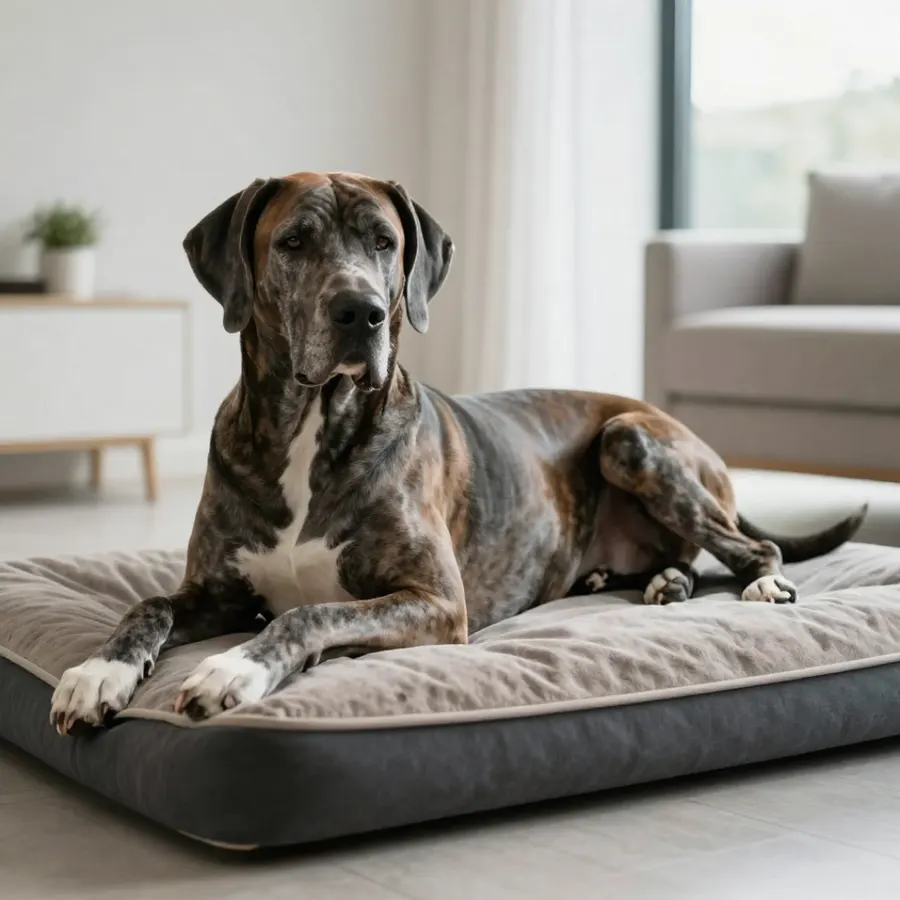
The quick answer
Great Danes are predisposed to several serious conditions. The most urgent is bloat or gastric dilatation-volvulus (GDV), where the stomach swells and can twist — a life-threatening emergency. They are also prone to dilated cardiomyopathy (a heart-muscle disease), hip and elbow dysplasia, Wobbler syndrome (a neck/spinal cord condition) and bone cancer (osteosarcoma).
There is no kind way to dress this up: Great Danes are a breed with a serious health profile. Their giant size brings them a higher risk of several major, sometimes life-threatening conditions, and any honest discussion of the breed has to confront that head-on. This is not meant to put you off — it is meant to help you make an informed choice, recognise problems early, and care for a Dane responsibly. Here is a factual guide to the main health problems Great Danes face.
Bloat (gastric dilatation-volvulus, GDV)
The single most urgent risk for a Great Dane is bloat, properly called gastric dilatation-volvulus (GDV). The stomach fills with gas and fluid and can then twist on itself, cutting off the blood supply and trapping the contents. It is a life-threatening emergency: without prompt surgery it can kill within hours. Large, deep-chested breeds like the Great Dane are among the most at risk of any dog.
Warning signs include a swollen, hard or distended tummy, unproductive retching (trying to be sick but bringing nothing up), restlessness and pacing, excessive drooling, pale gums and obvious distress. If you see these signs, treat it as an emergency and contact your vet immediately.
To reduce the risk, vets commonly advise feeding smaller, more frequent meals, avoiding vigorous exercise just before and after eating, and discouraging rapid gulping of food or water — a slow feeder can help. Many owners and breeders also choose a preventive surgery called gastropexy, in which the stomach is tacked to the body wall so it cannot twist; this is often done at the same time as neutering. Discuss whether it is right for your dog with your vet.
Dilated cardiomyopathy (DCM)
Great Danes are predisposed to dilated cardiomyopathy (DCM), a disease in which the heart muscle becomes thin and weakened so the heart enlarges and pumps less effectively. It can lead to abnormal heart rhythms, heart failure and sometimes sudden death. Signs may include tiredness, reluctance to exercise, coughing, breathlessness, a swollen abdomen or fainting — but it can also be silent in the early stages. This is one of the key reasons responsible breeders heart-screen their breeding dogs, and why any sign of exercise intolerance in a Dane warrants a prompt vet check.
Hip and elbow dysplasia
As a giant, heavy breed, Great Danes can suffer from hip and elbow dysplasia, where the joints develop abnormally and fail to fit together smoothly. Over time this causes pain, lameness and arthritis. Responsible breeders hip-score their breeding dogs to reduce the risk. As an owner, you can protect your dog's joints by keeping them lean, feeding a correct large-breed diet, and — critically — managing puppy exercise carefully so that growing joints are not overloaded, as explained in our size and growth guide. A supportive orthopaedic bed helps an adult Dane rest comfortably.
Wobbler syndrome
Great Danes are one of the breeds associated with Wobbler syndrome (cervical spondylomyelopathy), a condition affecting the vertebrae and discs in the neck that puts pressure on the spinal cord. It typically causes a wobbly, unsteady gait — especially in the hind legs — neck pain and weakness, hence the name. It is more common in large and giant breeds and can develop as the dog grows or in adulthood. Treatment ranges from medical management to surgery depending on severity, so any persistent unsteadiness, stumbling or neck discomfort should be investigated by your vet.
Bone cancer (osteosarcoma)
Large and giant breeds, including the Great Dane, have a higher risk of osteosarcoma, an aggressive bone cancer that most often affects the limbs. Warning signs include persistent lameness, swelling over a bone, or pain that does not resolve with rest. It is a serious diagnosis, and early veterinary attention gives the best chance of managing it. Any unexplained, persistent limp in a Great Dane deserves prompt investigation rather than a wait-and-see approach.
Other considerations
Great Danes can also experience other problems common to large breeds, including certain eye conditions, thyroid issues and the general wear-and-tear of carrying a giant frame. Their deep chest and big appetite make sensible feeding and weight control a lifelong priority. Routine preventive care — vaccinations, parasite control, dental care and regular check-ups — is just as important as watching for the headline conditions above.
Reducing the risks
While you cannot change a dog's genetics, you can stack the odds in your favour:
- Buy from health-tested parents — heart-screened and hip-scored — from a reputable breeder (see our cost and buying guide).
- Feed carefully — smaller meals, calm eating, and a chat with your vet about bloat and gastropexy.
- Keep your dog lean — check portions with our pet calorie calculator.
- Protect growing joints with gentle, limited puppy exercise.
- Know the emergency signs, especially of bloat, and keep your nearest emergency vet to hand via our vet finder.
- Insure early so serious illness is affordable to treat.
None of this guarantees a problem-free life, but it gives your Great Dane the best possible chance. For the wider picture, see our lifespan and health guide.
*This is general guidance, not a substitute for advice from your own vet, who can assess and treat your individual dog. If you suspect bloat, treat it as an emergency and contact a vet immediately.*
Sources
- The Kennel Club — Great Dane breed health and recommended testing (thekennelclub.org.uk).
- RVC VetCompass — UK dog health research (rvc.ac.uk/vetcompass).
- PDSA — bloat (GDV), heart disease and joint problems in dogs (pdsa.org.uk).
- Blue Cross — dog health conditions (bluecross.org.uk).
- RSPCA — dog health and welfare (rspca.org.uk).
Common questions
What health problems are Great Danes prone to?
Great Danes are predisposed to several serious conditions. The most urgent is bloat or gastric dilatation-volvulus (GDV), where the stomach swells and can twist — a life-threatening emergency. They are also prone to dilated cardiomyopathy (a heart-muscle disease), hip and elbow dysplasia, Wobbler syndrome (a neck/spinal cord condition) and bone cancer (osteosarcoma). Many breeders choose a preventive surgery called gastropexy to reduce GDV risk. Buying from health-tested parents and knowing the warning signs is essential.
What are the signs of bloat in a Great Dane?
Bloat (gastric dilatation-volvulus, GDV) is a life-threatening emergency. Warning signs include a swollen, hard or distended tummy, unproductive retching (trying to be sick but bringing nothing up), restlessness and pacing, excessive drooling, pale gums and obvious distress. Large, deep-chested breeds like the Great Dane are especially at risk. If you see these signs, contact your vet immediately — without prompt surgery, bloat can be fatal within hours. Feeding smaller meals and avoiding exercise around mealtimes helps reduce the risk.
What is gastropexy and should my Great Dane have it?
Gastropexy is a preventive surgery in which the stomach is tacked to the body wall so it cannot twist, greatly reducing the risk of the most dangerous form of bloat. Because Great Danes are at high risk of gastric dilatation-volvulus (GDV), many owners and breeders choose to have it done, often at the same time as neutering to avoid a second anaesthetic. It does not prevent the stomach filling with gas, but it stops the life-threatening twist. Discuss whether it is right for your individual dog with your vet.
About the author
Matt Garnett — founder, Giddy Pets
Matt started Giddy Pets to make getting pets the good stuff simpler and fairer. Everything in these guides comes from real life with pets and a lot of trial and error — it's practical guidance, not veterinary advice. If a guide gets something wrong, tell him directly.
Free tools & more guides
Read next
How Long Do Great Danes Live? Lifespan & Health
An honest look at the Great Dane's short lifespan, why giant breeds live fewer years, the serious conditions they face, and how to help yours live as long and well as possible.
How Much Does a Great Dane Cost? Buying & Lifetime Costs
What a Great Dane really costs — the price of a health-tested puppy, and the high lifetime running costs of feeding, equipping, insuring and treating a giant breed.
How Big Do Great Danes Get? Size & Growth
How big Great Danes really get — typical heights and weights, their slow giant-breed growth, and the joint-safe exercise that protects a growing Dane puppy.
Are Great Danes Good Family Dogs?
What Great Danes are really like to live with — their gentle-giant temperament, how they are with children, the practical cautions of a huge dog, and the families they suit best.