


Laziest dog breeds for apartment living
The calmest, lowest-energy dog breeds genuinely suited to flats and small homes, and the health trade-offs worth knowing first
The quick answer
The Kennel Club rates the French Bulldog, Cavalier King Charles Spaniel, Pug, Shih Tzu, Basset Hound and Bulldog as needing up to one hour of exercise a day, its lowest banding, and lists most of them as suited to flat or apartment living.
If you live in a flat or a small home and you're worried a dog will need more space and stamina than you can give, the good news is that plenty of breeds are genuinely built for a quieter, more compact life. "Lazy" isn't quite the right word for these dogs; the ones that thrive in apartments are better described as low-energy, easy-going and content with a modest daily walk rather than hours of running.
Choosing the right breed matters more than choosing the right square footage. A calm, adaptable dog can be perfectly happy in a one-bedroom flat with no garden, while a high-drive working breed will struggle even in a large house if its exercise and mental stimulation needs aren't met. This guide looks at the breeds most consistently recommended for flat and apartment living, what "low exercise" actually means day to day, and the health trade-offs worth knowing about before you commit.
We've grounded this in breed information from the Kennel Club, along with guidance from PDSA, the RSPCA and Dogs Trust on choosing a dog and understanding breed-specific health needs. As with any guide like this, treat it as a starting point for research, not the final word — every individual dog is different.
What "low energy" actually means
None of the breeds on this list need no exercise at all. Every dog, whatever its size or temperament, needs daily walks, toileting breaks and some form of mental stimulation to stay physically and mentally healthy. What changes between breeds is the ceiling, not the floor. A Border Collie left with a single 20-minute walk a day is likely to develop problem behaviours out of sheer frustration; a Bulldog given the same routine is often perfectly content.
The Kennel Club rates most of the breeds below as needing "up to one hour per day" of exercise — its lowest exercise banding — compared with two hours or more for high-drive working and pastoral breeds. That one hour can usually be split into two shorter walks, which suits flat living far better than one long outing, especially if you're managing lifts, stairs, or a walk to the nearest green space.
The best low-energy breeds for flats
These are the breeds most consistently rated by the Kennel Club as low-exercise and suited to flat or apartment life:
- French Bulldog — The Kennel Club lists the French Bulldog as needing up to one hour of exercise a day, suited to flat or apartment living in either town or country, with once-a-week grooming. Their compact size and generally calm, affectionate temperament make them one of the most popular flat dogs in the UK — they became the country's most-registered breed in the years leading up to 2018.
- Cavalier King Charles Spaniel — Also rated at up to one hour a day by the Kennel Club, and specifically listed as suitable for a flat or apartment with a small-to-medium garden or no garden at all. Cavaliers are sociable, affectionate and rarely destructive when left for reasonable periods, though their coat needs grooming more than once a week.
- Pug — Another Kennel Club "up to one hour a day" breed, described in their own profile as needing only a small or medium garden and suitable for flat living. Pugs are sturdy, sociable and easily satisfied by a couple of short walks and some play indoors.
- Shih Tzu — Rated up to one hour a day and listed as suitable for flats, though be aware this breed needs grooming every single day to keep its coat in good condition — a real time cost even if the exercise cost is low.
- Basset Hound — Also an up-to-one-hour breed according to the Kennel Club, suited to a small or medium garden and either town or country living. Bassets were bred to hunt at a slow, methodical pace rather than sprint, and most adults are content with a couple of unhurried walks a day, though their long backs mean stairs and jumping should be limited.
- Bulldog (British Bulldog) — Kennel Club data again puts this breed at up to one hour a day, suited to a small house or flat with a small-to-medium garden. Bulldogs are famously placid indoors, but their brachycephalic build (see below) means exercise has to be managed carefully around heat and exertion.
- Greyhound — The breed with the biggest gap between reputation and reality. More on this below, because it's genuinely one of the best-kept secrets in flat-friendly dog ownership.
If you're weighing up whether your day-to-day routine can support any dog at all, our Pet Ownership Quiz is a useful first step, and our Dog Walking Calculator can help you work out whether your available time each day realistically covers a given breed's needs.
The greyhound exception: the "couch potato" breed
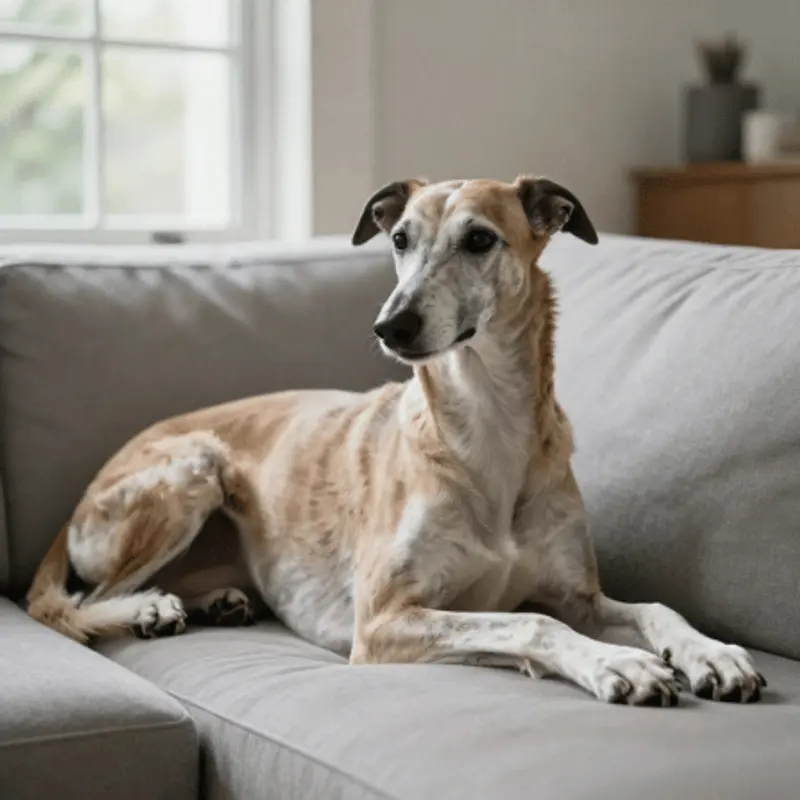
Greyhounds have an image problem. People assume a dog built for 40mph sprints must need endless exercise, when in fact retired racing greyhounds are some of the calmest, laziest dogs you can bring into a flat. Dogs Trust describes greyhounds as "usually moderately active dogs who also enjoy their lounging time," built for short bursts of speed rather than endurance, with daily needs that come down to a couple of walks plus some time to explore and play — nothing like the distance a working gundog or collie would need.
Greyhound Trust, the UK's largest greyhound rehoming charity, rehomes ex-racing greyhounds into flats, including homes with only a communal garden or no garden at all, provided the owner can manage lead-only toileting. Sighthounds like greyhounds and their smaller cousins, whippets and Italian greyhounds, are often described as needing surprisingly little daily exercise once their sprint is satisfied, then spending the rest of the day asleep on the nearest soft surface.
There are two catches worth knowing before you consider a greyhound for a flat. First, they're a genuinely large breed — the Kennel Club's own breed profile calls for a large house and large garden as the "ideal," reflecting the traditional working environment rather than what a well-matched pet greyhound actually needs day to day, and rescue-specific charities take a more flexible, case-by-case view. Second, greyhounds have thin coats and very little body fat, so they feel the cold and need a coat for winter walks, and most benefit from a properly cushioned bed given their lack of natural padding over bony joints.
The catch with flat-faced "lazy" breeds
Several of the most popular low-exercise breeds — the French Bulldog, Pug, Bulldog and Shih Tzu among them — are brachycephalic, meaning flat-faced. Their low exercise tolerance isn't only a matter of temperament; for many individuals, it's also a physical limitation caused by breathing difficulty.
PDSA explains that Brachycephalic Obstructive Airway Syndrome (BOAS) results from breeding dogs with normal amounts of soft tissue crammed into a shortened skull, leading to narrow nostrils, an elongated soft palate and a narrowed windpipe. Affected dogs — commonly Pugs, French Bulldogs, British Bulldogs, Shih Tzus and similar breeds — can show noisy breathing, snoring, exercise intolerance, excessive panting at rest, disrupted sleep, and in severe cases collapse, with symptoms often appearing in puppyhood or worsening between two and four years old.
A dog that seems "lazy" because it doesn't want to walk far may in fact be struggling to breathe — not simply low-energy by temperament.
The RSPCA's Healthier Breeds campaign is blunt about the scale of the problem, noting that flat-faced breeds commonly develop serious breathing difficulties, allergy-related skin and ear problems, eye injuries linked to their prominent eyes, and joint issues, often within their first three years of life — and that treatment, including airway surgery, can run into the thousands of pounds. The RSPCA's advice to anyone drawn to these breeds is to research thoroughly, understand the likely ongoing veterinary costs, seriously consider a rescue dog instead of buying a puppy, and if you do go ahead, only use a breeder who screens parent dogs for breathing problems using the Kennel Club and University of Cambridge's Respiratory Function Grading Scheme.
None of this means these breeds can't make wonderful flat companions — millions of happy French Bulldogs and Pugs prove otherwise — but it does mean their low exercise needs come with a genuine duty of care around heat, exertion and vet checks, not just a lucky lifestyle match.
What apartment life still demands, whatever the breed
Even the calmest, lowest-energy breed still has needs that a flat can make harder to meet, and it's worth being honest with yourself about these before you commit:
- Toileting access. Without a garden, every toilet break means a lead, a lift or stairs, and a walk outside — including in the middle of the night with a puppy, and first thing every single morning for the rest of the dog's life.
- Noise and neighbours. Barking travels through walls and floors far more than it does in a detached house. Even naturally quiet breeds can develop separation-related barking if left alone too long, which becomes a neighbour relations issue fast in a block of flats.
- Mental stimulation. Dogs that don't need much physical exercise still need something to do with their brains — food puzzles, training, sniffing games and simply being included in daily life all matter, regardless of how many miles they walk.
- Time alone. PDSA's advice on choosing a dog is clear that no dog should regularly be left alone for more than about four hours; a low-energy breed doesn't change that rule, and boredom without space to roam can show up as destructive chewing or excessive barking.
- Lift and stair access, if you're above ground floor, particularly for breeds like the Basset Hound and Bulldog whose long backs or short legs make repeated stairs harder as they age.
Matching the breed to your actual life, not just your flat
PDSA's PetWise guidance suggests thinking through five practical questions before choosing any dog: do you have the right place for it, can you meet its exercise needs, do you have enough time for it day to day, can you afford its ongoing costs, and have you done the research to understand its specific needs. A small flat with no garden rules out very few breeds on its own — what actually narrows the field is your daily schedule, your patience for grooming, and your budget for a breed with known health costs.
It's also worth being honest about breed stereotypes versus individual dogs. Temperament varies within every breed, and rescue organisations like Dogs Trust and Battersea are often better placed than a breeder to match a specific dog's proven, observed temperament to your home, rather than relying on breed averages alone. An adult rescue dog, whose energy levels and habits are already established, can be a far more reliable bet for flat living than a puppy of the same breed, whose adult temperament is still an educated guess.
Common mistakes when choosing a "lazy" apartment dog
- Assuming small means low-energy. Small terriers and spaniels bred for work — Jack Russells, springer spaniels — are often far higher-energy than a supposedly "lazy" large breed like a greyhound.
- Ignoring grooming as part of the workload. A Shih Tzu's daily grooming commitment can be a bigger daily time cost than a greyhound's exercise needs, even though the greyhound is the larger dog.
- Overlooking noise sensitivity in shared buildings. A breed's calm reputation is about energy, not necessarily about barking tendency — check both.
- Choosing a flat-faced breed without researching BOAS. Ask about the parents' Respiratory Function Grading Scheme results if you're considering a French Bulldog, Pug or Bulldog puppy specifically.
- Forgetting the "large dog, small footprint" option. Greyhounds and their sighthound relatives are consistently overlooked for flats simply because of their size, when their actual day-to-day needs are lower than many small breeds.
When to see your vet
If a dog of any breed seems reluctant to walk, tires unusually quickly, breathes noisily, snores heavily while awake, or struggles in warm weather, don't assume this is just "laziness" — get it checked by your vet, particularly with flat-faced breeds where breathing difficulty is common and treatable. A vet can also advise on realistic exercise levels for your individual dog's age, weight and health, which will always matter more than general breed guidance.
*This is general guidance, not a substitute for advice from your vet, who can assess your individual pet.*
Sources
- The Kennel Club — French Bulldog, Cavalier King Charles Spaniel, Basset Hound, Pug, Shih Tzu, Bulldog and Greyhound breed profiles, including exercise ratings and flat/apartment suitability (royalkennelclub.com).
- PDSA — exercise guidance for dogs (pdsa.org.uk) and choosing a pet with the PetWise framework (pdsa.org.uk).
- PDSA — BOAS, breathing problems in flat-faced dogs (pdsa.org.uk).
- RSPCA — Healthier Breeds campaign on flat-faced dog health problems (rspca.org.uk).
- Dogs Trust — greyhound breed advice (dogstrust.org.uk).
- Greyhound Trust — homing a greyhound, including flats and gardens (greyhoundtrust.org.uk).
Common questions
What is the easiest low-energy dog breed for a flat?
The Kennel Club rates the French Bulldog, Cavalier King Charles Spaniel, Pug, Shih Tzu, Basset Hound and Bulldog as needing up to one hour of exercise a day, its lowest banding, and lists most of them as suited to flat or apartment living. The right choice still depends on your grooming tolerance and daily routine, not just exercise needs.
Do greyhounds really make good apartment dogs?
Yes, despite their size. Dogs Trust describes greyhounds as moderately active dogs who also love lounging, built for short sprints rather than endurance, and Greyhound Trust rehomes retired greyhounds into flats, including homes with only a communal garden or no garden at all, provided lead-only toileting is manageable.
Are French Bulldogs and Pugs a good choice for apartments given their health issues?
They can be, but their low exercise needs are partly caused by BOAS, a breathing condition common in flat-faced breeds, according to PDSA. If you choose one, ask about the parents’ Respiratory Function Grading Scheme results and keep an eye on breathing, snoring and heat tolerance throughout their life.
How much exercise does a low-energy dog breed still need?
Even the calmest breeds need daily walks and mental stimulation; the Kennel Club’s lowest exercise banding is still up to one hour a day, usually split into two shorter walks. No breed is genuinely a no-exercise dog, and your vet can advise on the right level for your individual dog.
Can I get a low-energy dog if I work full time?
PDSA advises that no dog should regularly be left alone for more than around four hours, regardless of breed, so a low-energy dog does not remove the need for a dog walker, doggy daycare or a household member who can be home. Low exercise needs help with your evenings and weekends, not with long working days.
About the author
Matt Garnett — founder, Giddy Pets
Matt started Giddy Pets to make getting pets the good stuff simpler and fairer. Everything in these guides comes from real life with pets and a lot of trial and error — it's practical guidance, not veterinary advice. If a guide gets something wrong, tell him directly.
Advice & planning
Free tools & more guides
Practical calculators and trusted guides relevant to this product.
Read next
The fluffiest dog breeds
A round-up of the fluffiest dog breeds, from Samoyeds to Bearded Collies, with real coat-care, shedding and heatstroke-risk advice for UK owners
How Much Exercise Does a Cane Corso Need?
What Does a Yellow Ribbon on a Dog's Collar Mean?