


Keeping Indoor Cats Happy and Active
Indoor cats can live brilliantly happy, healthy lives — but a four-walls world doesn't meet their needs on its own. Here's how to build vertical space, scratching outlets, hunting-style play and a calm routine that keeps boredom, weight and stress at bay.

The quick answer
Yes — but only if you put the effort in. The RSPCA points out that life indoors can become predictable and boring, which leads to stress and obesity, so an indoor cat needs more of your time.
I'll be honest: when we first kept a cat indoors full-time, I assumed a comfy sofa and a bowl of biscuits would do the job. They don't. A house isn't naturally set up for a small predator who wants to climb, hunt, scratch and patrol — and when those needs go unmet, you see it in the cat. The good news is that keeping indoor cats happy is genuinely doable. It's mostly about giving them the right *things to do* and a bit of predictable routine. This is lived-experience guidance from years of looking after indoor cats, not veterinary advice — if anything here rings alarm bells about your own cat, please speak to your vet.
Start with the five pillars
Vets and feline behaviour specialists keep coming back to the same framework: the "five pillars of a healthy feline environment", set out in the AAFP and ISFM guidelines and championed by International Cat Care. They're a brilliant backbone for any indoor setup. In plain English, your cat needs:
1. A safe place — a private bolt-hole where they can rest undisturbed and feel secure, ideally up high. 2. Multiple, separated key resources — food, water, litter, scratching posts, beds and resting spots, each in its own spot rather than clustered together. 3. Opportunity to play and hunt — predatory-style play that lets them stalk, chase and pounce. 4. Positive, predictable human interaction — on the cat's terms, consistent and calm. 5. Respect for their sense of smell — letting them scent-mark and not scrubbing away every familiar smell or overwhelming them with strong scents.
If you build your home around those five, most of the boredom and stress problems sort themselves out. Let's get practical.
Think vertical: cat trees, shelves and window perches
Cats feel safest when they're up high — it lets them survey their patch and avoid anything that worries them. Cats Protection and the RSPCA both stress that vertical space is one of the most valuable resources you can give an indoor cat, and its importance shouldn't be underestimated.
The easiest win is a sturdy cat tree with a couple of levels and a covered hideaway near the top. Add wall shelves to create a route around the room — a cat "motorway" they can travel without touching the floor. And don't overlook windows: a window perch or hammock gives a sunny basking spot plus hours of "cat TV" watching birds, leaves and next door's comings and goings. For a confident climber, more height genuinely means more usable territory in the same square footage.
Give them somewhere proper to scratch
Scratching isn't bad behaviour — it's an essential one. As Cats Protection explains, scratching lets cats leave their scent on objects (which they find reassuring), keeps their claws in shape and helps relieve stress. If you don't provide an outlet, your sofa becomes the outlet.
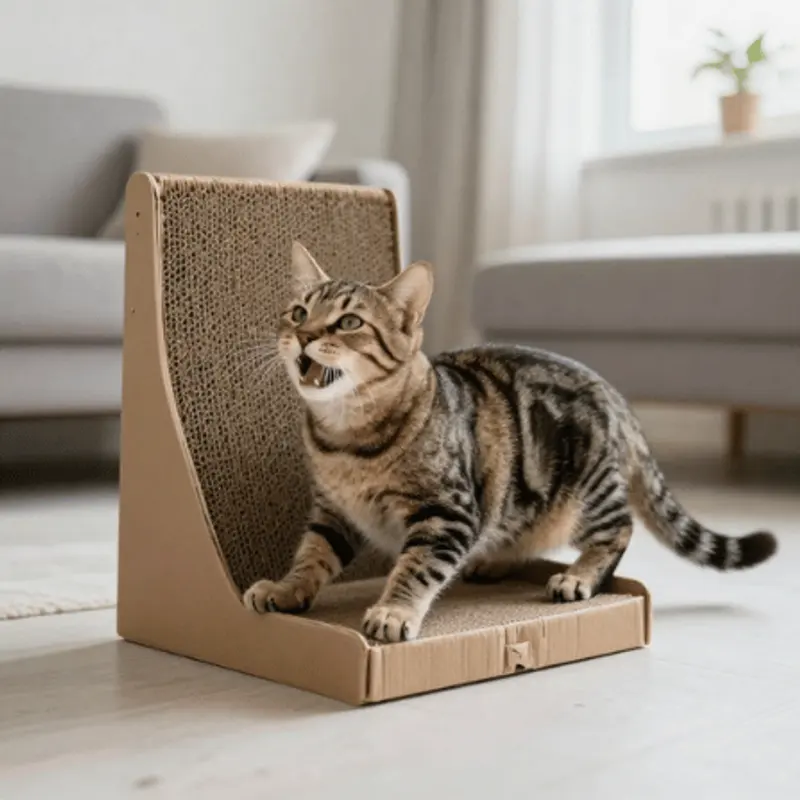
The two rules that matter most: the scratching post must be tall enough for a full stretch, and it must have a heavy, stable base so it doesn't wobble or topple mid-scratch — a wobble will put a cat off for good. Offer variety, because cats have preferences: an upright sisal post, a flat cardboard scratcher, maybe an angled one. Place at least one near where they sleep (cats love a scratch-and-stretch on waking) and one near the doorway to the main living area.
Play like it's a hunt
This is the bit people most often skip, and it's the most important for an indoor cat. Your cat is a hunter with no prey, so you have to bring the hunt to them.
Interactive wand play is the gold standard. Use a fishing-rod-style toy and move the "prey" *away* from your cat — dragging it past, hiding it behind a cushion, letting them stalk and then pounce. Crucially, let them catch it at the end so the sequence resolves; an endless chase with no capture is frustrating. Cats Protection notes that older cats enjoy three or four sessions a day while younger ones will happily play ten or more times, and games as short as one to two minutes are perfectly fine.
Between your sessions, lean on puzzle and food-based enrichment:
- Puzzle feeders and food puzzles make your cat work biscuits out of a gadget, replicating the hunt and slowing down eating. iCatCare recommends feeding little and often — dividing the daily ration into at least five portions across the day — and puzzle feeders are a tidy way to do that.
- Rotate the toys. Leaving the same five toys out forever kills novelty. Keep most in a box and swap a couple every few days so they feel new again.
- Scatter-feed a portion of dry food around the room or hide it in cardboard boxes for a daily "foraging" hunt.
Routine, resources and a comfy place to land
Cats are creatures of habit, and a calm, consistent routine helps them feel secure — predictable feeding and play times do a lot of quiet good. Alongside routine, spread your resources out, as the five pillars advise. The classic guideline is one litter tray per cat plus one spare, placed in separate, quiet locations away from food and water (cats dislike toileting next to where they eat). Do the same with water — an extra bowl in a different room often means a cat drinks more.
And give them a genuinely comfy bed. Cats sleep most of the day and tend to prefer warm, slightly enclosed spots, so a soft, cosy bed somewhere quiet — bonus points for one up high or by a radiator — completes the "safe place" pillar.
Heading off boredom, weight gain and stress
Here's why all of this matters beyond a happy cat. The RSPCA is blunt that life indoors can become predictable and boring, which leads to stress, inactivity and obesity. And there's a well-documented health link worth knowing: indoor confinement, inactivity and a lack of elevated vantage points are associated with feline idiopathic cystitis (FIC) — also called stress cystitis — a painful, sometimes dangerous bladder condition that the PDSA links directly to stress. Stress can also show up as overgrooming (bald patches where a cat licks to self-soothe).
Enrichment isn't a luxury, then — it's preventative care. Daily play and puzzle feeding keep weight in check and, as Cats Protection notes, help release "feel-good" hormones. The whole point is to let a cat *behave like a cat*.
Should indoor cats get outdoor access or a catio?
The honest answer: cats with safe outdoor access get more chances to climb, explore, patrol and behave naturally, and the RSPCA recognises those benefits. But the outside world carries real risks — traffic, other cats, theft — and for some cats (those with certain health conditions, the very nervous, or those near busy roads) indoor living is the kinder, safer choice.
You don't have to pick between the two extremes. A "catio" (a secure, enclosed outdoor run or balcony enclosure) or a cat-proofed garden gives fresh air, sights and smells with none of the traffic risk — a lovely middle ground if you have the space. Harness-and-lead training works for some confident cats too. Whatever you choose, an indoor-only cat simply needs more of your time and creativity indoors to make up for what the garden would have offered.
Signs your cat may be bored or stressed
Keep an eye out for changes from your cat's normal self. Common signs of boredom or stress include:
- Overgrooming, or bald patches and sore skin from over-licking
- Becoming withdrawn and hiding more than usual, or unusually clingy
- Sleeping far more than normal, or restless pacing
- Overeating and weight gain — or loss of appetite
- Repetitive or destructive behaviour (scratching furniture, knocking things off surfaces)
- Toileting outside the litter tray
- Irritability or sudden aggression
- More vocal than usual, or yowling
When to involve a vet: Always speak to your vet if you notice signs of cystitis — straining to urinate, going little and often, blood in the urine, or crying in the tray. A cat (especially a male) who is straining but passing no urine at all is an emergency — contact a vet immediately, as a blocked bladder can be life-threatening. Likewise, get any sudden change in appetite, weight, grooming, litter habits or temperament checked, because behaviour changes often have a medical cause underneath. Your vet can rule out illness and, if needed, refer you to a qualified behaviourist.
Get the vertical space, scratching, hunting-style play and a steady routine right, and you'll have a cat who's busy, calm and content — four walls and all.
Sources
- International Cat Care — Making your home cat friendly: https://icatcare.org/articles/making-your-home-cat-friendly
- Cats Protection — Our guide to indoor cats: https://www.cats.org.uk/help-and-advice/home-and-environment/indoor-cats
- RSPCA — Keeping cats indoors: https://www.rspca.org.uk/adviceandwelfare/pets/cats/environment/indoors
- PDSA — Feline Idiopathic Cystitis (stress cystitis): https://www.pdsa.org.uk/pet-help-and-advice/pet-health-hub/conditions/stress-cystitis-feline-idiopathic-cystitis-in-cats
- AAFP & ISFM — Feline Environmental Needs Guidelines (the five pillars): https://journals.sagepub.com/doi/full/10.1177/1098612X13477537
Common questions
Can indoor cats be just as happy as outdoor cats?
Yes — but only if you put the effort in. The RSPCA points out that life indoors can become predictable and boring, which leads to stress and obesity, so an indoor cat needs more of your time. Give them vertical space (cat trees, shelves, window perches), good scratching posts, daily hunting-style play with a wand toy, puzzle feeders and a steady routine, and an indoor cat can thrive.
How much should I play with my indoor cat each day?
Little and often beats one marathon session. Cats Protection notes that older cats enjoy three or four play sessions a day while younger cats will happily play ten times or more, and games as short as one to two minutes are fine. Use a fishing-rod-style wand, move the toy away from your cat so they can stalk and chase, and always let them catch it at the end.
Why does my indoor cat scratch the furniture, and how do I stop it?
Scratching is a natural, essential behaviour — it lets cats leave their reassuring scent, condition their claws and relieve stress, so you can't stop it, only redirect it. Provide a scratching post that's tall enough for a full stretch with a heavy, stable base that won't wobble, and place it near where they sleep and by the main doorway. Offering a few types (upright sisal, flat cardboard, angled) covers different preferences.
How many litter trays does one indoor cat need?
The widely recommended rule is one litter tray per cat plus one spare, so a single cat ideally has two. Keep them in separate, quiet spots away from food and water bowls, since cats dislike toileting next to where they eat. Spreading resources out like this is one of the five pillars of a healthy feline environment.
Can being kept indoors make my cat ill?
It can contribute to problems if their needs aren't met. Indoor confinement, inactivity and a lack of high vantage points are associated with feline idiopathic cystitis (stress cystitis), a painful bladder condition the PDSA links to stress, and boredom indoors can lead to obesity and overgrooming. The fix is enrichment — climbing space, hunting-style play and puzzle feeding all help reduce stress and keep weight in check. Always see your vet if you spot signs of illness.
Should I let my indoor cat outside or build a catio?
It depends on your cat and your location. Outdoor access lets cats climb, explore and behave naturally, but carries risks like traffic and other cats. A catio — a secure, enclosed outdoor run — is a great middle ground, giving fresh air, sights and smells without the dangers. Harness training or a cat-proofed garden can work too. For cats near busy roads or with certain health needs, indoor living with plenty of enrichment is often the safest choice.
About the author
Matt Garnett — founder, Giddy Pets
Matt started Giddy Pets to make getting pets the good stuff simpler and fairer. Everything in these guides comes from real life with pets and a lot of trial and error — it's practical guidance, not veterinary advice. If a guide gets something wrong, tell him directly.
Advice & planning
Free tools & more guides
Practical calculators and trusted guides relevant to this product.
Read next

How to Stop a Dog Marking Indoors
Why Is My Cat So Active at Night (and How to Stop It)

Keeping Your Dog Safe at Christmas: Hazards Checklist

Do Cats Get Cold? Winter Warmth for Indoor and Outdoor Cats
Cats hide discomfort well, so the signs are behavioural rather than obvious. What to watch for, and what actually helps.