







When should you bring a new puppy home?
The ideal age to bring a puppy home, why 8 weeks matters for socialisation, and how to settle them in safely before full vaccination
The quick answer
No, 8 weeks (56 days) is the recognised UK minimum age, and it is written into law that puppies under 8 weeks can only be viewed with their biological mother. Some breeders choose to keep puppies slightly longer, which is also fine, but reputable breeders will not let a puppy go before 8 weeks.
Shop the guide

Biodegradable Scented Dog Poo Bags — 50 or 200
Citrus-scented biodegradable poo bags with tie handles — breaking down in months rather than the centuries a standard plastic bag takes.
From£4.49

DIRTBAG Compostable Dog Poo Bags – Plastic-Free
Genuinely compostable, plant-based poo bags that break down in 180 days — strong, leak-proof, tie-handle bags with no hidden plastics.
From£6.99

ANIGENE Pet Urine Eliminator 750ml – Citrus Fragrance
Breaks down urine crystals at the source rather than masking the smell — helps fully eliminate odours and reduce repeat marking behaviour.
£12.99

Coffee Wood Tug & Chew Dog Toy
Two coffee wood chews joined with hemp rope for a tug-and-chew combo — natural, sustainable, and brilliant for interactive play.
£17.49
Picking your puppy up for the first time is one of the most exciting days you'll have with your new dog, but the timing of that day matters more than most new owners realise. Take a puppy home too early and you can miss out on vital lessons only their mother and littermates can teach. Get the timing right, and you land your puppy in the middle of the most important learning window of their life, with plenty of time left to make the most of it.
This guide explains the age most vets and welfare charities recommend, why that age is not arbitrary, and what "socialisation" actually means in practice during those first few weeks, including how to do it safely before your puppy is fully vaccinated.
The recommended age: 8 weeks, not before
In the UK, welfare organisations including the PDSA, Blue Cross, RSPCA and Dogs Trust all recommend that puppies should not leave their mother and littermates until they are at least 8 weeks (56 days) old. This isn't just guidance, either: UK law states that a puppy under 8 weeks old can only be shown to a prospective owner if it is with its biological mother, and reputable breeders will not let puppies go to new homes before this age.
Despite this, research from Dogs Trust's long-running Generation Pup study, published in the Veterinary Record in 2020, found that a quarter of puppies studied (461 of 1,844) had been acquired before they were 8 weeks old. The same study found that around 8% of puppies were obtained without the owner ever seeing the mother, and that puppies were more likely to be acquired early if they were intended as working dogs, if the breed composition was unknown, or if the owner had visited the puppy multiple times before collection. In other words, early acquisition is common, but it is not what the evidence recommends.
Some experts now suggest that closer to 10 to 12 weeks may be even better for certain puppies, since a little extra time with mum and littermates allows more bite-inhibition learning and canine social skills to develop. If your breeder offers to keep your puppy slightly longer for good reason, that isn't a red flag.
Why the first weeks with mum and littermates matter
Between around 3 and 8 weeks of age, puppies are still learning fundamental canine skills from their mother and littermates that a human household simply cannot replicate. Rough-and-tumble play with siblings teaches bite inhibition (how to control the pressure of their jaws), while their mother teaches early impulse control and canine body language. Puppies removed from this environment too soon can grow up struggling to read other dogs' signals or to moderate their own bite pressure, which can show up later as fear, reactivity or poor play manners with other dogs.
This is why the 8-week minimum exists: it's roughly the point at which a puppy has had enough time to absorb these lessons from their canine family, while still leaving several weeks of the all-important socialisation window for you to build on once they're home.
What the socialisation window actually is
Puppies go through what's often called a critical socialisation period, roughly from 3 or 4 weeks old up to around 12 to 14 weeks of age (some sources extend this to 16 weeks). The PDSA describes this as the time when "your pup's brain learns about new things, and is developing to be resilient and flexible." During this window, a puppy's brain is unusually receptive to new experiences, and what they learn now shapes how they react to the world for the rest of their life.
Dogs that miss out on positive experiences during this window tend to grow into more anxious, fearful adults who struggle with everyday situations: unfamiliar people, other dogs, traffic noise, vet visits, or simply being left alone. Conversely, puppies who are gently and positively exposed to a wide variety of sights, sounds, people, surfaces and situations during this period tend to grow into calmer, more adaptable dogs.
Because a puppy arrives home at 8 weeks, right in the middle of this window, timing your puppy's homecoming to that age (rather than earlier or much later) gives you the maximum useful runway to socialise them while their brain is most open to it.
Socialising before full vaccination
One of the trickiest parts of bringing a puppy home at 8 weeks is that they won't be fully vaccinated yet, and many new owners assume this means keeping their puppy shut away until injections are complete. Vets and welfare charities are consistent that this is the wrong approach: the socialisation window is too short and too important to put on hold for several weeks.
The RSPCA and PDSA both recommend a middle path:
- Carry your puppy outdoors rather than letting their paws touch the ground in public places, so they can see, hear and smell the world (traffic, prams, other people, different surfaces) without picking up disease from pavements parks may harbour.
- Invite people to your home or garden to meet your puppy in a controlled, low-risk setting.
- Only let your puppy interact with dogs you know are fully vaccinated and healthy.
- Keep to your own garden for off-lead exploring, rather than shared or public outdoor spaces, until your vet confirms your puppy is protected.
- Always check with your vet on exactly when your puppy's course of vaccinations will be complete, since this varies by vaccine brand and by individual puppy.
This balances the very real risk of serious, sometimes fatal diseases like parvovirus and distemper against the equally real long-term cost of an unsocialised dog. Carrying your puppy to the local shops, café or a friend's garden counts as valuable socialisation, even if their paws never touch the ground.
A simple first-four-weeks approach
A useful rule of thumb echoed across UK veterinary guidance is to aim to expose your puppy to each item on a socialisation checklist (different people, sounds, surfaces, objects, vehicles, gentle handling) at least three times in a positive way during your first month together. "Positive" is the key word: each new experience should be paired with something your puppy enjoys, such as a small treat, calm praise or a favourite toy, and you should let your puppy retreat or disengage if they seem worried rather than forcing an encounter. A single bad experience during this sensitive period can leave a lasting negative association, so little and often, always ending on a good note, works far better than long or intense sessions.
Practical questions to ask your breeder
Before you commit to a collection date, it's worth asking your breeder a few direct questions:
- Has the puppy been raised in a home environment around normal household sounds and activity, rather than isolated in a kennel or outbuilding?
- Can you see the puppy with its mother, and ideally with littermates, before collection day?
- What has the breeder already done to begin socialisation (visitors, gentle handling, exposure to different surfaces and noises)?
- Has the puppy had its first health check and, where appropriate, its first vaccination, worming and microchipping already arranged?
- Will the breeder provide a diet sheet so you can keep your puppy on the same food initially, to avoid an upset stomach on top of the stress of moving home?
A good breeder will be pleased to answer all of these, and reputable ones will actively encourage you to view the puppy with its mother rather than meeting you at a car park or other neutral location, which is one of the clearest warning signs of poor breeding practice or a puppy farm.
Settling your puppy in during week one
The day you bring your puppy home is, from their point of view, the single biggest upheaval of their short life so far. They're leaving the only family, smells and sounds they've ever known. A calm, unhurried first day and week helps enormously:
- Keep the first day quiet. Resist the urge to invite the whole family and every neighbour round at once; let your puppy explore their new space at their own pace first.
- Stick to the same food your breeder was using for at least the first few days, changing gradually if you want to switch, to avoid tummy upset.
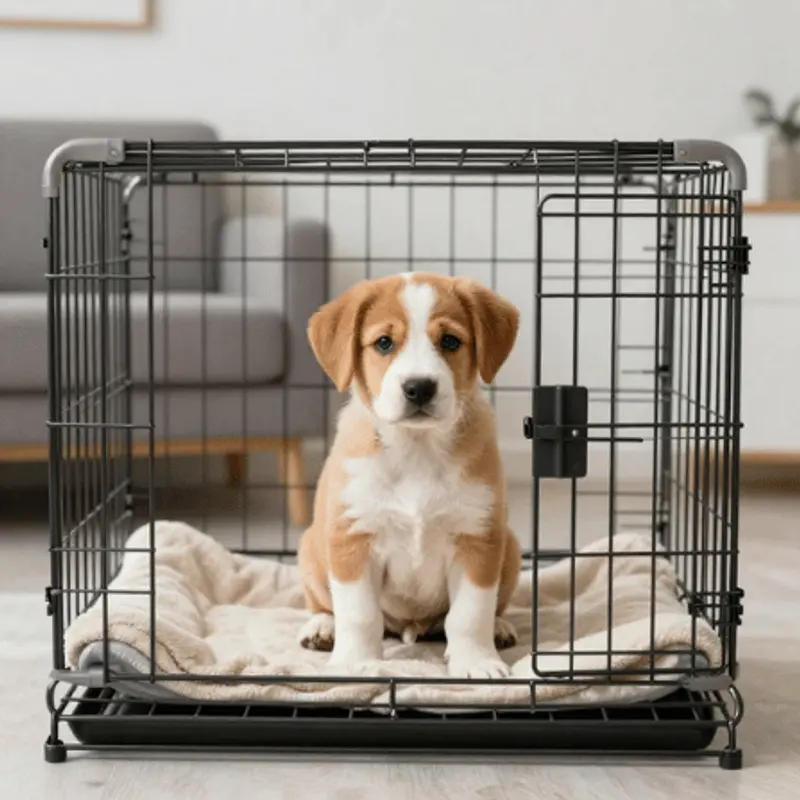
- Set up a safe, cosy space (a crate or bed in a quiet corner) that becomes your puppy's own retreat when things feel overwhelming.
- Start short periods alone early, even just a few minutes in another room, to help prevent separation anxiety developing later.
- Expect some disturbed nights in the first week or two; this is completely normal for a puppy adjusting to being away from their littermates.
If you want help judging how much exercise is appropriate as your puppy grows, our Dog Walking Calculator can give you an age-appropriate starting point, since over-exercising very young puppies can put unnecessary strain on developing joints.
When to see your vet
Book your puppy's first vet visit within the first few days of bringing them home, even if their breeder has already started their vaccination course. Your vet will check them over generally, confirm which vaccinations they still need and when, discuss worming and flea prevention, and advise on neutering timing further down the line. Contact your vet promptly if your puppy seems lethargic, isn't eating, has persistent diarrhoea or vomiting, or seems unusually withdrawn in their first weeks home, as puppies can deteriorate quickly if something is wrong.
The bottom line
Eight weeks old is the earliest a puppy should leave their mother and littermates, both as a matter of UK law and animal welfare guidance, and it isn't a random cut-off: it reflects the time needed for essential lessons in bite inhibition and canine social skills. From that point, you have a precious few weeks left of your puppy's critical socialisation window to build their confidence around the world, and that work matters just as much as anything a breeder has already done. Do it thoughtfully, positively and without rushing, and you give your puppy the best possible start toward becoming a confident, well-adjusted adult dog.
*This is general guidance, not a substitute for advice from your vet, who can assess your individual pet.*
Sources
- PDSA — puppy socialisation advice (pdsa.org.uk).
- Blue Cross — socialising your puppy (bluecross.org.uk).
- RSPCA — caring for your puppy, 6 weeks to 12 months (rspca.org.uk).
- The Royal Kennel Club — your puppy's first few weeks at home (royalkennelclub.com).
- Dogs Trust — Generation Pup research (dogstrust.org.uk).
- Kinsman et al., "Puppy acquisition: factors associated with acquiring a puppy under eight weeks of age and without viewing the mother", Veterinary Record, 2020 (pmc.ncbi.nlm.nih.gov).
Common questions
Is 8 weeks too young for a puppy to leave its mother?
No, 8 weeks (56 days) is the recognised UK minimum age, and it is written into law that puppies under 8 weeks can only be viewed with their biological mother. Some breeders choose to keep puppies slightly longer, which is also fine, but reputable breeders will not let a puppy go before 8 weeks.
Can I socialise my puppy before their vaccinations are finished?
Yes, and vets recommend you do. Carry your puppy outdoors so they can see, hear and smell the world without their paws touching potentially contaminated ground, invite people to your home or garden, and only let them meet dogs you know are fully vaccinated. Always check with your vet on your puppy's exact vaccination timeline.
What happens if a puppy is taken from its mother too early?
Puppies separated before around 8 weeks can miss out on learning bite inhibition and canine social skills from their mother and littermates, which can contribute to behaviour problems such as poor bite control or difficulty reading other dogs' signals later in life.
How long does the puppy socialisation window last?
Most UK veterinary and welfare sources place the critical socialisation period at roughly 3 or 4 weeks old up to around 12 to 14 weeks, with some extending it to 16 weeks. This is why the weeks right after you bring your puppy home matter so much.
What should I ask a breeder before collecting my puppy?
Ask to see the puppy with its mother, check what socialisation has already happened (visitors, handling, everyday household noise), confirm any vaccinations, worming or microchipping completed so far, and get a diet sheet so you can keep feeding the same food at first.
About the author
Matt Garnett — founder, Giddy Pets
Matt started Giddy Pets to make getting pets the good stuff simpler and fairer. Everything in these guides comes from real life with pets and a lot of trial and error — it's practical guidance, not veterinary advice. If a guide gets something wrong, tell him directly.
Advice & planning
Free tools & more guides
Practical calculators and trusted guides relevant to this product.
Read next

The Complete New Puppy Checklist (UK)
Bringing a puppy home? Here is the complete UK checklist — the kit, the first-week plan, and the vet and legal admin that catches new owners out.

150+ German Shepherd Names: Ideas for Your New Puppy
Puppy parties: what they are and why they help socialisation
What puppy parties involve, why the socialisation window matters, and how to find a well-run, reward-based class
Puppy socialisation: how to do it right
How to use your puppy's critical socialisation window safely, before and after vaccination, without overwhelming them