




Ten steps to a healthier dog
A practical, vet-sourced checklist covering diet, weight, exercise, vaccines, parasites, teeth, grooming, neutering and check-ups.
The quick answer
There isn't one silver bullet, but keeping your dog at a healthy weight has one of the biggest effects on long-term health, since excess weight is linked to arthritis, diabetes and a shorter life. Combined with a balanced diet and regular exercise, it forms the foundation everything else builds on.
Mentioned in this guide

Plush Foam Pet Stairs
Soft foam steps with a plush, washable cover that help senior, small or short-legged pets reach the sofa or bed safely. The lightweight, sturdy build reduces jumping strain on ageing joints.
From£21.99
A long, healthy life for your dog rarely comes down to one big decision. It's built from a handful of everyday habits, repeated for years: what goes in the bowl, how far you walk, whether the vaccine boosters are up to date, whether anyone's looked inside that mouth lately.
None of these steps are complicated, and you don't need to do them perfectly. But taken together, they're the difference between a dog who's merely getting by and one who's genuinely thriving into old age. Here are ten habits worth building, in an order that roughly matches how much day-to-day impact they have.
We've grounded this guide in advice from UK veterinary charities including the PDSA and the RSPCA, and we've been specific about what's proven and what's general good practice. Where a claim needs a number behind it, we've sourced it; where the advice is simply sound husbandry, we've said so plainly.
1. Feed a balanced diet, in the right amount
The single biggest lever you have over your dog's long-term health is what you put in their bowl, and how much of it. The PDSA recommends feeding a high-quality, "complete" commercial food, because a complete label means it already contains all the nutrients your dog needs in the correct balance — you don't need to add extras on top. Whether that's wet, dry, or a mixture of both usually comes down to what suits your dog and your budget, unless your vet has advised otherwise for a specific health reason.
Life stage matters more than most owners realise. A puppy, an adult, and a senior dog all need different ratios of protein, fat and calories, which is why food is sold as puppy, junior, adult and senior formulas — feeding an adult-only diet to a growing puppy, or vice versa, can leave gaps in their nutrition. The PDSA also recommends splitting the daily ration into two meals for most adult dogs, with smaller and younger dogs sometimes needing theirs split into three or four.
It's worth resisting the urge to feed table scraps. Human food is rarely balanced for a dog's needs, tends to add unnecessary calories, and some everyday foods — grapes, raisins, onions and chocolate among them — are genuinely toxic to dogs. If you're ever unsure whether something is safe to share, our Can My Pet Eat This? tool is a quick way to check before you hand anything over.
2. Keep them at a healthy weight
This deserves its own step because it's a bigger problem than most owners think. Vets estimate that around 46% of UK dogs are overweight or obese, yet in surveys the vast majority of owners believe their own dog is a healthy weight — a real gap between perception and reality, according to the PDSA. Carrying extra weight is linked to arthritis, diabetes, breathing difficulties, some cancers, a higher risk during anaesthesia, and a shorter life overall.
The good news is that weight is one of the most controllable factors in your dog's health. The PDSA suggests using a Body Condition Score — a simple visual and hands-on check of how easily you can feel your dog's ribs and see their waist from above — rather than relying on the bathroom scales alone, since a healthy weight varies enormously between breeds. If your dog needs to lose weight, a dedicated weight-management food (rather than just less of their normal food) is usually recommended, because it keeps nutrient levels correct while cutting calories. Treats should make up no more than around 10% of daily calorie intake. Our Pet Calorie Calculator can help you work out a sensible daily allowance to aim for, and it's worth asking your vet nurse for a free weigh-in if you're not sure where your dog currently sits.
3. Give them enough exercise, every day
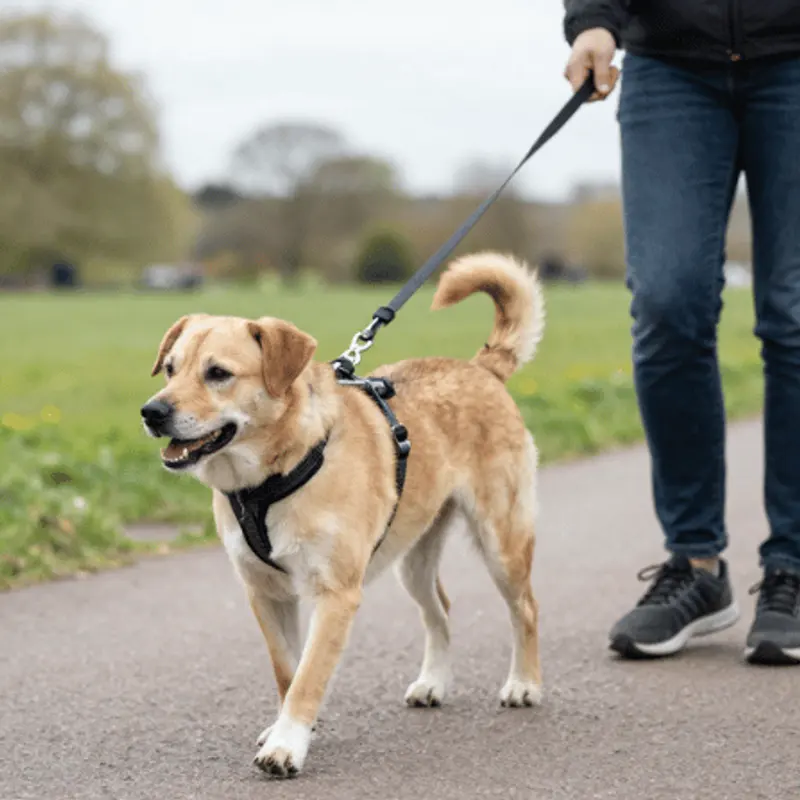
"Exercise is the joy of a dog's life" — and it does far more than burn calories.
Regular activity strengthens the heart, builds muscle to protect the joints, and helps keep weight in check. The PDSA's general guidance is that most dogs need at least one to two walks a day, though the right amount varies hugely: some breeds are content with an hour or so, while working breeds and high-energy types often need considerably more. Puppies need exercise introduced gradually, in short bursts, to protect growing joints, while senior dogs typically need a little less than they did in their prime — but rarely none at all.
It's worth tailoring exercise to the individual dog in front of you rather than a generic rule of thumb. Health status, current fitness, and simple personal preference (some dogs love to run, others would rather sniff every lamppost slowly) all play a part. If you're planning routes and want a rough guide for your specific dog's breed and age, our Dog Walking Calculator is a useful starting point — and if you're at all unsure what's appropriate, particularly for a very young, very old, or unwell dog, ask your vet.
4. Stay on top of vaccinations
Vaccination remains one of the most effective ways to prevent serious, often fatal disease. In the UK, core vaccines protect against parvovirus, distemper, infectious hepatitis and leptospirosis — the PDSA describes these as protecting against diseases that are "serious, potentially fatal" and, in several cases, still circulating in the UK dog population.
Puppies typically start their primary course at six to eight weeks old, with a second injection two to four weeks later; full protection usually kicks in a couple of weeks after that final dose, which is why puppies are generally kept away from unvaccinated-dog areas until then. After the primary course, boosters follow different schedules depending on the disease — leptospirosis is usually needed annually, while distemper, hepatitis and parvovirus boosters are typically required every three years, though your vet will confirm the exact schedule for your dog and area. Dogs who mix frequently with others — at daycare, kennels, training classes or shows — often also need the kennel cough vaccine annually, and any dog travelling abroad will need rabies vaccination under the pet travel scheme. As with any medicine, side effects are possible but rare, and vets are consistent that the protection vaccination offers far outweighs the risk.
5. Protect against fleas, worms and ticks
Parasite prevention is easy to forget precisely because, when it's working, you don't see any evidence of it. The PDSA is clear that how often you need to treat depends on the specific product: always follow your vet's advice if the treatment came from them, or the packet instructions otherwise, since not all products cover the same parasites or last the same length of time.
Worming needs also change with age and lifestyle — ask your vet or vet nurse which worms your dog needs protecting against, since this depends on their age, how much they scavenge or hunt, and where in the UK you live. Fleas are a particularly persistent problem: PDSA notes that fifty fleas on your dog can mean up to a thousand fleas or eggs already established in your home, since the vast majority of the flea life cycle happens in carpets, bedding and soft furnishings rather than on the animal itself. This is also why the PDSA recommends treating every pet in the household at the same time, rather than just the one showing symptoms — and ideally using a prescription-strength product from your vet, since over-the-counter treatments vary widely in effectiveness. Ticks are worth checking for by hand after walks in long grass or woodland, particularly in spring and summer.
6. Look after their teeth and gums
Dental disease is one of the most common — and most under-reported — health problems in dogs, largely because most dogs carry on eating even when their mouth is uncomfortable, so owners simply don't notice. The PDSA's advice is that daily brushing, or at minimum three times a week, meaningfully reduces the risk of your dog needing painful dental treatment or a general anaesthetic for advanced disease later in life. That frequency matters because plaque hardens into tartar within around 72 hours of a meal, and once it's tartar, brushing alone won't shift it — only a professional scale and polish will.
If your dog isn't used to having their teeth touched, it's worth building it up slowly using positive, reward-based training rather than forcing a brush into their mouth on day one: let them lick a smear of dog-specific toothpaste from your finger first, then gradually introduce the brush once they're relaxed about it. Only ever use toothpaste made for dogs — human toothpaste isn't designed to be swallowed and can upset their digestion. Dental chews and appropriately soft chew toys can help between brushes, but they're a supplement to brushing, not a replacement for it. It's worth checking your dog's mouth regularly for yourself too: bad breath, red or swollen gums, or a reluctance to chew on one side are all worth flagging to your vet.
7. Groom regularly and check their skin
Grooming is about more than a tidy coat. Regular brushing removes loose hair and dead skin cells, keeps the coat free of dirt and parasites, and spreads natural oils along the hair shaft — and for dogs with long, silky or curly coats, daily brushing is usually needed to stop mats forming, especially around the ears, armpits and the backs of the legs. Dogs don't generally need frequent bathing unless there's a medical reason for it, since shampooing too often strips away those natural oils; a rinse with warm water after a muddy walk is usually all that's needed, and any shampoo used should be formulated for dogs rather than humans.
Grooming time doubles as a health check. Running your hands over your dog regularly gives you a chance to notice lumps, sore patches, ticks, or changes in their coat or skin condition early, while they're still easy to treat. If mats do form, resist the temptation to cut them out yourself close to the skin — a reputable, qualified groomer is the safer option. Any unexplained change in coat or skin condition is worth mentioning to your vet, since it can sometimes be an early sign of an underlying health issue rather than just a grooming problem.
8. Consider neutering
Neutering is a personal decision and not automatically right for every dog, but it's worth an informed conversation with your vet. The RSPCA notes that neutering reduces the risk of certain cancers — testicular cancer in males is prevented entirely, while spaying females reduces the risk of mammary tumours and removes the risk of womb infections and cancers. It also has practical and behavioural effects: neutered males are typically less inclined to roam or mark territory, and spayed females won't come into season, which for an unspayed female can mean up to three weeks of bleeding roughly twice a year, plus unwanted attention from male dogs.
Timing is genuinely dog-specific. The RSPCA is careful to note that neutering isn't universally straightforward for every dog — there's some evidence that neutering anxious or fearful male dogs isn't always in their best interest, and behaviour should be discussed with your vet or a qualified behaviourist before deciding. Breed, size and current health also affect the ideal age. This is a decision to make with your vet's input rather than by following a blanket rule.
9. Keep their mind busy, not just their body
A physically tired dog isn't necessarily a content one. Mental stimulation matters alongside exercise, and a dog who isn't getting enough of it often shows it through behaviour owners find frustrating — excessive barking, digging, destructive chewing, or restless pacing are all common signs of an under-stimulated dog rather than simply a "naughty" one.
There are plenty of low-effort ways to build this in. Puzzle feeders and treat-dispensing toys turn mealtime into a problem to solve rather than something over in ten seconds. Scent games — scattering treats around a room or garden and letting your dog sniff them out — tap into one of a dog's strongest natural senses and can be surprisingly tiring in a good way. Short training sessions, five to ten minutes of practising a new cue or trick, exercise the brain much as a walk exercises the legs, and varying your walking route occasionally gives your dog new smells and sights to process. None of this needs to be elaborate or expensive; the aim is simply variety, so the same instincts that would otherwise go looking for entertainment somewhere less convenient get a legitimate outlet instead.
10. Book regular vet check-ups
Even a dog who seems perfectly well benefits from a routine health check, because vets are trained to spot the small early signs that owners often miss — a slightly enlarged lymph node, an early heart murmur, the first hint of joint stiffness. An annual wellness check is the general standard for adult dogs, while older dogs are often better served by two check-ups a year, since health can change faster in later life. A typical visit covers a full physical examination, a review of vaccination and parasite-control status, weight and body condition, and a conversation about diet, exercise and any changes you've noticed at home.
It's worth going into the appointment prepared: know roughly how much and what your dog eats, whether anyone in the household feeds table scraps, and whether you've noticed any change in drinking, toileting, appetite or energy. These small observations often help a vet spot patterns that a single snapshot exam wouldn't reveal. If you're tracking your dog's life stage and want a sense of how their age compares to a human equivalent, our Dog Age Calculator is a handy way to think about when those check-ups might need to step up in frequency.
When to see your vet
Most of the steps above are things you can build into a normal week. But some signs warrant a same-day or urgent call to your vet rather than waiting for the next routine check-up: sudden lethargy or collapse, repeated vomiting or diarrhoea, difficulty breathing, a swollen or painful abdomen, sudden lameness, a lump that's grown quickly, or any loss of appetite lasting more than a day or two. Trust your instincts here — you know your dog's normal behaviour better than anyone, and a vet would always rather see a false alarm than a genuine problem left too late.
*This is general guidance, not a substitute for advice from your vet, who can assess your individual pet.*
Sources
- PDSA — dog vaccination advice, core vaccines and booster schedule (pdsa.org.uk).
- PDSA — obesity in dogs, prevalence and health risks (pdsa.org.uk).
- PDSA — how much exercise does your dog need (pdsa.org.uk).
- PDSA — dental disease in dogs, brushing frequency and tartar formation (pdsa.org.uk).
- PDSA — flea and worm treatment advice for dogs (pdsa.org.uk).
- PDSA — diet and feeding advice for dogs (pdsa.org.uk).
- RSPCA — benefits of neutering your pet (rspca.org.uk).
- PDSA — grooming advice for pets (pdsa.org.uk).
Common questions
What is the single most important thing I can do for my dog's health?
There isn't one silver bullet, but keeping your dog at a healthy weight has one of the biggest effects on long-term health, since excess weight is linked to arthritis, diabetes and a shorter life. Combined with a balanced diet and regular exercise, it forms the foundation everything else builds on.
How often should I take my dog to the vet if they seem healthy?
Most adult dogs benefit from an annual wellness check, even when nothing seems wrong, as vets can often spot early signs of problems before symptoms appear. Older dogs are commonly recommended to have two check-ups a year. Your vet can advise on the right frequency for your individual dog.
How do I know if my dog is a healthy weight?
You should be able to feel your dog's ribs easily without pressing hard, and see a visible waist when looking down at them. This is often called a Body Condition Score check. If you're unsure, ask your vet or vet nurse for a free weigh-in and assessment.
Do I really need to brush my dog's teeth?
Yes — dental disease is one of the most common health problems in dogs, and most affected dogs keep eating normally so owners don't notice until it's advanced. Brushing daily, or at least three times a week, with a dog-specific toothpaste significantly reduces the risk.
Is neutering necessary for a healthy dog?
Neutering isn't compulsory, but it does reduce the risk of certain cancers and some behavioural issues like roaming and marking. It isn't right for every dog in every circumstance, particularly some anxious male dogs, so it's best discussed individually with your vet or a behaviourist.
About the author
Matt Garnett — founder, Giddy Pets
Matt started Giddy Pets to make getting pets the good stuff simpler and fairer. Everything in these guides comes from real life with pets and a lot of trial and error — it's practical guidance, not veterinary advice. If a guide gets something wrong, tell him directly.
Advice & planning
Free tools & more guides
Practical calculators and trusted guides relevant to this product.