


Mental exercise for dogs: games and enrichment ideas
Why mental stimulation matters as much as physical exercise, with practical games, puzzles and enrichment ideas for dogs of every age
The quick answer
There's no single figure that suits every dog, as it depends on breed, age and temperament. As a general guide, aim to include some form of mental stimulation every day, even if it's just a ten-minute scent game or short training session, rather than treating it as an occasional extra.
Most of us know our dogs need walks. Fewer of us stop to think about what's going on in their heads for the other 23 hours of the day. A dog's brain needs almost as much regular exercise as its legs do, and a dog who is physically tired but mentally under-stimulated can still end up bored, frustrated, and difficult to live with.
The good news is that mental exercise doesn't need special equipment, a big garden, or hours of spare time. Some of the best enrichment activities take five minutes and use things you already have in the kitchen cupboard. This guide explains why mental stimulation matters so much, what it actually looks like day to day, and how to build it into a routine that suits your dog's age, breed, and personality.
Whether you have a working-breed collie who needs a job to do, an elderly dog whose walks are getting shorter, or a puppy who chews everything in sight, the principles below apply. The aim isn't to exhaust your dog every single day — it's to give their brain regular, satisfying work.
Why mental exercise matters as much as physical exercise
Exercise works a dog's body; enrichment works a dog's brain, and the two are not interchangeable. A dog who's had a long physical walk but no mental stimulation can still be restless, because walking on a lead at your pace, without much sniffing or choice, doesn't use much of their problem-solving ability at all. Dogs Trust points out that enrichment lets dogs "explore and use their natural instincts" — behaviours like sniffing, foraging, chewing, chasing and problem-solving that don't get much of an outlet in a typical on-lead walk or a day at home.
The RSPCA is equally clear that mental stimulation is just as important as physical exercise for keeping a dog happy and healthy, and that toys and enrichment help prevent boredom-driven behaviours such as scratching at furniture or digging up the garden. Battersea Dogs & Cats Home makes the same point from the shelter side: mental exercise sits alongside physical activity as an essential, not an optional extra.
Working breeds — collies, spaniels, terriers, many gundogs — were bred to do a specific job, and a lack of mental outlet is a common cause of frustration in these dogs in particular. But every dog, regardless of breed or age, benefits from having their brain given something useful to do.
Signs your dog needs more mental stimulation
An under-stimulated dog doesn't usually announce it directly. Instead, you tend to see it through behaviour: excessive barking, destructive chewing, digging, counter-surfing, pacing, or a dog who seems to "switch on" the moment you pick up your keys and struggles to settle. None of these signs is proof of boredom on its own — they can have other causes, including anxiety or a medical issue — but a sudden increase in this kind of behaviour, especially alongside a change in routine (less exercise, a house move, a new baby), is worth reading as a signal that your dog's day needs more to occupy their mind.
It's also worth remembering that a dog who seems constantly "hyper" isn't necessarily under-exercised physically — more exercise alone can sometimes make a fit young dog fitter and more wired, without solving the underlying problem. Adding mental work, rather than simply adding more miles, is often the better fix.
Food-based enrichment games
Food is the easiest and most reliable way into mental exercise for most dogs, because nearly all dogs are highly motivated by it. Battersea recommends starting simple: scatter feeding, where you throw some or all of a meal across the floor, garden, or a patch of grass instead of using a bowl, taps into natural foraging behaviour and immediately slows a fast eater down.
From there, you can build up to:
- Puzzle feeders — trays or contraptions that require your dog to slide, lift, or nudge parts to release kibble or treats. Start on the easiest setting and increase difficulty gradually so your dog doesn't get frustrated and give up.
- Snuffle mats — fabric mats with fleece strips your dog roots through with their nose to find scattered kibble. PDSA highlights snuffle mats, alongside puzzle feeders, as a straightforward way to add mental exercise to a dog's routine, particularly on days when physical exercise is limited.
- Stuffed activity toys — rubber toys such as a KONG that you fill with dry food to begin with, then progress to stickier fillings (plain, dog-safe peanut butter, for example) once your dog is confident, and freeze for an extra challenge. Battersea's advice is to start easy and only make things harder once your dog is succeeding, not before.
- Search games — hide small piles of food around a room or the garden and let your dog use their nose to find them, gradually making the hiding places trickier as they improve.
Always use a portion of your dog's normal daily food allowance for these games rather than adding extra on top, since food-based enrichment can otherwise contribute to weight gain over time. If you're ever unsure whether a treat or filling is safe, our Can My Pet Eat This? tool is a quick way to check, and it's also worth tracking treats against your dog's daily needs using our Pet Calorie Calculator.
Scent games and nose work
A dog's sense of smell is extraordinary, and using it is deeply satisfying to them — arguably more so than almost any other activity. Scent-based games are highlighted by Dogs Trust and the RSPCA alike as some of the most accessible and effective enrichment available, and they cost nothing beyond a few minutes of your time.
Simple versions include:
- Hiding a handful of treats around one room and letting your dog systematically search them out.
- Hide-and-seek with a favourite toy, hidden somewhere increasingly tricky as your dog gets the hang of it.
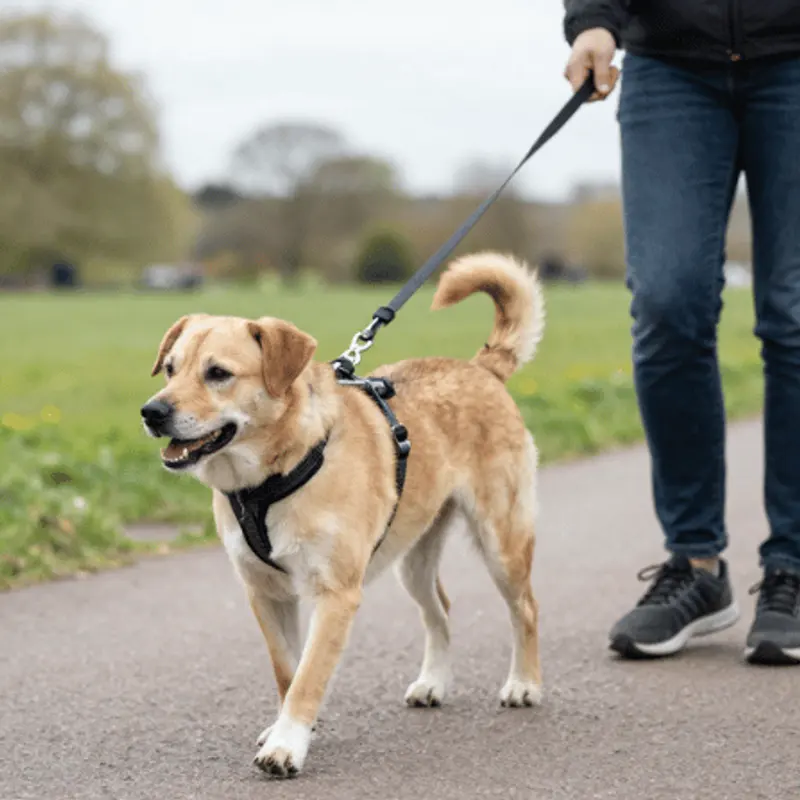
- Letting your dog have a proper, unhurried sniff on walks, rather than marching them past every lamppost and hedge. A walk where your dog is allowed to stop and investigate smells is doing real mental work, even if you cover less ground.
Letting your dog stop and sniff isn't wasted time on a walk — for a dog, it's often the most mentally satisfying part of it.
If you want to structure your dog's daily activity — balancing physical distance with time for sniffing and enrichment — our Dog Walking Calculator can help you plan walks that suit your dog's age, breed, and fitness level.
Training as mental exercise
Reward-based training isn't just for teaching manners — it's genuine mental exercise, and both the RSPCA and Blue Cross use almost the same language to describe it: a short training session can tire a dog out mentally in a way that's comparable to a burst of physical exercise. This makes it especially useful on days when a full walk isn't possible, for recovering or older dogs, or simply as a rainy-day alternative.
Useful, easy tricks to build a session around include:
- A hand target (touching your open palm with their nose)
- "Find it" — dropping and searching for a treat
- Walking through your legs, weaving between them, or turning in a circle
- Picking up an object and giving it to you
- A reliable "settle" on a mat, which doubles as a genuinely useful life skill
Keep sessions short — five to ten minutes is plenty — and always end on a success so your dog finishes the game feeling confident rather than frustrated. Training little and often, several short sessions across the week, tends to work better than one long, tiring session.
DIY enrichment at home
You don't need to buy anything to give your dog a good mental workout. Dogs Trust's own guidance includes several DIY ideas that use household items:
- A dig box — a shallow box or tray filled with scrunched-up newspaper or an old towel, with kibble or treats hidden inside for your dog to root through.
- A destruction box — Battersea's suggestion of an old cardboard box filled with scrunched paper, empty toilet rolls, and other safe-to-shred items, with food and toys scattered inside and around it, giving a safe, appropriate outlet for a dog who enjoys ripping things up.
- A homemade snuffle mat — strips of old fleece or towelling tied to a rubber mat or bath mat base, with treats worked into the strips.
- A muffin tin puzzle — treats placed in the wells of a muffin tin, covered with tennis balls your dog has to move to get to the food.
These are ideal for wet days, for puppies who aren't yet fully vaccinated and can't get out and about, or for older dogs who need lower-impact activities that still occupy their minds.
Introducing puzzle toys safely
Puzzle and activity toys are widely recommended, but they need a little care to introduce well. Start with the easiest level your dog can succeed at — a puzzle that's too hard, too soon, tends to cause frustration rather than engagement, and some dogs will simply give up. Once your dog is comfortable and confident, you can gradually increase the difficulty.
A few safety points are worth keeping in mind:
- Always supervise puzzle toys and activity feeders, particularly the first few times, to make sure your dog doesn't chew off and swallow any part of the toy.
- Choose the right size and durability of toy for your dog's size and how hard they chew — a toy that's fine for a gentle chewer may not survive a determined one.
- Rotate toys regularly. The RSPCA notes that dogs enjoy novelty, and swapping toys in and out (rather than leaving all of them available all the time) keeps your dog more engaged with each one when it reappears.
- Separate dogs at food-puzzle time if you have more than one, to avoid any tension or resource guarding around food.
If your dog shows any sign of guarding food or toys — stiffening, growling, or snapping when you approach — stop and speak to your vet or a qualified behaviourist rather than working through it alone.
Mentally stimulating walks
A walk doesn't have to be purely physical to count as good exercise. Small changes make a big difference to how mentally engaging it is:
- Vary your route. A new street, park, or path gives your dog a completely different set of smells and sights to process, which is itself a form of enrichment, even over a familiar distance.
- Let them sniff. Build in loose-lead time where your dog can stop and investigate, rather than a constant brisk pace.
- Add a bit of structure. Practising recall, a few tricks, or a scatter-feed partway through turns a walk into a more varied, engaging outing.
- Use different terrain. Grass, sand, shallow water, and uneven ground all ask more of a dog's body and attention than a flat pavement.
How much does your dog need, and does it change with age?
There's no single figure that suits every dog — needs vary hugely by breed, age, and individual temperament, and PDSA is careful to stress that requirements should be judged on the individual dog rather than a blanket rule. As a general guide, aim to build some form of mental enrichment into every day, even if it's only a ten-minute scent game or a short training session, rather than treating it as an occasional extra.
Age matters too. Puppies need short, frequent, low-pressure enrichment — their attention span is limited and over-facing them with a hard puzzle can be counterproductive; simple, successful games build confidence instead. Older dogs often need less physical exercise but just as much, if not more, mental stimulation, since gentle enrichment activities like sniffing games and easy puzzles can help keep them engaged without stressing joints or affecting stamina. If you're working out how your dog's needs are likely to be changing with age, our Dog Age Calculator can give you a helpful comparison to human years as a starting point for that conversation with your vet.
Common mistakes to avoid
A few habits can undermine otherwise good intentions:
- Making every puzzle too hard, too soon. This leads to frustration rather than engagement — dial the difficulty back if your dog loses interest or seems stressed.
- Leaving all toys out all the time. Without novelty, even a great puzzle toy becomes background furniture. Rotate what's available.
- Forgetting the food budget. Treats and stuffed toys used for enrichment should come out of your dog's normal daily food allowance, not be added on top of it.
- Assuming more exercise fixes everything. A tired body and an under-stimulated brain are two different problems; sometimes a shorter walk with more sniffing and a training session afterwards achieves more than an extra mile on the lead.
- Skipping supervision. Even reliable dogs should be watched with new puzzle toys until you know how they interact with them.
When to see your vet
Mental stimulation is a genuinely powerful tool for preventing and reducing boredom-related behaviour, but it isn't a fix for every behavioural issue. If your dog's chewing, barking, digging, or restlessness is sudden, severe, or paired with other changes — reduced appetite, lethargy, signs of pain, or a shift in toileting habits — it's worth ruling out an underlying medical cause with your vet before assuming it's boredom. Similarly, if you suspect separation anxiety, resource guarding, or a fear-based behaviour, these are best addressed with your vet and, where appropriate, a referral to a qualified clinical animal behaviourist, rather than enrichment alone. Your vet can also advise on suitable activity levels if your dog has a health condition that limits certain types of play or exercise.
*This is general guidance, not a substitute for advice from your vet, who can assess your individual pet.*
Sources
- Dogs Trust — enrichment activities for dogs (dogstrust.org.uk).
- PDSA — exercise and mental stimulation guide for dogs (pdsa.org.uk).
- RSPCA — creating a good home environment for dogs, including toys and mental enrichment (rspca.org.uk).
- Battersea Dogs & Cats Home — brain games for dogs (battersea.org.uk).
Common questions
How much mental exercise does a dog need each day?
There's no single figure that suits every dog, as it depends on breed, age and temperament. As a general guide, aim to include some form of mental stimulation every day, even if it's just a ten-minute scent game or short training session, rather than treating it as an occasional extra.
Can mental exercise replace a dog's daily walk?
No. Mental exercise and physical exercise both matter and work different parts of a dog's body and brain, so one shouldn't fully replace the other. However, a shorter walk combined with some training or a puzzle game can be just as satisfying for your dog as a longer walk with no mental input.
What are the easiest enrichment games to start with?
Scatter feeding (throwing kibble across the floor or garden instead of using a bowl) and simple hide-and-seek with treats are among the easiest games to start with, since almost every dog is naturally motivated to search for food using their nose.
Is it bad to leave puzzle toys with my dog unsupervised?
It's best to supervise your dog with puzzle toys and activity feeders, especially the first few times, to make sure they don't chew off and swallow any parts. Choose toys suited to your dog's size and chewing strength, and check them regularly for damage.
My dog is chewing and barking more than usual - is this always boredom?
Not necessarily. A sudden or severe increase in chewing, barking or restlessness can also signal an underlying medical issue, anxiety or a fear-based problem, so it's worth speaking to your vet to rule these out rather than assuming it's boredom alone.
About the author
Matt Garnett — founder, Giddy Pets
Matt started Giddy Pets to make getting pets the good stuff simpler and fairer. Everything in these guides comes from real life with pets and a lot of trial and error — it's practical guidance, not veterinary advice. If a guide gets something wrong, tell him directly.
Advice & planning
Free tools & more guides
Practical calculators and trusted guides relevant to this product.
Read next
Enrichment for cats: how to enrich an indoor cat's life
Practical, vet-informed ways to enrich an indoor cat's world through play, foraging, climbing, scent and safe spaces
Thai ridgeback: breed guide, temperament and care
An honest guide to the Thai ridgeback's origins, temperament, exercise needs and health, for UK owners considering this rare, primitive breed

Responsible dog ownership: a complete guide
What UK law and welfare charities expect of dog owners, from microchipping and control in public to diet, exercise, training and lifelong vet care