





Enrichment for cats: how to enrich an indoor cat's life
Practical, vet-informed ways to enrich an indoor cat's world through play, foraging, climbing, scent and safe spaces
The quick answer
Most cats do well with a few short interactive sessions spread through the day rather than one long one. Five to ten minutes of wand-toy play, two or three times a day, is a good starting point, timed before mealtimes when many cats are naturally more predatory.
Mentioned in this guide

Tuffy Junior Zoo Monkey
A scaled-down monkey from Tuffy's Junior range, built to the same bonded-layer specification with webbing-reinforced seams, sized so smaller dogs can actually pick it up and carry it.
£22.99

Tuffy Junior Dinosaur Stegosaurus
A junior-sized Tuffy stegosaurus built from bonded layers, multiple rows of stitching and webbed seams, so it stands up to shaking and carrying far better than ordinary plush.
£27.99

Tuffy Ocean Creature Dolphin
A long, slim dolphin plush built in bonded layers with webbing-backed seams, easy to throw, quick for a dog to catch mid-run, floats on water and machine washable.
£21.99

Tuffy Alien UFO
One of the toughest plush toys we stock: bonded layers, several rows of stitching and webbed seams, in a flying disc shape that floats and machine washes.
£20.99
If your cat spends most of her life indoors, she's safer from traffic, disease and getting lost — but she also misses out on the climbing, hunting, exploring and territory-patrolling that a cat living with outdoor access does every day without thinking about it. None of those instincts switch off just because the front door stays shut.
That's where enrichment comes in. It isn't about buying every toy in the pet shop; it's about giving your cat regular chances to use her senses, her brain and her body in ways that come naturally to her. Done well, it prevents the boredom, frustration and stress that can otherwise show up as scratched furniture, overgrooming, weight gain or a cat who seems flat and disengaged.
The good news is that most enrichment is cheap, quick to set up, and just as much fun for you as it is for your cat. Here's how to build a genuinely stimulating indoor life for her, section by section.
Why enrichment matters for indoor cats
The RSPCA is clear that an indoor-only life can become "predictable and boring" for a cat, and that this can lead to stress, inactivity and obesity if nothing is done about it. Cats Protection makes a similar point: daily enrichment — whether that's a puzzle feeder or a proper play session — brings real welfare benefits, especially for cats who never go outside and for cats sharing a home with other cats.
Boredom in cats rarely looks dramatic. It's more likely to show up as a cat who sleeps even more than usual, loses interest in toys she used to love, over-grooms a particular patch of fur, or starts scratching somewhere she shouldn't. None of these are "naughty" behaviours — they're a cat telling you her environment isn't giving her enough to do.
A bored cat is an unhappy cat — enrichment isn't a luxury, it's part of basic indoor cat care.
Give her height and a lookout post
Cats are natural climbers, and being up high genuinely makes many cats feel safer and calmer, not just entertained. Cat trees, wall-mounted shelves and clear space on top of wardrobes or bookcases all give your cat somewhere to survey her territory from above.
A window perch is one of the simplest, cheapest wins here. Battersea specifically recommends elevated spots with an interesting view as part of a cat-friendly home, and PDSA suggests adding shelves around the house so your cat has several routes and vantage points, not just one. Watching birds, passers-by or the neighbour's car pull up is genuinely engaging for most cats — a form of enrichment that costs nothing once the perch is in place.
One caveat worth knowing, from VCA vets: it's fine for a cat to choose height because she likes the view, but if she's only up high because she's too frightened to be down at floor level with the household, that's a sign something else needs addressing, not just a quirk of personality.
Feed the hunting instinct with play
Even the most pampered, fully-fed house cat retains a genuine drive to stalk, chase and pounce — vets at VCA note that "even well-fed cats will stalk when they see or hear potential prey," because hunting behaviour isn't only about hunger. Denying that outlet is one of the most common causes of indoor-cat boredom.
Wand toys and fishing-rod style teasers that mimic the movement of prey are the most effective way to meet this need, because they let your cat go through the full sequence: stalk, chase, pounce, "catch". Short, focused sessions work better than one long one — aim for a few five-to-ten-minute bursts spread through the day rather than a single marathon session, and let her win by catching the toy at the end so the sequence feels complete.
- Rotate toys every week or two so nothing becomes background furniture
- Time a play session before mealtimes, when many cats are naturally more predatory
- Vary toy movement — sudden darts and stops mimic real prey far better than smooth, constant motion
Make mealtimes work harder
Standard bowl feeding gives a cat nothing to do except eat, which is a wasted opportunity. Food puzzles and treat balls make her work for at least part of her ration, tapping into natural foraging and hunting behaviour rather than bypassing it entirely.
Cats Protection's guidance on feeding enrichment explains that puzzle feeding lets cats "express natural behaviours they'd perform outdoors" and helps prevent the boredom and frustration that comes from unmet hunting needs. It's also a good way to slow down cats who eat too fast, and to add extra activity to an indoor lifestyle that might otherwise be quite sedentary.
You don't need to buy anything specialist to start. Cats Protection suggests simple DIY options such as:
- An open egg box with dry food in a few of the compartments, progressing to a closed lid as your cat gets the idea
- A row of taped-together toilet roll tubes, filled with a few biscuits each
- Small amounts of food wrapped loosely in paper for her to "unwrap"
Introduce puzzle feeders gradually — show her how it works to begin with, and make early challenges easy so she doesn't simply give up and walk away hungry. Whatever goes into a puzzle feeder should come out of her normal daily food allowance rather than being extra, since treats and puzzle-feeder biscuits can add up quickly. Our Pet Calorie Calculator is a useful way to check her daily allowance so enrichment feeding doesn't tip her into gaining weight.
Support natural scratching
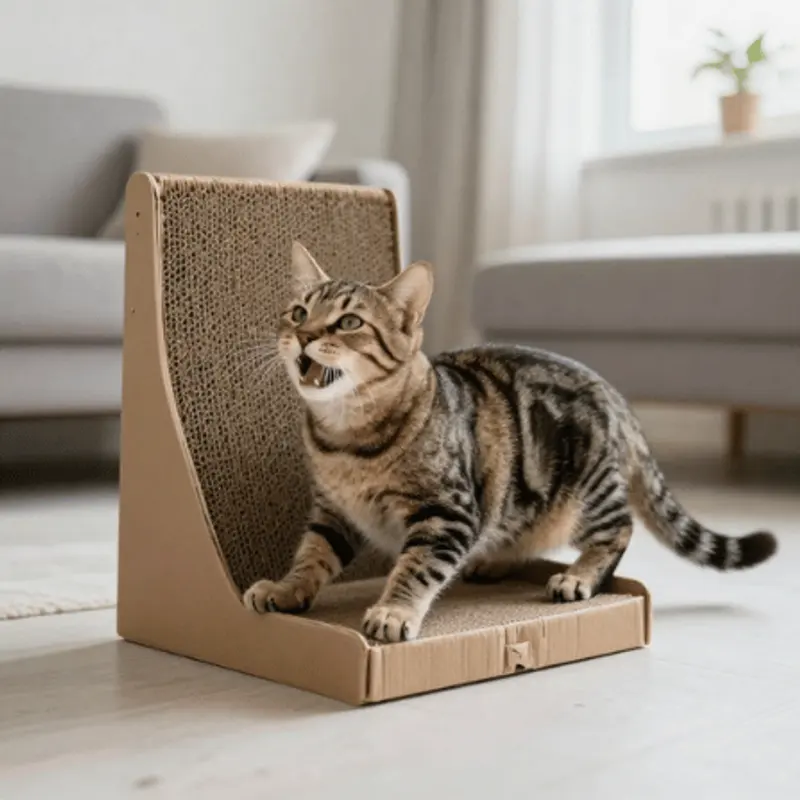
Scratching isn't destructive behaviour gone wrong — it's a normal, necessary part of being a cat. It conditions the claws, stretches the muscles, and deposits scent from glands in the paws that helps a cat feel secure in her own territory, a point both the RSPCA and VCA make clearly.
Give her the right outlets and she's far less likely to use your sofa instead:
- Sturdy and tall enough for a full stretch — a post that wobbles or is too short will often be rejected in favour of furniture
- The right material — most cats favour sisal rope or corrugated cardboard, but some prefer bark, wood or carpet, so it's worth offering more than one texture
- In the right place — near where she already sleeps or spends time, not tucked away in an unused corner
- More than one, especially in a multi-cat household, so scratching posts don't become a source of competition
A light sprinkle of catnip or valerian on a new post, as Battersea suggests, can help draw her to it early on.
Add sensory and scent enrichment
Cats experience the world heavily through scent and texture, and both are easy to build into an indoor life. Cat-safe plants such as catnip and cat grass, grown in small pots around the home, give her something to sniff, chew and rub against. Cardboard boxes or tunnels with a few dry leaves, treats or feathers scattered inside — a favourite Battersea suggestion — combine scent, texture and a bit of hidden "hunting" all at once.
Rotating textures matters as much as rotating toys. A cat who has the same blanket, the same box and the same scratching surface for months on end has far less sensory variety than one whose environment changes gently over time. Small swaps — a new box, a different textured mat, a fresh spot for the water bowl — keep things interesting without unsettling her routine.
Give her genuine safe spaces
Enrichment isn't only about activity — calm, secure retreats matter just as much. Every cat needs somewhere she can get away from noise, visitors, other pets or anything else she finds overwhelming, with more than one way in and out if possible so she never feels trapped.
Cardboard boxes, covered beds, a gap under furniture, or a shelf tucked away from the main household traffic all work well. Cats Protection's own research into their centres found that simply giving a cat somewhere to hide markedly improved her welfare — it's one of the simplest and most effective forms of enrichment there is, and it costs nothing if you already have a spare box.
Keep resources predictable — and multiplied
Cats generally cope better with an enriched environment when the basics around it stay stable. Battersea's guidance frames this well: cats need predictability and security before enrichment can really help, because a cat who feels unsettled by constant change in feeding times or furniture layout won't relax enough to enjoy new toys or puzzles.
In multi-cat households especially, resources should be spread out and duplicated rather than clustered in one place:
- Food and water in separate areas, away from the litter tray
- One litter tray per cat, plus one spare, in quiet locations
- Multiple beds and resting spots so no cat has to compete for the best one
Common mistakes owners make
A few habits quietly undo a lot of good enrichment work:
- Leaving all toys out permanently. Novelty is a big part of what makes a toy interesting — if it's always there, it becomes invisible. Rotate a portion of the toy box weekly instead.
- Skipping interactive play in favour of toys alone. Solo toys are useful, but they don't replace the stalk-chase-pounce sequence that only happens with you moving a toy like real prey.
- Adding treats on top of, rather than instead of, the daily food allowance. This is one of the fastest routes to a cat carrying extra weight.
- Only providing one of everything — one scratching post, one bed, one hiding spot — in a multi-cat home, which creates competition rather than choice.
- Changing everything at once. New feeding times, a rearranged living room and a new cat tree in the same week can overwhelm a cat rather than enrich her. Introduce changes gradually.
Recognising when enrichment isn't enough
Most cats respond well to the changes above within a couple of weeks. But enrichment on its own isn't a fix for every behaviour change, and it's worth knowing what genuine stress looks like so you don't mistake a welfare problem for simple boredom. Cats Protection notes that stressed cats are often subtle about it — flattened ears, wide pupils, hiding more than usual, a drop in appetite, or over-grooming a specific area can all be signs, and cats are naturally good at masking discomfort or pain because doing so would have helped them avoid predators in the wild.
If your cat's behaviour doesn't improve with more play, puzzle feeding and safe spaces, or if you notice weight loss, toileting changes, or hiding that seems driven by fear rather than choice, treat it as more than an enrichment gap.
When to see your vet
Sudden or ongoing changes in appetite, weight, grooming, litter tray habits or general activity can have a medical cause as well as a behavioural one, and the two often overlap — a painful joint, for example, can look exactly like a cat who's "just gone off climbing." Speak to your vet if enrichment changes don't help within a few weeks, if your cat seems persistently withdrawn or anxious, or if any physical symptoms appear alongside the behaviour change. A vet can rule out pain or illness first, and if needed, refer you on to a qualified feline behaviourist for anything more deeply rooted.
*This is general guidance, not a substitute for advice from your vet, who can assess your individual pet.*
Sources
- PDSA — keeping indoor and house cats happy and stimulated (pdsa.org.uk).
- Cats Protection — feeding enrichment and food puzzles for cats (cats.org.uk).
- Cats Protection — recognising and reducing stress in cats (cats.org.uk).
- RSPCA — keeping cats indoors and preventing boredom (rspca.org.uk).
- Battersea Dogs & Cats Home — creating a cat-friendly home (battersea.org.uk).
- VCA Animal Hospitals — enrichment for indoor cats (vcahospitals.com).
Common questions
How much playtime does an indoor cat need each day?
Most cats do well with a few short interactive sessions spread through the day rather than one long one. Five to ten minutes of wand-toy play, two or three times a day, is a good starting point, timed before mealtimes when many cats are naturally more predatory. If your cat seems uninterested even after a few tries, vary the toy's movement or try a different texture before giving up.
Are food puzzles safe for all cats?
Food puzzles are safe for the vast majority of healthy cats and are recommended by vets and welfare charities as a way to slow down fast eaters and add mental stimulation. Introduce them gradually and start easy so your cat doesn't get frustrated and walk away hungry. Always count puzzle-fed biscuits as part of her normal daily allowance rather than extra, to avoid weight gain.
How do I know if my cat is bored rather than unwell?
Boredom often shows as increased sleeping, reduced interest in toys, or minor changes like scratching in the wrong place. Genuine stress or illness tends to bring more, or more persistent, signs together, such as appetite changes, weight loss, over-grooming a specific area, or hiding far more than usual. If enrichment changes don't help within a few weeks, or you notice physical symptoms alongside behaviour changes, it's time to speak to your vet.
Do I need to buy expensive toys to enrich my cat's life?
No. Some of the most effective enrichment is free or nearly free: cardboard boxes, a taped-together tower of empty toilet roll tubes, a paper ball, or a shelf cleared for a window view. What matters most is variety and rotation, plus regular interactive play with you, rather than the price tag of any single item.
Can too much enrichment stress a cat out?
Yes, if changes happen all at once. Cats generally cope better with new toys, puzzles or furniture layouts when the rest of their routine stays predictable, so introduce one change at a time and give your cat a few days to adjust before adding the next. Always keep safe hiding spaces and consistent feeding times in place throughout.
About the author
Matt Garnett — founder, Giddy Pets
Matt started Giddy Pets to make getting pets the good stuff simpler and fairer. Everything in these guides comes from real life with pets and a lot of trial and error — it's practical guidance, not veterinary advice. If a guide gets something wrong, tell him directly.
Advice & planning
Free tools & more guides
Practical calculators and trusted guides relevant to this product.
Read next

Mental exercise for dogs: games and enrichment ideas
Why mental stimulation matters as much as physical exercise, with practical games, puzzles and enrichment ideas for dogs of every age

What Is Rally Obedience? A Beginner's Guide for UK Dog Owners

What Is Static Correction? Are Shock Collars Legal in the UK?

The best foods for a dog's digestive system
A vet-informed guide to the foods that support healthy digestion in dogs, the everyday triggers to avoid, and how to transition diets safely